All dishes / 東南アジア
Laksa Period BOrigin theory CVerified
Some fields (dish name, region and gates) are shown from the Japanese-edition data.
One origin story says the sailors of Zheng He, the great Ming admiral, invented laksa. But the chili pepper that a spicy laksa cannot do without reached these shores a full eighty years after his fleet had sailed away.
Verification highlight popular claim → verdict → evidence
A popular legend credits Zheng He's 15th-century Chinese sailors with inventing laksa, but chili peppers, the ingredient that makes laksa spicy, didn't reach Malacca until 1511 via the Portuguese, about 80 years after Zheng He's voyages, so the spicy noodle soup could not yet have existed. The dish instead took shape through Peranakan (Nyonya) fusion cooking in the Straits Settlements, blending Chinese noodles with Malay spice pastes, as documented by Singapore's National Heritage Board.
The three gates
- Ingredient-supply gate
- Chili peppers are native to the New World and reached Southeast Asia only in the 16th century via the Portuguese. Rice and coconut were already available locally, so the spicy noodle soup as we know it could not have existed before chili's arrival.
- Cooking-technique gate
- Grinding spice pastes (sambal/rempah) and making rice noodles.
- Venue gate
- A home and street-food dish eaten by ordinary people, sold in markets, within the Peranakan Chinese community.
Overview
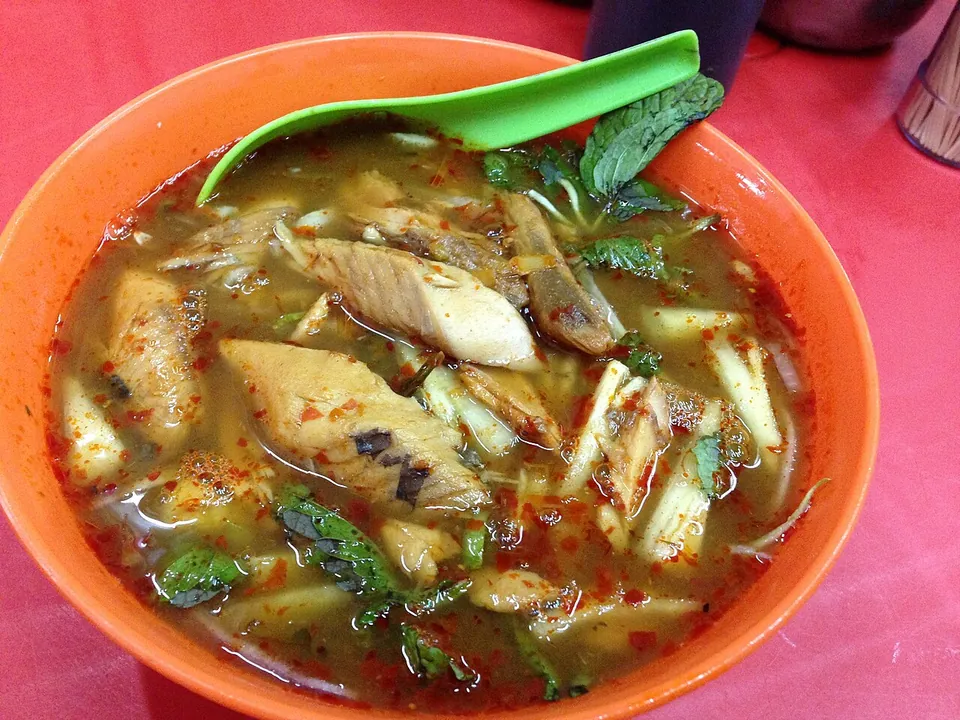
Laksa is a spicy noodle soup that took shape among the Peranakan Chinese of the Straits Settlements, in ports such as Penang, and became a fixture across the region during the nineteenth-century Straits Settlements era. Its date of formation is, by scholarly measure, largely settled.
Three ingredients carry the dish: chili pepper, rice noodles, and coconut. Of these, both the rice noodles and the coconut were already at hand locally. Only the chili pepper came from across the ocean, a New World crop that the Portuguese carried by way of Goa, which they reached in 1498, into Malacca in 1511, from where it spread through the Malay archipelago. A spicy noodle soup called laksa could only be cooked once that chili had arrived in Malacca.
The place where the dish came together was the home and street kitchen of the people known as Peranakan. They were the descendants of Chinese men who had crossed the sea and married local Malay women, the Nyonya, and they married a noodle brought from China to a ground spice paste of the Malay kitchen, the sambal or rempah, with chili and coconut. In this way a spicy laksa grew out of the Nyonya kitchens of Malacca, Penang, and Singapore. In time it branched into an assam style, sharp with sourness and made without coconut, and a curry style thickened with coconut. Singapore's National Heritage Board lists this Peranakan laksa on its inventory of intangible cultural heritage.
How we know
Laksa has long trailed a reputation for being very old, and the tales attach themselves to that reputation. Among them is the story that a Chinese sailor accompanying Zheng He on his voyages to the Southern Seas (1405-1433) devised the dish at a port of call. It is true enough that Zheng He's fleets increased Chinese migration and trade and laid part of the groundwork for later Peranakan society. But leaping from there to 'a sailor of Zheng He invented laksa' will not square with the dates. The chili pepper a spicy laksa depends on is a New World crop that reached Malacca, by way of the Portuguese, in 1511 — some eighty years after Zheng He's fleet had left the Southern Seas. The sailors had, as yet, no chili with which to make a spicy laksa at all.
The dish's supposed age is also argued from the age of its name. The word 'laksa' is traced to Persian lakhsha (noodle) or Sanskrit laksha (a hundred thousand, hence many kinds), and the Biluluk inscription of Java (1391) records a hanglaksa, a maker of vermicelli. That reading of the inscription comes down to us through the work of the French historian Denys Lombard (Le carrefour javanais, 1990). Laksa appears early in English writing as well: the Oxford English Dictionary gives its first attestation in an 1846 geographical journal.
What is old here, though, is the word 'laksa' as a noodle and the ingredient itself — not a dish of unspiced laksa recorded as a forerunner before the chili arrived. The written record says the same when read closely. In a Dutch East Indies cookbook of 1866, laksa means the rice noodle itself, and the spicy preparation is set down separately, as Kerrie Laksa. At the earliest stage where it appears in writing, a spicy laksa was already made with chili.
The old name and today's spicy laksa need to be kept apart. Neither the inscription of the vermicelli maker nor the tale of Zheng He's voyages stands as the origin of the spicy dish itself. The laksa we know first rose in a Nyonya kitchen, after the chili reached Malacca in 1511.
The full set of origin theories and the detailed verification log — traceable all the way to their sources — are available on the Japanese edition.
See the full origin theories and verification log (Japanese) →
Related dishes
Shares the key ingredient
- KimchiSouth KoreaC
- Mapo tofuSichuan (China)C
- Doro watEthiopian HighlandsB
- Indigenous molli (chilmolli, pre-Old-World-spice chili sauce proto-layer)MexicoC
- RendangMinangkabau, West Sumatra (Indonesia)C
- Tom yum goongThailandC
- SambalMalay Archipelago (Indonesia)C
- TteokbokkiKorean PeninsulaC
- Tandoori chickenNorth India (Punjab / Delhi)C
- MuhammaraAleppo, SyriaC
- VindalooGoa (India)C
- Piri piri chickenMozambique (Portuguese colonial sphere)C
- HarissaTunisiaC
- BibimbapSouth KoreaC
- Twice-cooked pork (huiguorou)Sichuan (China)C
- LarbLaos / Isan (Thailand)C
- Chili con carneTexas, USA (San Antonio)C
- Dan dan noodlesChengdu, Sichuan (China)C
- General Tso's chickenNew York (USA)C
- Pol sambolSri LankaB
- Chapli kebabPeshawar (Pakistan)C
- ShiroEthiopian HighlandsB
- Hiroshima soupless dandan noodlesHiroshima (Japan)B
- Kung pao chickenSichuan (China)C
- Fuqi feipianSichuan (China)D
- Nasi lemakMalaysiaC
- LampraisSri LankaC
- Nigerian pepper soupNigeria (West Africa)C
- MerguezMoroccoB