All dishes / 東南アジア
Sambal Period BOrigin theory CVerified
Some fields (dish name, region and gates) are shown from the Japanese-edition data.
Sambal, the chili condiment that no Indonesian table goes without. The popular idea that "sambal was born when the New World chili arrived" runs against the record. Long before the chili reached these islands, ground aromatic pastes were already here. The chili did not create sambal; it displaced the older spices and remade the paste.
Verification highlight popular claim → verdict → evidence
Myth: sambal is purely a product of the New World chili pepper. Verdict: ground aromatic pastes made from local spices, the Javanese long pepper cabya among them, were already in use before the chili arrived, as the Biluluk II copperplate inscription of 1391 shows by naming cabe among goods taxed in trade. The word 'sambal' traces back to Tamil and Sanskrit terms for 'spices' and meant simply 'ground spices', not anything chili-specific; whether the word was in use before the chili, however, is not established, its firm first appearance in writing being Stavorinus's account of the East Indies (1798). The chili later displaced the older spices and remade the paste into the chili-based sambal of today. Key sources: Journal of Ethnic Foods (2022); Biluluk II copperplate inscription (1391 CE).
The three gates
- Ingredient-supply gate
- The chili pepper at the center of the dish is a New World crop: it reached Southeast Asia through Portuguese trade in the sixteenth and seventeenth centuries, and that arrival sets the earliest possible date for sambal in its present, chili-led form. Salt and fermented shrimp paste (terasi) were both long at hand locally.
- Cooking-technique gate
- Sambal is ground down on a stone mortar (cobek/ulekan), and cooking it over heat is optional.
- Venue gate
- It was everyday food for ordinary people, set out with the meal as a matter of course, and it was shared across Malay communities at large.
Overview
A standing heat, ground from the mortar
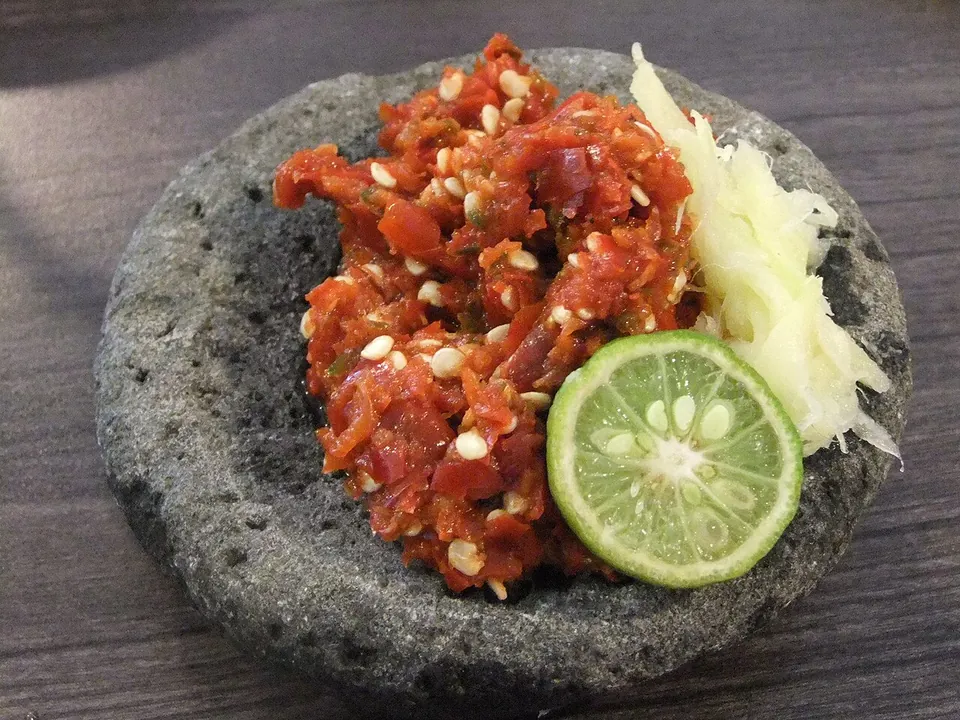
Sambal is a keeping condiment: chili at its center, combined with salt and fermented shrimp paste (terasi), ground down in a stone mortar (cobek) until it is coarse and pungent. It may be cooked or left raw. In Malay households it is deeply established as an everyday heat set beside almost any dish.
The source of that sharp bite, the chili, is a crop from the New World. It came to Southeast Asia through Portuguese trade across the sixteenth and seventeenth centuries, reaching Indonesia around the first half of the sixteenth century. Salt and terasi are of the land, but the chili sambal we know today had no way of coming into being until the chili crossed the sea and reached these kitchens.
There is one distinction worth keeping here. When today's chili sambal took shape is one question; how old the practice of grinding aromatics into a paste is, is another. The chili-led style is the later of the two, but the act itself—grinding spices in a mortar—was in this land far longer. And so sambal's origin does not resolve to a single point; several views stand together.
Ground spice, older than the chili
The main ingredient we call sambal today may be the chili, but the older aromatic spices ground in that same mortar—the Javanese long pepper cabya (Piper retrofractum), ginger, andaliman and the like—were long-established here, on everyday tables from early on. It is this local pantry that gave the grinding practice its foundation.
How we know
Sambal comes with a popular understanding: that the New World chili brought the dish into being. That stinging heat, the reasoning goes, is the essence of sambal, and since its source came from the New World, the whole genre of sambal must have arisen after the chili's arrival.
This understanding is right as far as it marks when today's chili sambal stood up. That heat, the leading note, does indeed belong to the age after the chili came. But trace the origin of the ground aromatic paste as a genre back to the chili, and you run against the record. The key is a single copperplate from Java. The Biluluk II copperplate inscription, cut in 1391, names Javanese long pepper (cabe) alongside black pepper, cubeb, and cardamom as goods taxed in trade. More than a century before the New World chili showed itself in island Southeast Asia, the local pungent spices that serve as the stuff of the grind were already traded here day to day. A researcher at Leiden likewise states plainly that the New World chili did not exist in fourteenth-century island Southeast Asia. The groundwork of the aromatic-paste genre was, through such local spices, already in place.
There is a second thing about the word itself that calls for care. The word sambal traces back to Tamil and Sanskrit terms for "spices," and originally meant "ground spices" without limiting it to chili. From this, it is sometimes said that the word sambal was in use before the chili. But no old inscription directly recording that word has been found. The firm first appearance of the word sambal in the written record is in the account of Stavorinus, a Dutchman who wrote of his East Indies voyages at the end of the eighteenth century—well after the chili's arrival. The inscription confirms the priority of the local ground aromatic paste and of cabe, but whether the word sambal itself reaches back before the chili has not yet been established. These two are to be told apart.
Set the two together and sambal's honest present position comes into view. Today's chili sambal belongs to the age after the chili came; the ground-paste dish was rooted in this land before it. The chili did not make it from nothing; it displaced and remade what was there. To see when the style took shape apart from how old the genre itself is—that is the key to telling sambal rightly.
The full set of origin theories and the detailed verification log — traceable all the way to their sources — are available on the Japanese edition.
See the full origin theories and verification log (Japanese) →
Related dishes
Lineage Family, predecessor, variants
Shares the key ingredient
- KimchiSouth KoreaC
- Mapo tofuSichuan (China)C
- Doro watEthiopian HighlandsB
- Indigenous molli (chilmolli, pre-Old-World-spice chili sauce proto-layer)MexicoC
- RendangMinangkabau, West Sumatra (Indonesia)C
- Tom yum goongThailandC
- TteokbokkiKorean PeninsulaC
- Tandoori chickenNorth India (Punjab / Delhi)C
- LaksaPenang (Straits Settlements)C
- MuhammaraAleppo, SyriaC
- VindalooGoa (India)C
- Piri piri chickenMozambique (Portuguese colonial sphere)C
- HarissaTunisiaC
- BibimbapSouth KoreaC
- Twice-cooked pork (huiguorou)Sichuan (China)C
- LarbLaos / Isan (Thailand)C
- Chili con carneTexas, USA (San Antonio)C
- Dan dan noodlesChengdu, Sichuan (China)C
- General Tso's chickenNew York (USA)C
- Pol sambolSri LankaB
- Chapli kebabPeshawar (Pakistan)C
- ShiroEthiopian HighlandsB
- Hiroshima soupless dandan noodlesHiroshima (Japan)B
- Kung pao chickenSichuan (China)C
- Fuqi feipianSichuan (China)D
- Nasi lemakMalaysiaC
- LampraisSri LankaC
- Nigerian pepper soupNigeria (West Africa)C
- MerguezMoroccoB