All dishes / 東南アジア
Rendang Period BOrigin theory CVerified
Some fields (dish name, region and gates) are shown from the Japanese-edition data.
Rendang is often said to have been born in the age of the fourteenth-century kingdoms. But the chili pepper that gives the red rendang its heat only reached this coast in the sixteenth century, and on that single point the tale of a royal origin comes apart.
Verification highlight popular claim → verdict → evidence
Multiple accounts of rendang's origin coexist because they explain different layers, not competing claims. The core technique -- merendang, simmering coconut milk down to a dry paste -- is genuinely old, attested in a Malay manuscript from the early 16th century, and reflects Minangkabau preserved-food practice tied to merantau (migratory labor). A separate strand credits Indian traders with the curry-style spice base (turmeric, coriander, cumin). But the fiery red rendang eaten today could not exist before chili, a New World crop, reached Sumatra via Portuguese trade in the early 16th century, and it only took its familiar shape in the 18th-19th century. Key sources: Journal of Ethnic Foods (Rahman 2020; Nurmufida et al. 2017); Wilkinson's Malay-English Dictionary (1901); Marsden, The History of Sumatra (1811).
The three gates
- Ingredient-supply gate
- Beef, coconut, and native spices were locally available. But the chili that today's red rendang requires is a New World crop, and its arrival in Sumatra (roughly early 16th c.) sets the earliest possible date for the dish in its current form.
- Cooking-technique gate
- Coconut milk is simmered down for a long time until the liquid cooks off, then fried in its own oil (a dry method that makes the dish keep well). Spices are ground to a paste.
- Venue gate
- A dish of Minangkabau homes and of the community's festive occasions, served at feasts and ritual gatherings and shared by ordinary people and the community as a whole.
Overview
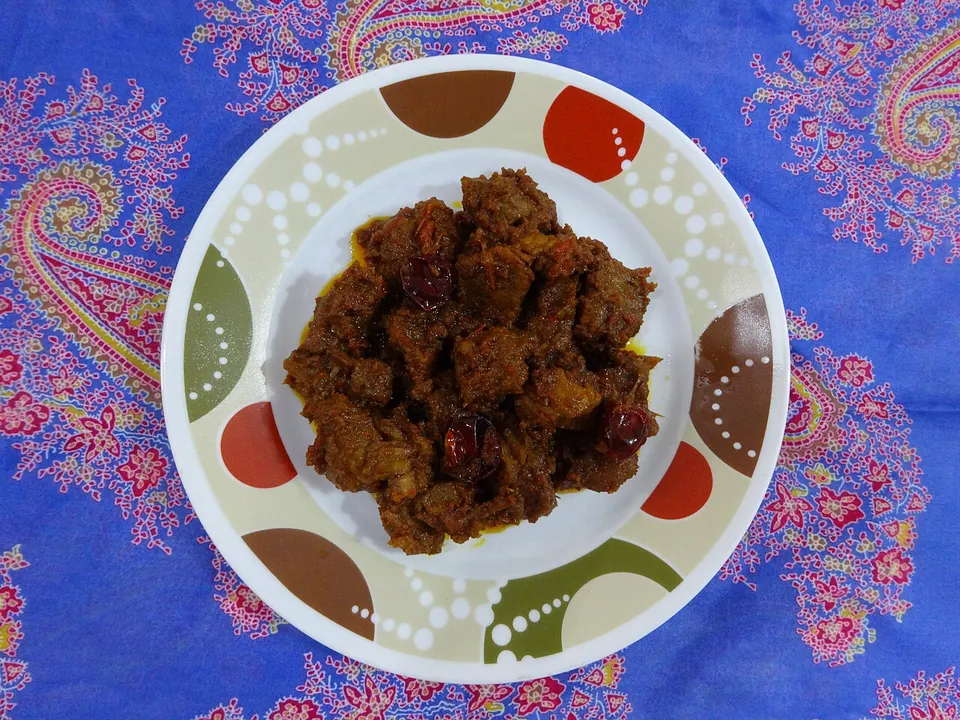
Rendang is a dish the Minangkabau people of West Sumatra, in Indonesia, have long made by simmering beef in coconut milk until it cooks right down. The longer it cooks, the more the liquid boils away, until the meat enters a stage of frying in its own oil. Finished this way, the beef keeps well even in a hot climate. The chili-laced red rendang of today took its present form only in the sixteenth century or later.
One of the leading players in the red rendang, the chili, did not begin here. It is a New World crop that crossed the sea, and it reached Sumatra early in the sixteenth century, after the Portuguese took Malacca in 1511. Until the chili had crossed the sea and arrived, a deep-red rendang had no way of existing on this soil. The beef, the coconut, and the local spices, by contrast, were long rooted in Minangkabau life.
Among the Minangkabau, this dish was the feast without which weddings, funerals, ritual gatherings, and the welcoming of guests would not be complete. They also keep a custom called merantau, in which the young leave home to make their way in other lands. Long-keeping rendang was a food that could be carried on such journeys, and the form perfected here, dried down as far as it would go into a preserved food, is thought to owe much to that life of movement. Its familiar guise as the rendang of "Padang cuisine" appears by name only in cookbooks of the early twentieth century.
How we know
Rendang began in the fourteenth century, in the reign of Adityawarman of the Pagaruyung kingdom, so runs a story often seen in travel writing. But the dates do not fit. The chili that makes the red rendang hot is a New World crop, and it reached Sumatra in the first half of the sixteenth century. In fourteenth-century Sumatra there was as yet no chili, and it is hard to see today's red rendang having been born there then. A tale that seeks the beginning in a kingdom's glory does not square with when the heat arrived.
How far back, then, can it be traced? The technique and the name of the dish itself are indeed old. The earliest solid record is an early sixteenth-century Malay tale, Hikayat Amir Hamzah, in which the phrase "goat-meat rendang" surfaces in a market scene (per food historian Fadly Rahman's research). A Malay-Dutch wordlist compiled at Ambon in 1623 already records rendang as a method of simmering. English dictionaries, too, trace the word to the Minangkabau marandang, "to cook until dry." The act of cooking down, and the local word for it, were in the land well before.
An even older claim circulates: that the word merendang appears in a late-fourteenth-century tale, Hikayat Muhammad Hanafiah. But this comes down only at second hand, through a popular book, and its supposed content — roasting wheat and corn dry — cannot be taken at face value, since corn is a New World crop that could not have been in Southeast Asia before 1492. The English word "corn" could be read in its older, generic sense of "grain," or the passage could be a later addition to the manuscript; which it is has not been settled, and the manuscript itself has not yet been checked directly. The 1901 Malay-English dictionary's entries for rĕndang, for what it's worth, give examples with sago and banana, not wheat or corn.
Even so, the dish as we know it today, simmered with chili and coconut milk, appears clearly in the record much later. In 1811 William Marsden, writing his account of Sumatra, set down West Sumatran cooking as "a kind of curry, we should call it, boiled in coconut milk and chili." The oldest surviving recipe comes down only to a chicken rendang in a cookbook of 1936. The technique and the name are old; the red rendang appears only after the chili had come. The two do not belong to the same era.
The full set of origin theories and the detailed verification log — traceable all the way to their sources — are available on the Japanese edition.
See the full origin theories and verification log (Japanese) →
Related dishes
Lineage Family, predecessor, variants
Shares the key ingredient
- KimchiSouth KoreaC
- Mapo tofuSichuan (China)C
- Doro watEthiopian HighlandsB
- Indigenous molli (chilmolli, pre-Old-World-spice chili sauce proto-layer)MexicoC
- Tom yum goongThailandC
- SambalMalay Archipelago (Indonesia)C
- TteokbokkiKorean PeninsulaC
- Tandoori chickenNorth India (Punjab / Delhi)C
- LaksaPenang (Straits Settlements)C
- MuhammaraAleppo, SyriaC
- VindalooGoa (India)C
- Piri piri chickenMozambique (Portuguese colonial sphere)C
- HarissaTunisiaC
- BibimbapSouth KoreaC
- Twice-cooked pork (huiguorou)Sichuan (China)C
- LarbLaos / Isan (Thailand)C
- Chili con carneTexas, USA (San Antonio)C
- Dan dan noodlesChengdu, Sichuan (China)C
- General Tso's chickenNew York (USA)C
- Pol sambolSri LankaB
- Chapli kebabPeshawar (Pakistan)C
- ShiroEthiopian HighlandsB
- Hiroshima soupless dandan noodlesHiroshima (Japan)B
- Kung pao chickenSichuan (China)C
- Fuqi feipianSichuan (China)D
- Nasi lemakMalaysiaC
- LampraisSri LankaC
- Nigerian pepper soupNigeria (West Africa)C
- MerguezMoroccoB