All dishes / 東南アジア
Nasi lemak Period BOrigin theory CVerified
Some fields (dish name, region and gates) are shown from the Japanese-edition data.
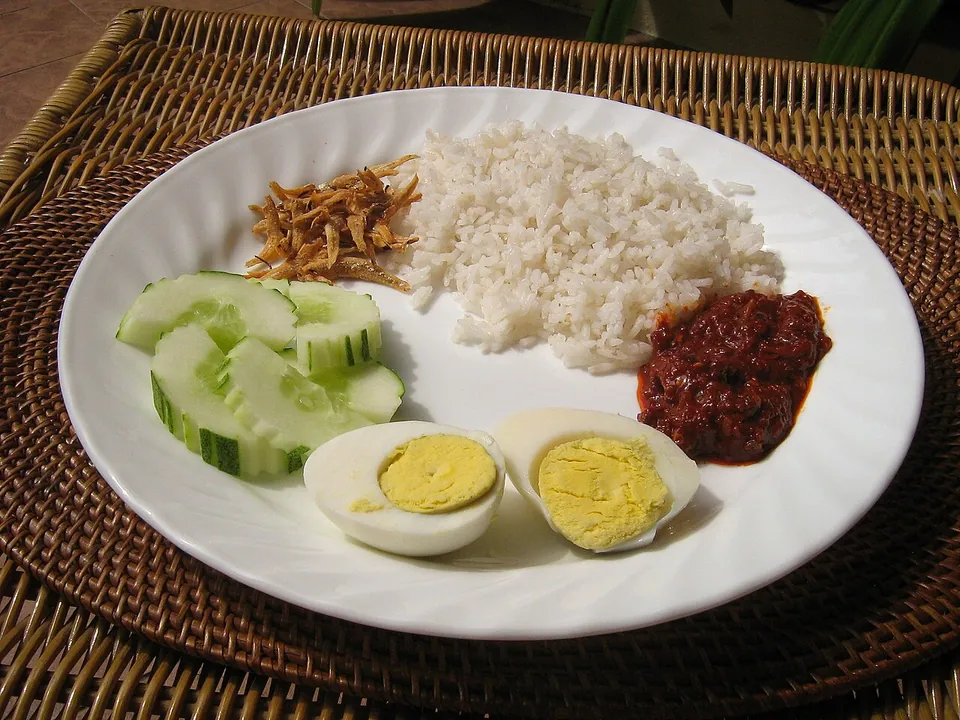
Nasi lemak, the Malaysian breakfast of rice cooked in coconut milk served with a fiery sambal. The famous quarrel over whether it belongs to Malaysia or Singapore is, in truth, a question that cannot stand.
Verification highlight popular claim → verdict → evidence
The Malaysia-vs-Singapore rivalry over which country invented nasi lemak doesn't resolve historically — heritage historians describe both as growing independently out of a shared Malay food culture rather than one deriving from the other. The dish is first attested in print in Favre's Malay-French dictionary (1875) and Winstedt (1909), but these mark only a documented lower bound, not the actual origin, which lies earlier among 19th-century coastal Malay communities.
The three gates
- Ingredient-supply gate
- Rice and coconut are native; the chili in the sambal only arrived after the Columbian Exchange, which decided when the dish could take its final form.
- Cooking-technique gate
- Rice cooked in coconut milk, paired with a prepared chili sambal.
- Venue gate
- Originated as a rural Malay breakfast, later becoming an urban hawker staple and national dish.
Overview
Nasi lemak is a plate of rice cooked in coconut milk, served with a chili-laden sambal and small fish (ikan bilis). The name means roughly rich rice, and it was born on the west coast of the Malay Peninsula in the 19th century. The coastal communities had coconut in abundance and pulled small fish from the shore in plenty. Coconut and rice, the very staples of the dish, were long-established local ingredients on everyday tables here from early on. Gathered into one plate as a breakfast of the rich coastal bounty, it later became the daily food of rice farmers.
The chili in the sambal that gives the dish its color and heat is an ingredient that came from far across the New World. Carried by the trade of the Age of Exploration, it reached the Malay world in the 16th century and sank deep into Southeast Asian cooking. Once chili had crossed the sea and taken root here, the red, fiery sambal we now know alongside nasi lemak took its form.
Once a village breakfast, the dish later spread to the hawker stalls of the cities and came to be called one of Malaysia's national dishes. Migrants who crossed the sea from Java, Sulawesi, and Sumatra carried this way of eating, along with the flavors of their own homelands, to many places, and helped push its spread.
How we know
Nasi lemak is often the subject of a quarrel over ownership: is it Malaysian, or is it Singaporean? Yet from the standpoint of food history, this contest over which country is the true home rests on a question wrongly framed.
The food historian Ahmad Najib Ariffin (Nadge) holds that neither one derived from the other. Across the Malay world, where coconut is everywhere at hand, this way of eating grew up separately in many places, a shared Malay food culture. Singapore is geographically part of the Malay Peninsula and culturally continuous with the Malay world. So the question of which country owns it has no answer from the start.
Another common confusion is to mistake the year the name appears in print for the year of its birth. The word nasi lemak is recorded in Favre's Malay dictionary (1875) and in Winstedt's account (1909). But these mark the latest date by which it existed, not the year the dish was born. Its origin reaches back earlier, to the native coastal communities of the 19th-century west coast. Singapore's National Library Board likewise places this history on the west coast of the Malay Peninsula in the 19th century and traces the path by which migrants carried it to Singapore. Rather than which country is its origin, the present view holds it a dish grown in many places out of a native food culture spread across the Malay Peninsula.
The full set of origin theories and the detailed verification log — traceable all the way to their sources — are available on the Japanese edition.
See the full origin theories and verification log (Japanese) →
Related dishes
Shares the key ingredient
- KimchiSouth KoreaC
- Mapo tofuSichuan (China)C
- Doro watEthiopian HighlandsB
- Indigenous molli (chilmolli, pre-Old-World-spice chili sauce proto-layer)MexicoC
- RendangMinangkabau, West Sumatra (Indonesia)C
- Tom yum goongThailandC
- SambalMalay Archipelago (Indonesia)C
- TteokbokkiKorean PeninsulaC
- Tandoori chickenNorth India (Punjab / Delhi)C
- LaksaPenang (Straits Settlements)C
- MuhammaraAleppo, SyriaC
- VindalooGoa (India)C
- Piri piri chickenMozambique (Portuguese colonial sphere)C
- HarissaTunisiaC
- BibimbapSouth KoreaC
- Twice-cooked pork (huiguorou)Sichuan (China)C
- LarbLaos / Isan (Thailand)C
- Chili con carneTexas, USA (San Antonio)C
- Dan dan noodlesChengdu, Sichuan (China)C
- General Tso's chickenNew York (USA)C
- Pol sambolSri LankaB
- Chapli kebabPeshawar (Pakistan)C
- ShiroEthiopian HighlandsB
- Hiroshima soupless dandan noodlesHiroshima (Japan)B
- Kung pao chickenSichuan (China)C
- Fuqi feipianSichuan (China)D
- LampraisSri LankaC
- Nigerian pepper soupNigeria (West Africa)C
- MerguezMoroccoB