All dishes / 東南アジア
Tom yum goong Period BOrigin theory CVerified
Some fields (dish name, region and gates) are shown from the Japanese-edition data.
Tom yum kung, the sharp, sour-hot shrimp soup that has come to stand for Thai cooking abroad, gets its bite from chili. But chili is not a native Thai ingredient. It was carried across the sea from the Americas by Portuguese traders, and only after it reached Southeast Asia in the sixteenth century did the fiery version we know today become possible.
Verification highlight popular claim → verdict → evidence
The soup's defining heat depends on chili pepper, a New World crop that only reached Thailand around 1550 (arrival window 1511-1600) via Portuguese trade, so an older, non-spicy sour soup likely existed earlier as a separate ancestral dish. A claim that tom yum traces back to an Indian 'sour prawn soup' (attributed to historian Giles Milton) rests on a single unsupported line in Wikipedia with no independent corroboration; the native Central Thai river-community origin, backed by UNESCO's 2024 heritage listing, is far better attested. Key sources: UNESCO Intangible Cultural Heritage listing (2024); Mae Krua Hua Bpak (1908).
The three gates
- Ingredient-supply gate
- Shrimp, lemongrass, galangal, and kaffir lime leaf are all native to Southeast Asia. Chili, which carries the heat, is a New World crop; its arrival in Southeast Asia via the Portuguese in the 16th century sets the physical lower bound for the current spicy form. A pre-chili sour soup precursor could reach further back.
- Cooking-technique gate
- Simmered soup cookery, seasoned with fermented fish sauce (nam pla).
- Venue gate
- home and market food-stall fare / common people / everyday / central Thailand
Overview
A soup born of the river
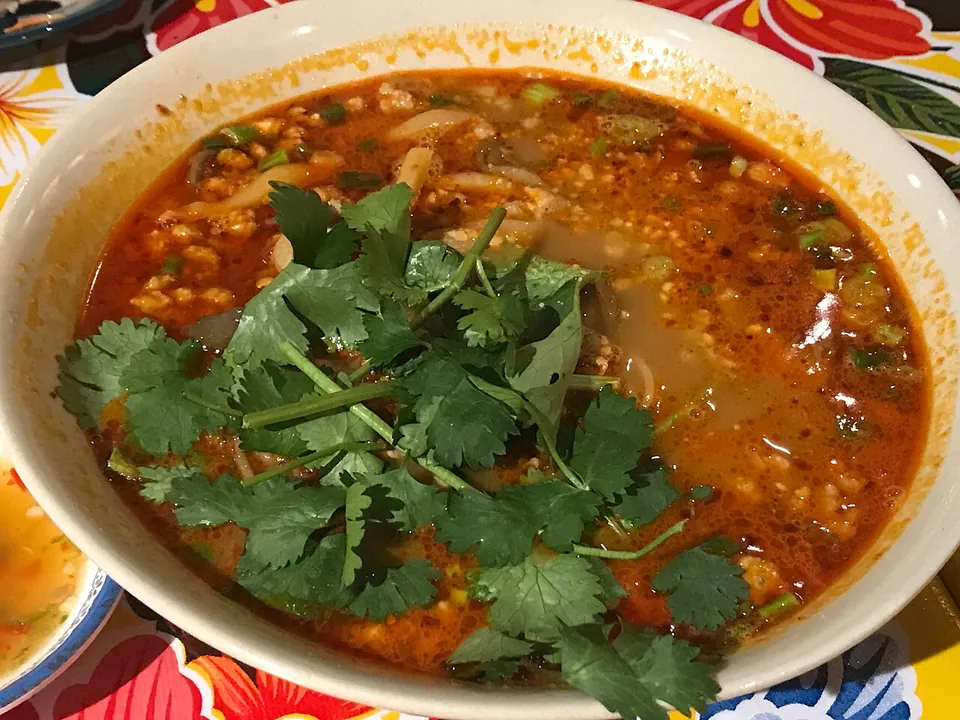
Tom yum kung is a sour and spicy soup of river shrimp simmered with fragrant herbs. It grew up on the central plain of Thailand, along the Chao Phraya River, as an everyday dish of ordinary people who had river shrimp and medicinal herbs close at hand. Lemongrass, galangal, and kaffir lime leaves give it aroma; fermented fish sauce (nam pla) lends savor; and layer upon layer of sourness gives the soup its backbone.
The river shrimp at its center were long-established creatures of the Chao Phraya basin, always within reach of riverside life. The herbs that scent it—lemongrass, galangal, kaffir lime leaves—were old, deeply rooted plants of Southeast Asia, dropped into the everyday pot from early on. Simmer these freely, deepen them with fish sauce, and sharpen them with the tartness of fruit and leaf, and you have a fragrant sour soup.
Then, in the sixteenth century, Portuguese trading ships brought the chili of the New World to Southeast Asia. Once that red pod reached ports such as Ayutthaya, a keen heat entered the soup. Over the native herbs and river shrimp, the sourness of the local pot met the fire of an ingredient from across the sea, and the hot tom yum kung the world now pictures took shape.
Rooted in riverside life, the soup moved from the home to the market stall and on to the status of a national dish. Today it is known internationally as an emblem of Thai cooking itself, and in 2024 it was inscribed on the UNESCO list of intangible cultural heritage.
How we know
Two accounts of tom yum kung's origin have long been told side by side: a native Thai account and an Indian-prototype account.
The native account holds that this is a soup of the land, raised on Thailand's central plain. Buddhist river communities along the Chao Phraya, avoiding the slaughter of large animals, made it from the river shrimp they caught in abundance and from herbs such as lemongrass, kaffir lime leaves, and galangal. The official origin narrative published when the dish was inscribed as UNESCO intangible cultural heritage in 2024 likewise places its beginning in the life of these river communities. Thai cookbooks record it too: the name appears in a late-nineteenth-century lexicon and in early-twentieth-century cookery writing, including Mae Krua Hua Bpak (1908), the first systematically compiled Thai cookbook.
The other account, an Indian-prototype claim, holds that the very form of a sour-and-hot shrimp soup can be traced back to an Indian sour prawn soup. It is passed along as the view of the historian Giles Milton, but follow the sources and the claim goes no further back than a single sentence in an encyclopedia entry. Milton's own text and the relevant citation cannot be located, and no primary source or scholarly study points to India as a direct prototype. Where the native account is backed by the UNESCO narrative and by reporting, the Indian-prototype claim rests on an isolated mention with no independent footing.
Following the written record clears up a second misunderstanding. An early appearance of the name tom yam in a text is the fish-based tom yam pla of 1889. The shrimp version, tom yum kung—this dish—is first firmly recorded in writing only in a royal cookbook of 1964. But the year a dish is first written down is not the year it was born: the sour-soup lineage runs far earlier along the riverbanks, and only the written account of the shrimp version came somewhat later.
Whichever account one takes, and however one reads the dates, one fact holds steady. The chili that gives the soup its decisive heat was a New World crop, brought by Portuguese hands in the sixteenth century. The hot tom yum kung of today could only have come after that chili crossed the sea.
The full set of origin theories and the detailed verification log — traceable all the way to their sources — are available on the Japanese edition.
See the full origin theories and verification log (Japanese) →
Related dishes
Shares the key ingredient
- KimchiSouth KoreaC
- Mapo tofuSichuan (China)C
- Doro watEthiopian HighlandsB
- Indigenous molli (chilmolli, pre-Old-World-spice chili sauce proto-layer)MexicoC
- RendangMinangkabau, West Sumatra (Indonesia)C
- SambalMalay Archipelago (Indonesia)C
- TteokbokkiKorean PeninsulaC
- Tandoori chickenNorth India (Punjab / Delhi)C
- LaksaPenang (Straits Settlements)C
- MuhammaraAleppo, SyriaC
- VindalooGoa (India)C
- Piri piri chickenMozambique (Portuguese colonial sphere)C
- HarissaTunisiaC
- BibimbapSouth KoreaC
- Twice-cooked pork (huiguorou)Sichuan (China)C
- LarbLaos / Isan (Thailand)C
- Chili con carneTexas, USA (San Antonio)C
- Dan dan noodlesChengdu, Sichuan (China)C
- General Tso's chickenNew York (USA)C
- Pol sambolSri LankaB
- Chapli kebabPeshawar (Pakistan)C
- ShiroEthiopian HighlandsB
- Hiroshima soupless dandan noodlesHiroshima (Japan)B
- Kung pao chickenSichuan (China)C
- Fuqi feipianSichuan (China)D
- Nasi lemakMalaysiaC
- LampraisSri LankaC
- Nigerian pepper soupNigeria (West Africa)C
- MerguezMoroccoB