All dishes / 東南アジア
Larb Period COrigin theory CVerified
Some fields (dish name, region and gates) are shown from the Japanese-edition data.
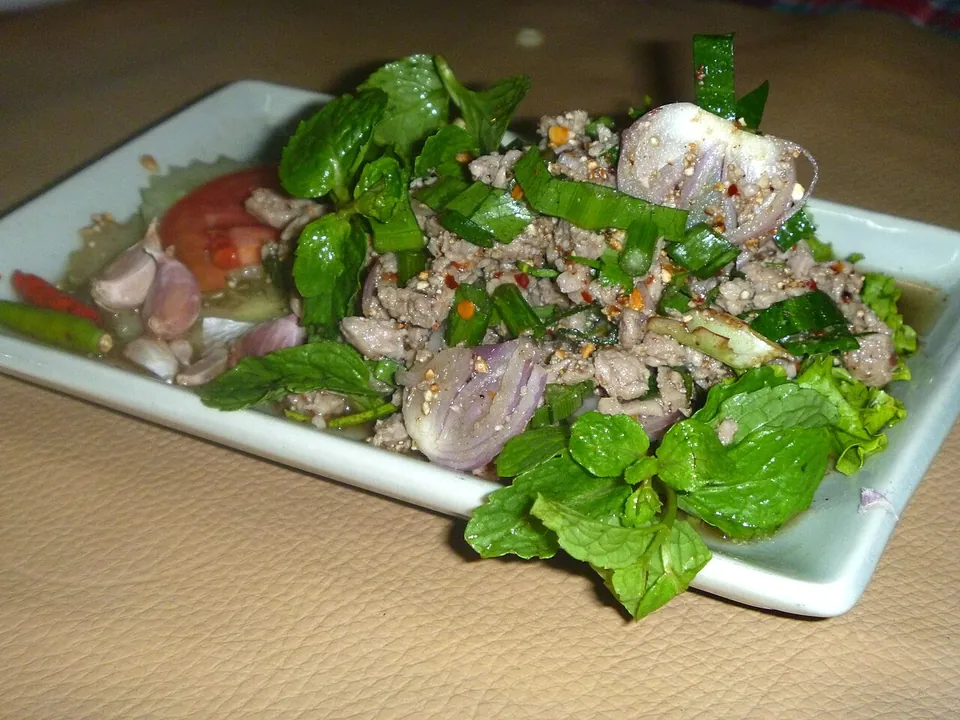
Larb, minced meat tossed with herbs, is an old dish of Laos and Isan. Its tongue-stinging heat, though, is not as old as it looks.
Verification highlight popular claim → verdict → evidence
Myth: the spicy larb eaten today has come down unchanged from ancient times. Verdict: the claim folds two separate things together. The genre -- raw or lightly cooked minced meat dressed with herbs and toasted rice powder -- really is old: the Huang Qing zhigong tu, the illustrated survey of tributary peoples commissioned by the Qianlong emperor in 1751, notes that the Lao of Nanzhang (Laos) were fond of eating raw meat. The chili heat is younger. Chili is a New World crop, and it reached the Tai-speaking world only in the sixteenth century, around 1550 and at the very earliest 1511; before that a chili-laced larb had nothing to be hot with. The earliest known text to set one down is Étienne Aymonier's Voyage dans le Laos (surveyed 1883, published 1895), which records a favoured Lao dish of chopped meat dressed with spring onion, lemongrass leaf, fermented fish and chili. The spicy form therefore took shape somewhere between 1550 and 1895, centuries later than the older habit of dressing raw minced meat from which it grew.
The three gates
- Ingredient-supply gate
- The minced meat itself was locally available, but the current spicy form depends on the arrival of New World chili peppers.
- Cooking-technique gate
- The technique of dressing raw or lightly cooked minced meat with herbs and toasted rice powder.
- Venue gate
- A festive and home-cooked dish of the Lao/Isan cultural sphere.
Overview
Larb is a dish of Laos and northeastern Thailand's Isan region: minced meat, raw or cooked, tossed with herbs such as mint, fragrant toasted rice powder (khao khua), fermented fish (padaek) or fish sauce, and lime. Its name comes from a Lan Na word meaning "to chop, to mince" (jin lap, meat chopped), and it has long been an indispensable dish at festivals and on the family table.
The practice itself, chopping meat fine and tossing it with herbs, was handed down for centuries across the sphere of the Lao Lan Xang kingdom (1353 to 1707). In 1751, the Qing illustrated compendium Huang Qing zhigong tu, compiled at the Qianlong emperor's command, noted that the Lao of Nanzhang (Laos) "like to eat raw meat," showing that the chopped-and-dressed raw meat was already eaten in the eighteenth century. In the twentieth century, Phia Sing (1898 to 1967), a cook of the royal kitchen at Luang Prabang, set down the royal household's larb in his own notebooks, which were later edited and published.
The sharp heat that marks larb today comes from chili. Chili is a New World crop, and it reached the Tai-speaking region through the Portuguese around the middle of the sixteenth century, about 1550. Until it crossed the sea and arrived on Lao tables, a hot, chili-laced larb had no way of existing there. Étienne Aymonier's Voyage dans le Laos, published in 1895 from his 1883 survey, records larb as a favorite of the Lao, dressed with scallion, lemongrass leaf, fermented fish, and chili, showing that the chili-laced current form was in place by the end of the nineteenth century at the latest.
How we know
Larb often carries the refrain that the hot, present-day version is unchanged since antiquity. The plainness of minced meat tossed with herbs makes it feel like a taste held constant from the deep past. But two layers of different ages sit here, one on top of the other.
One is the layer of a genre: chopping raw meat and dressing it, which is centuries old. That the Huang Qing zhigong tu, compiled at the Qianlong emperor's command in 1751, recorded the people of Nanzhang (Laos) as liking raw meat speaks to that age. The compendium was recently edited and translated into English by Hostetler and Wu (Brill, 2022), so it can now be read as an eighteenth-century record. The other is the layer of the current form, dressing the dish with chili for heat. Chili crossed from the New World to Southeast Asia by way of the Portuguese in the mid-sixteenth century; before that, a hot larb was not on the table.
The oldest kind of document to set down a chili-laced larb is Aymonier's Voyage dans le Laos, published in 1895 from his 1883 survey. The herb-dressing tradition is old; the heat was added after the age of exploration. To fold the age of the genre and the time the present hot dish came together into a single "all from antiquity" is to confuse those two layers. Read apart, larb's history reads plainly.
The full set of origin theories and the detailed verification log — traceable all the way to their sources — are available on the Japanese edition.
See the full origin theories and verification log (Japanese) →
Related dishes
Shares the key ingredient
- KimchiSouth KoreaC
- Mapo tofuSichuan (China)C
- Doro watEthiopian HighlandsB
- Indigenous molli (chilmolli, pre-Old-World-spice chili sauce proto-layer)MexicoC
- RendangMinangkabau, West Sumatra (Indonesia)C
- Tom yum goongThailandC
- SambalMalay Archipelago (Indonesia)C
- TteokbokkiKorean PeninsulaC
- Tandoori chickenNorth India (Punjab / Delhi)C
- LaksaPenang (Straits Settlements)C
- MuhammaraAleppo, SyriaC
- VindalooGoa (India)C
- Piri piri chickenMozambique (Portuguese colonial sphere)C
- HarissaTunisiaC
- BibimbapSouth KoreaC
- Twice-cooked pork (huiguorou)Sichuan (China)C
- Chili con carneTexas, USA (San Antonio)C
- Dan dan noodlesChengdu, Sichuan (China)C
- General Tso's chickenNew York (USA)C
- Pol sambolSri LankaB
- Chapli kebabPeshawar (Pakistan)C
- ShiroEthiopian HighlandsB
- Hiroshima soupless dandan noodlesHiroshima (Japan)B
- Kung pao chickenSichuan (China)C
- Fuqi feipianSichuan (China)D
- Nasi lemakMalaysiaC
- LampraisSri LankaC
- Nigerian pepper soupNigeria (West Africa)C
- MerguezMoroccoB