All dishes / 東南アジア
Som tam Period BOrigin theory CVerified
Some fields (dish name, region and gates) are shown from the Japanese-edition data.
Som tam, the chili-laced green papaya salad, is now a dish that stands for Thailand. It was born where a fruit that had traveled across the world from the New World met the pounding-mortar culture of the Lao.
Verification highlight popular claim → verdict → evidence
Two accounts compete without resolution: a Lao origin (tam mak hoong, carried into Isan by ethnic Lao communities) and a central-Thai origin (Sujit Wongthes's hypothesis of Chinese-Lao migrant communities adapting the older Lao fruit-pounding dish tam som to papaya). Since the staple papaya is a New World crop, the dish cannot predate its arrival in Siam, confirmed widespread by La Loubère's 1693 account; the earliest textual mention of the dish itself is from 1869.
The three gates
- Ingredient-supply gate
- Papaya and chili are New World crops that reached Southeast Asia through trade — a hard physical floor for the dish.
- Cooking-technique gate
- Pounding and mixing ingredients in a mortar (khrok).
- Venue gate
- Originated in rural Isan, later spread as a street-food staple nationwide.
Overview
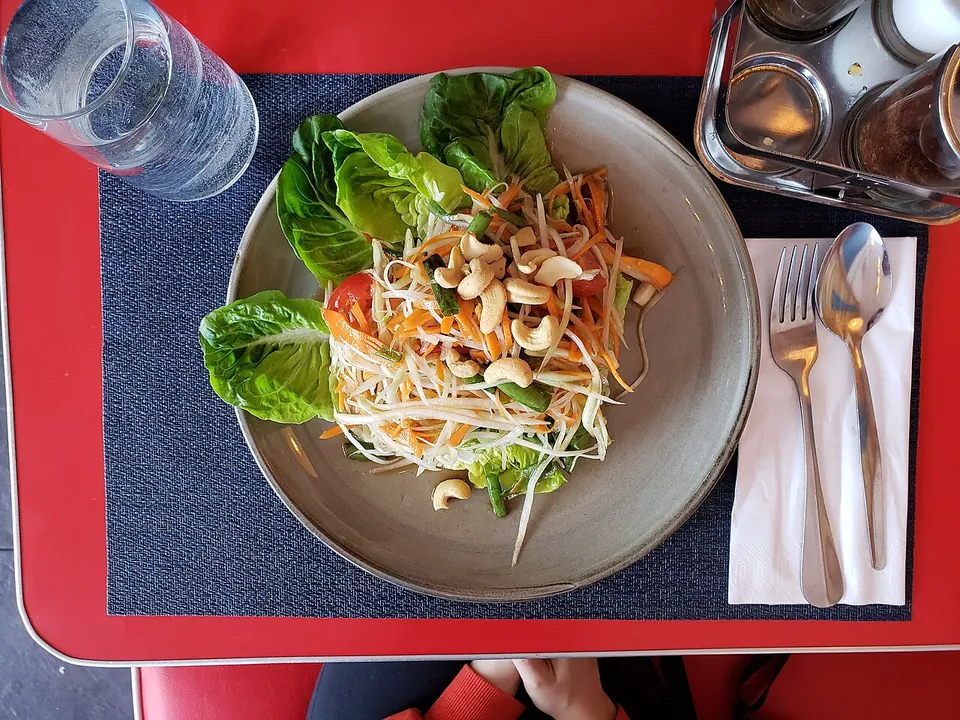
Som tam is a salad of unripe green papaya, shredded and pounded together with chili, fish sauce, and other seasonings in a mortar known as a khrok. Both its main ingredient, green papaya, and the chili that gives it heat were originally New World plants. Only after trade carried them across to Southeast Asia did the dish find its foundation.
The papaya's arrival in this land can be traced from a record of the late 17th century. In 1693, Simon de la Loubère, an envoy sent by Louis XIV to Siam (present-day Thailand), wrote that the cultivation of papaya was already widespread there. The fruit was in place. What remained was for the hand that pounds fruit in a mortar, and a setting to nurture the dish, to come together.
That setting was the farming villages of Isan, in Thailand's northeast. In this region, where much of the population is of Lao descent, the practice of pounding fruit in a mortar was turned to papaya, and som tam took shape. As a named dish, it rises into the record in the 19th century. The travel account left by the poet Khun Phum in 1869 notes that green papaya salad was known among Lao royalty living as hostages in Bangkok. By 1929, a printed Thai-language recipe naming som tam appears. As railways and roads later linked the northeast to Bangkok, the dish spread across the country as street food and became something eaten everywhere in Thailand.
How we know
Som tam is loved as a Thai dish, but tracing its source leads toward the neighboring country of Laos. The pounded green papaya dish arose among the Lao and became a national dish of Laos as tam mak hoong, meaning 'pounded papaya.' The Thai som tam and the Lao tam mak hoong may be regarded as equal sisters of one and the same dish. Because much of Isan's population is of Lao descent, the prevailing view today holds that the dish passed through Isan into the rest of Thailand and took hold under the Thai name som tam.
There is another reading. The Thai historian Sujit Wongthes holds that som tam emerged in the late 18th to early 19th century, among communities of Chinese-Lao migrants in what is now central Thailand. On this account, the old Lao tradition of pounded fruit salad, tam som, was applied to papaya, and by reversing the word order the name som tam was born. He sees it spreading to the northeast around 1900, when the railway was laid.
For a long time these two accounts rested mainly on English-language encyclopedia entries. In recent years, older clues have been unearthed. Khun Phum's 1869 note on the Lao royals in Bangkok is an early, independent sighting of a green papaya dish that connects to som tam, and the 1929 Thai recipe sets the dish's name down in print. These primary sources, together with a scholarly paper published in Springer's Journal of Ethnic Foods in 2023, have come to support the two accounts each from a different angle. Even so, whether it spread from Laos or emerged in central Thailand has not converged in scholarship, and the accounts still stand side by side.
The full set of origin theories and the detailed verification log — traceable all the way to their sources — are available on the Japanese edition.
See the full origin theories and verification log (Japanese) →