All dishes / ラテンアメリカ
Acarajé Period BOrigin theory CVerified
Some fields (dish name, region and gates) are shown from the Japanese-edition data.
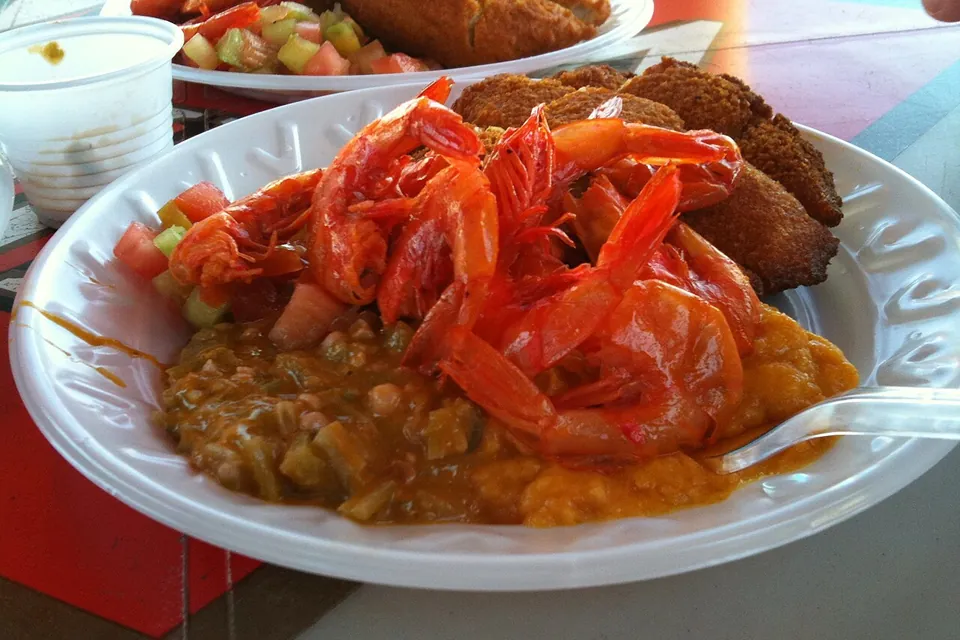
A fried cowpea fritter sold on the streets of Bahia by the Baiana women, in their white lace dresses. A West African bean fritter that crossed the ocean and, at the far end of the slave trade, took root as a new dish of its own.
Verification highlight popular claim → verdict → evidence
Acaraje descends from the Yoruba bean fritter akara, carried to Bahia through the transatlantic slave trade along with its key ingredients, black-eyed peas and palm oil (dende). Its existence is documented at least as early as 1802, when a letter in Luis dos Santos Vilhena's Recopilacao describes Black ganhadeira women in Salvador selling 'acarajes' from trays alongside other African-diaspora foods -- corroborated by academic research and Brazil's 2004 recognition of the Baianas de Acaraje as intangible cultural heritage. Key sources: Vilhena, Recopilacao (1798-1802); IPHAN heritage dossier (2004).
The three gates
- Ingredient-supply gate
- The main ingredient, black-eyed peas, originated in Africa and reached Brazil via the transatlantic slave trade, as did palm oil (dendê). The limiting factor was when black-eyed peas became available locally.
- Cooking-technique gate
- Grinding the beans, shaping them, and deep-frying in palm oil.
- Venue gate
- Candomblé ritual food in Bahia and street sales by Baiana women — later a Salvador specialty.
Overview
When and where it took shape
Acarajé is the signature street food of Salvador, in the northeastern Brazilian state of Bahia. Skinned cowpeas (black-eyed peas) are ground and shaped into a patty, deep-fried in dendê (the red oil of the African oil palm), then split open and filled with vatapá and other accompaniments.
Both of the ingredients that define the dish, the cowpea and the dendê oil, were originally West African. Both travelled to Brazil along the routes of the Atlantic slave trade. Bahia received more enslaved people than anywhere else in Brazil, and the beans and oil came across with the people themselves. Dendê oil appears in the Bahian record at the end of the seventeenth century, in 1699. Only once both bean and oil could be had reliably in this land did acarajé take its present form.
The cooking itself is plain and forceful. The peas are ground and worked into a light, airy batter, then dropped into hot dendê oil to fry. The red colour and the toasty aroma of the finished fritter come from that palm oil.
The settings in which it was served gave the dish its distinct character. Acarajé is indispensable to the rites of Candomblé, the Afro-Brazilian religion, and at the same time it was a good peddled by the Baiana women who stood in the streets. For them, selling it was a way to make a living — and to buy back their freedom. Moving between these two settings, the sacred and the street, acarajé became a dish that stands for Salvador.
How we know
Acarajé traces back to akara (àkàrà), a bean fritter that the Yoruba people of Nigeria and Benin have long made — skinned cowpeas ground and fried, a snack of the West African market and street corner.
When many Yoruba were brought to Bahia through the slave trade, the dish came with them. The name itself tells of its origin: acarajé is said to come from the cry of the vendor calling out to "come eat akara." The bean fritter that crossed the ocean joined with local dendê oil and vatapá and changed into something apart from the Yoruba akara — a dish particular to Bahia.
This origin lived for a long time in the oral tradition and the trade of the Baiana women, thin on firm documentary support. That changed with the letters that the Portuguese official Luís dos Santos Vilhena wrote home from Salvador between 1798 and 1802. Among the goods sold by the Black women who peddled from trays in the streets, he set down the name acarajés, listed alongside mocotós, carurus, and vatapás. By the time that letter of 1802 was written, acarajé in its present form was already rooted as a street food of Salvador.
Building on this contemporary source, the study by Bacelar (2013) reading Vilhena's account, the essay by Lody on the ties between Bahia and West Africa, and the dossier of the Brazilian government body IPHAN — which in 2004 inscribed the craft of the Baiana women's acarajé-making on the national list of intangible cultural heritage — together support the line of descent from a Yoruba origin. The dish carries in it the record of how the culture of people brought across in bondage survived on new ground and was handed down in two forms, the street trade and the sacred offering.
What the sources fix, it should be said, is the upper bound — that acarajé already existed by 1802 — not the moment the first fritter was made. Having grown up within the oral culture of street selling and Candomblé rites, its earlier steps were never set down in writing.
The full set of origin theories and the detailed verification log — traceable all the way to their sources — are available on the Japanese edition.
See the full origin theories and verification log (Japanese) →