All dishes / 南アジア
Chana masala Period BOrigin theory CVerified
Some fields (dish name, region and gates) are shown from the Japanese-edition data.
To lump Chana Masala together as "an ancient Indian dish" is only half right. The old layer of chickpeas simmered in spices is indeed old, but the version we know now, cooked deep red with tomato and chili, could not come into being until those two crossed the sea and reached northern India.
Verification highlight popular claim → verdict → evidence
A popular claim treats chana masala as an ancient or Mughal-era dish, but this confuses today's tomato-and-chili masala with an older, milder chickpea curry: tomato and chili are New World crops that only reached India after the 16th century, so the dish in its current form could not have existed under the Mughals. The record instead points to Punjab, with the dry "pindi chole" style crystallizing before Partition and spreading nationwide only after 1947, as documented in Lizzie Collingham's history of curry.
The three gates
- Ingredient-supply gate
- Chickpeas are native to South Asia and ancient there. But tomato and chili pepper (New World crops) are the bottleneck for today's masala -- their arrival in India via the Columbian Exchange (16th century onward) is the physical lower bound.
- Cooking-technique gate
- Grinding spices on a stone mortar, and slow simmering -- native techniques, not a bottleneck.
- Venue gate
- home/street / common people / everyday food / North India broadly
Overview
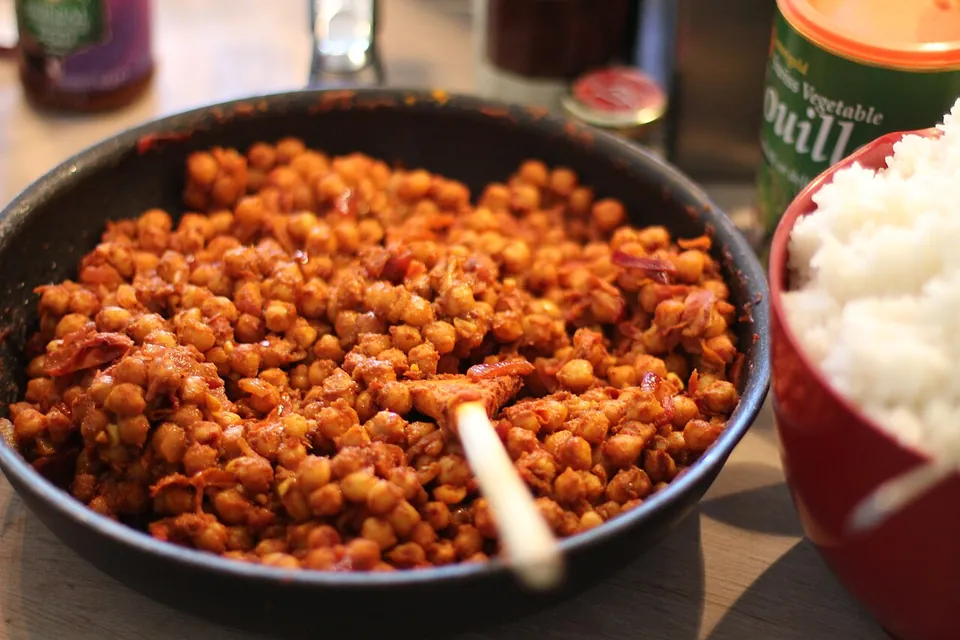
Chana Masala is a dish of Punjab in northern India: chickpeas (chana) simmered in a spiced sauce built on tomato and chili. It is everyday food, eaten at home and in the street, and long enjoyed from stalls as chole bhature, paired with fried bread. Its present form took shape in the early modern period, after New World ingredients arrived, and this dating is well settled in the scholarship.
The thing to be careful about is not to confuse "the dish is old" with "this form is old." The dish of chickpeas simmered in spices has a long prehistory. The red, fiery stew we call Chana Masala, by contrast, is far more recent.
The main ingredient, the chickpea, was a long-established South Asian crop, a staple rooted in the land. The tomato and chili that give today's masala its red color and heat, however, are both native to the New World. Through the exchange of foods in the age of exploration, they were carried into India by Portuguese trade from the sixteenth century onward. Chili spread into northern India around the eighteenth century. The tomato's arrival is a separate matter: it is not clearly on record in northern India until 1864, when Thomas Firminger's gardening manual for Calcutta, A Manual of Gardening for Bengal and Upper India, lists it, under the local name bilayati baingan ("foreign eggplant"), as an established vegetable with both an imported strain and a locally grown one, complete with its planting calendar. Only once both had arrived did the red masala of today become possible. Grinding spices on a stone mill and simmering them slowly were both handcrafts long present here.
The present form crystallized as a regional dish in undivided Punjab. Its core is held to be pindi chole, a dry style from Rawalpindi. Then, with the 1947 Partition of India and Pakistan, many people moved from Lahore and elsewhere to Delhi, and the dish traveled to the capital with them. Restaurants in Delhi such as Kwality and Sita Ram Diwan Chand spread it, and by the 1990s it had reached tables across the country.
In the colonial era, curry dishes like these of northern India were adapted by the British and standardized into the form of curry powder, becoming British-style curry. The indigenous curry dishes, Chana Masala among them, are among its distant ancestors.
How we know
The puzzle of Chana Masala is not about exposing a glamorous founding myth. Its heart lies in telling apart which era of the dish one is talking about.
First, the dish of chickpeas simmered in spices is older than New World ingredients. The Ni'matnama of the late fifteenth century and the Ain-i-Akbari of the late sixteenth record chickpea dishes cooked with long-established spices such as black pepper, coriander, and asafoetida. In other words, before tomato and chili came, it was not that "there was no dish" but that there was an older form without those two. This prehistory rests on primary sources and is firm.
So where was the red Chana Masala of today born? Here nothing is settled. One view places it in Rawalpindi in undivided Punjab (pindi chole); another traces it to Punjab as a whole; another names eastern Uttar Pradesh. There is no tale of a single inventor, and the dispute stays purely a matter of place. Because the birthplace does not converge on one point, the account of its origin remains without a single agreed version.
The path by which tomato and chili traveled from the New World into the curry dishes of northern India is charted in Lizzie Collingham's Curry (Oxford University Press): carried in by Portuguese trade from the sixteenth century, they were folded into the region's cooking only later, and the fiery red masala of today could follow no earlier than that. The old history of the dish, and the history of this one plate: reading the two apart is the key to tasting Chana Masala rightly.
The full set of origin theories and the detailed verification log — traceable all the way to their sources — are available on the Japanese edition.
See the full origin theories and verification log (Japanese) →
Related dishes
Lineage Family, predecessor, variants
Cross-links Sister dishes & same-name dishes (separate lineage)
Shares the key ingredient
- Pasta al pomodoroSouthern ItalyB
- Pizza MargheritaNaples (Italy)D
- ShakshukaMiddle East / North AfricaC
- Jollof riceWest AfricaC
- Butter chickenDelhi (India)C
- Khao SoiB
- GazpachoAndalusia (Spain)C
- LecsóHungaryC
- RatatouilleProvence, France (Nice)C
- Thieboudienne (ceebu jën)SenegalC
- ChakalakaSouth AfricaC
- KedjenouIvory CoastB
- Caprese saladCapri (Italy)C
- SaloonaPersian Gulf (Bahrain and Kuwait)C
- Shan khauk hswè (Shan noodles)Myanmar (Shan State)C
- American pizzaUnited StatesC
- FrancesinhaPorto (Portugal)D
- ChakhokhbiliGeorgia (Caucasus)C
- KachumberGujarat (Western India)C
- SalmorejoAndalusia (Spain)C
- Greek salad (horiatiki)GreeceC
- Shopska saladBalkans (Bulgaria)B
- Melanzane alla parmigianaItalyC