All dishes / 西欧
Shepherd's pie Period BOrigin theory BVerified
Some fields (dish name, region and gates) are shown from the Japanese-edition data.
A thrifty English pie of leftover meat capped with mashed potato and browned in the oven. The story that Irish peasants invented it, and the tidy rule that beef makes a cottage pie while lamb makes a shepherd's pie, are both later explanations grafted onto a dish whose name and recipe travelled separate roads.
Verification highlight popular claim → verdict → evidence
Two stories cling to shepherd's pie: that poor Irish farmers made it from leftover meat and cheap potatoes, and that the name properly follows the meat, cottage pie for beef and shepherd's pie for lamb. The earliest records point elsewhere. The dish came before the name. A mince of cold meat covered with mashed potato and baked appears in British cookery books as Sanders or Saunders, in Maria Rundell (1806) and in Eliza Acton's Modern Cookery for Private Families (1845, p.207), while cottage pie is written down in Parson Woodforde's diary in 1791. The name shepherd's pie turns up first in Edinburgh, in Mrs Williamson's The Practice of Cookery and Pastry (1854, p.72; the 1849 edition is reported to carry it too, though that text has yet to be checked), and that recipe asks for cold dressed meat of any kind, so dividing the two names by the meat is a later tidying-up rather than the original sense. No earlier independent Irish record has yet been found, and the potato became everyday food in Ireland and in Britain at much the same time. The potato itself could be had in England from about 1590, which is as far back as the dish can go.
The three gates
- Ingredient-supply gate
- Mutton is local. What defines the dish is its covering of mashed potato, and the potato is a New World crop: it became obtainable in England around 1590 (a window of 1588 to 1593), and that is the earliest the dish could be. Its arrival on ordinary tables at the end of the eighteenth century is a matter of how widely it came to be eaten, not of when the ingredient could first be had.
- Cooking-technique gate
- Covering the meat with mashed potato and baking it in the oven.
- Venue gate
- A thrifty way with leftover meat in working and country households.
Overview
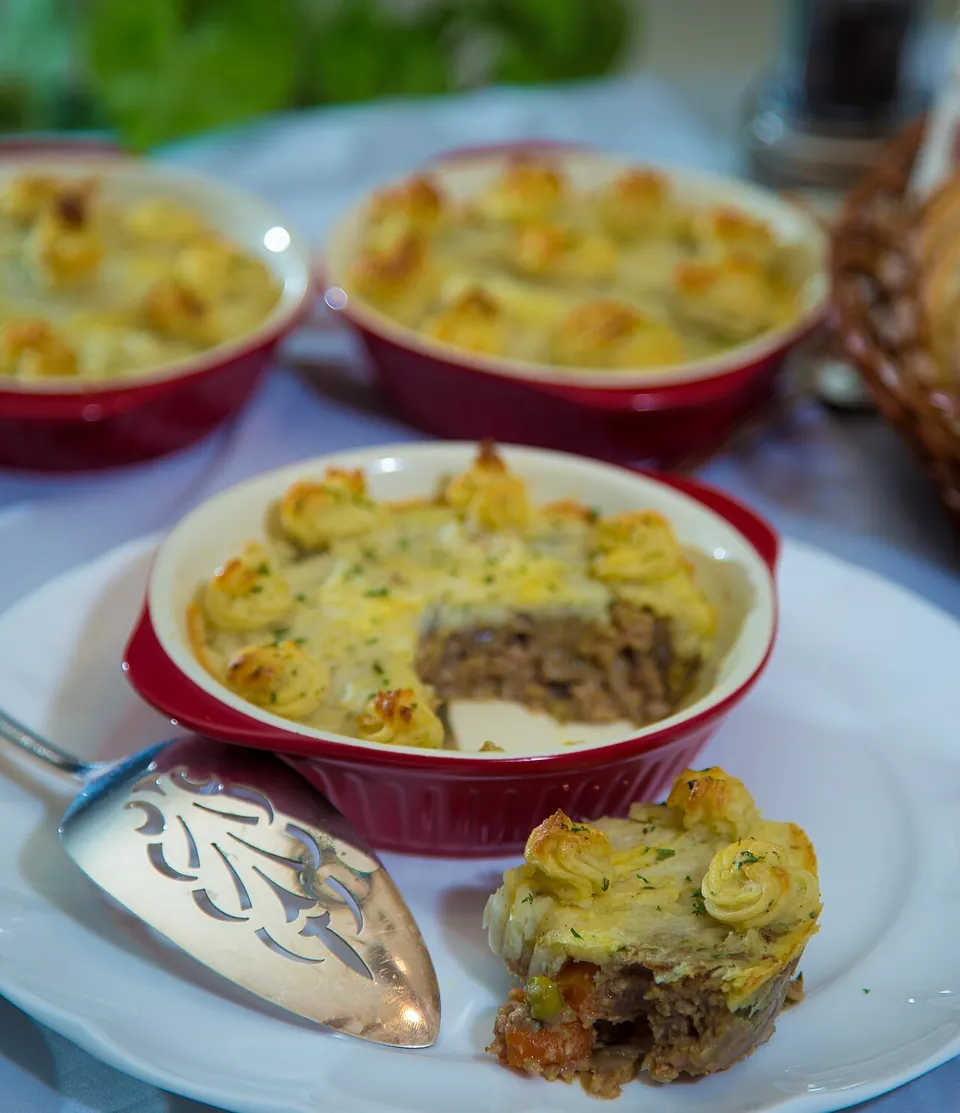
Shepherd's pie is a household dish of cold minced or chopped meat, capped with mashed potato and baked. It spread through working-class and country kitchens as a way to finish yesterday's meat without waste.
The cap of mashed potato is what gives the dish its shape. The potato itself crossed the Atlantic to England in the closing years of the sixteenth century, and it settled onto ordinary British and Irish tables toward the end of the eighteenth. Smooth potato spread over minced meat in a baking dish, scored on top and baked until the surface colours, is what sets this dish apart from other meat pies.
The dish itself is older than its name. British cookbooks from the late eighteenth and early nineteenth century already record a dish of minced cold meat covered with mashed potato and baked. Eliza Acton's 'Saunders' in her Modern Cookery for Private Families (1845) and the earlier dish known as 'cottage pie' both preserve this form. The name 'shepherd's pie' turns up in cookbooks only later.
How we know
Two familiar stories cling to shepherd's pie. One casts it as a 'classic Irish dish,' the invention of poor Irish farmers making do with leftover meat and cheap potatoes. The other holds that the true rule was always beef for cottage pie, lamb for shepherd's pie, the two names split by the kind of meat. Both have long been told alongside the dish, but the older records point elsewhere.
The name appears first not in Ireland. 'Shepherd's pie' is recorded in Williamson's The Practice of Cookery and Pastry, published in Edinburgh between 1849 and 1854, so its first attestation is Scottish. The dish's forerunners, 'cottage pie' and 'Saunders,' surface earlier still in British cookbooks. No independent, earlier record points to a distinctly Irish origin, and the potato reached ordinary tables at much the same time in Ireland and in Britain.
The split by kind of meat was also a later tidying-up. The oldest 'shepherd's pie' recipe — the 1854 edition is the one whose text can be read today — calls not for lamb but for 'cold dressed meat of any kind.' Through the late eighteenth and nineteenth centuries the two names were used interchangeably, and the rule that beef and lamb decide the name reads as a later rationalisation of what the names might mean.
So shepherd's pie took root first as a thrifty household dish across Britain, and only afterwards gathered its several names and its plausible-sounding origin stories.
The full set of origin theories and the detailed verification log — traceable all the way to their sources — are available on the Japanese edition.
See the full origin theories and verification log (Japanese) →
Related dishes
Shares the key ingredient
- Vada pavMumbai (India)C
- PoutineQuebec (Canada)C
- Proto-ajiaco (pre-chicken Muisca highland stew proto-layer)Bogotá highlands (Cundinamarca)C
- Pani puriNorth IndiaC
- Aloo kachoriIndia (Rajasthan / North India)C
- VichyssoiseFrance / USA (disputed)B
- Olivier saladMoscow (Russia)C
- Bacalhau à BrásLisbon (Portugal)C
- Caldo verdeMinho (Portugal)C
- Pav bhajiMumbai (India)C
- Abgoosht (dizi)IranC
- Jansson's temptationSwedenC
- California burritoCalifornia (USA)C
- StamppotNetherlandsC
- Sindhi biryaniSindh (Pakistan)C
- Patties (Sri Lankan)Sri LankaC
- OkroshkaRussiaC
- Potato chipsUnited StatesB
- DranikiBelarusC