All dishes / 西欧
Gyros Period BOrigin theory BVerified
Some fields (dish name, region and gates) are shown from the Japanese-edition data.
The vertical spit of gyros is a fixture of the Greek eatery, and many take it to be a purely Greek invention. But both the style and the name crossed the sea from Anatolia: gyros grew from the Turkish döner kebab, carried into Greece in the hands of refugees and settled there.
Verification highlight popular claim → verdict → evidence
Myth: gyros is an independent Greek invention with no connection to Turkish doner kebab. Verdict: refuted. In Greece the dish was originally called 'doner' using the Turkish word itself; the name 'gyros' only replaced it during a 1975 Greek language-purification campaign aimed at removing Turkish loanwords. The vertical-rotisserie technique itself traveled from 19th-century Bursa to Greece with refugees from the 1922-23 population exchange.
The three gates
- Ingredient-supply gate
- The meat was locally available; what limited the dish was the spread and adoption of the vertical rotisserie style from Anatolia to Greece.
- Cooking-technique gate
- Vertical rotisserie grilling (doner-style), adapted in Greece.
- Venue gate
- It spread as an urban street food and takeaway item following the influx of refugees from Asia Minor.
Overview
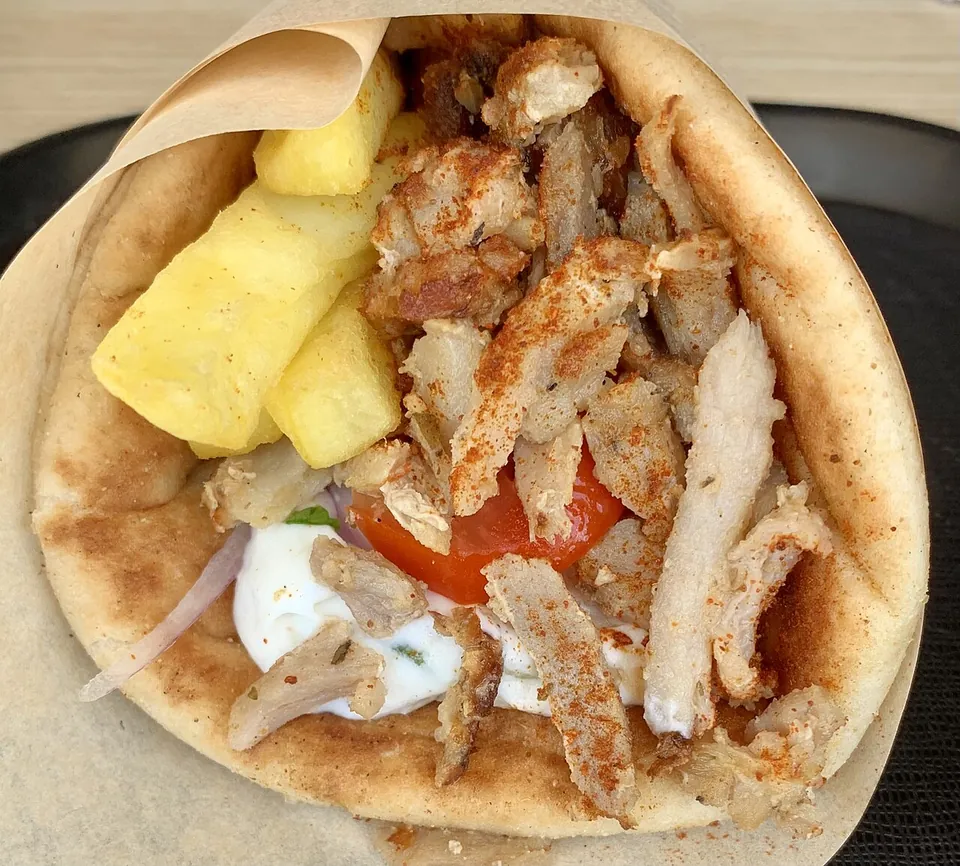
The name gyros means 'turning' in Greek. Thin slices of meat are stacked in layers on an upright spit, roasted from the outside and shaved off, then wrapped in pita and served. It is often made with pork, and that has become one of its Greek marks.
What makes this dish is less the meat than the way the meat is cooked: on a vertical rotisserie. Roasting a stacked block of meat as it turns and shaving it down took shape in the nineteenth-century Ottoman city of Bursa. That is the döner kebab. Döner, too, means 'turning' in Turkish, and the Greek gyros is its translation. The name itself tells you where the technique came from.
The style crossed into Greece in the twentieth century. In the population exchange of 1922–23, Greeks who had lived in Asia Minor, in Smyrna and Constantinople, moved to the mainland and brought the rotisserie craft they knew with them. It settled in post-war Athens, spread from the 1950s onward as street and takeaway food, and had become thoroughly common by around 1970. Through the switch to pork and the adaptation of a Greek name, gyros became a taste of this land.
How we know
There is a view, still stubbornly told, that gyros is a purely Greek invention with no connection to the Turkish döner kebab. That claim does not hold up against the record.
The clincher is the name itself. In Greece, too, the dish was at first called ntoner, straight from the Turkish döner. It was during the language-purification movement of 1975, an effort to scrub Turkish from the mother tongue, that the name döner was deliberately replaced with the Greek gyros. The name gyros, in other words, is not an independent birth but a borrowed word purified after the fact. Studies of its etymology also record the name as a translation of the Turkish döner.
The origin of the technique points the same way. The vertical rotisserie took shape in nineteenth-century Bursa and crossed into Greece with the refugees who arrived in the 1922–23 population exchange. This route can be traced in the scholarly literature, and by 1970 gyros was reported as a popular street food in Athens, Chicago, and New York.
Gyros does not have an independent origin; it is the döner kebab's style carried into Greece and adapted, made local through pork and a Greek name. Local touches were certainly added, but that is adaptation, not independent origin. The claim of a purely Greek origin, meant to erase the Turkish source, is undercut by the very movement that deliberately painted over the name.
The full set of origin theories and the detailed verification log — traceable all the way to their sources — are available on the Japanese edition.
See the full origin theories and verification log (Japanese) →
Related dishes
Cross-links Sister dishes & same-name dishes (separate lineage)
Shares the key ingredient
- TonkatsuJapanC
- Tacos al pastorMexicoB
- FeijoadaBrazilB
- Barbecue ribsSouthern United StatesC
- CurrywurstBerlin (Germany)B
- Twice-cooked reheated pork (Huiguorou precursor)Sichuan, ChinaC
- ChicharrónPeru / Latin AmericaB
- ChicharrónMexicoB
- ChicharrónColombiaB
- BaoziChinaC
- Chop sueyUSA (Cantonese diaspora) / Guangdong (China)C
- Cochinita pibilYucatán (Mexico)C
- LechonCebu (Philippines)C
- SaloUkraineC
- Bak kut tehSingaporeC
- GolonkaPolandC
- EisbeinBerlin (Germany)C
- SchweinshaxeBavaria (Germany)C
- Japanese-style twice-cooked porkJapanB
- ManchamantelesPuebla (Mexico)C
- PernilPuerto RicoC
- ChoripánRío de la Plata (Argentina)C
- Char siuGuangdong (China)C