All dishes / ラテンアメリカ
Choripán Period BOrigin theory CVerified
Some fields (dish name, region and gates) are shown from the Japanese-edition data.
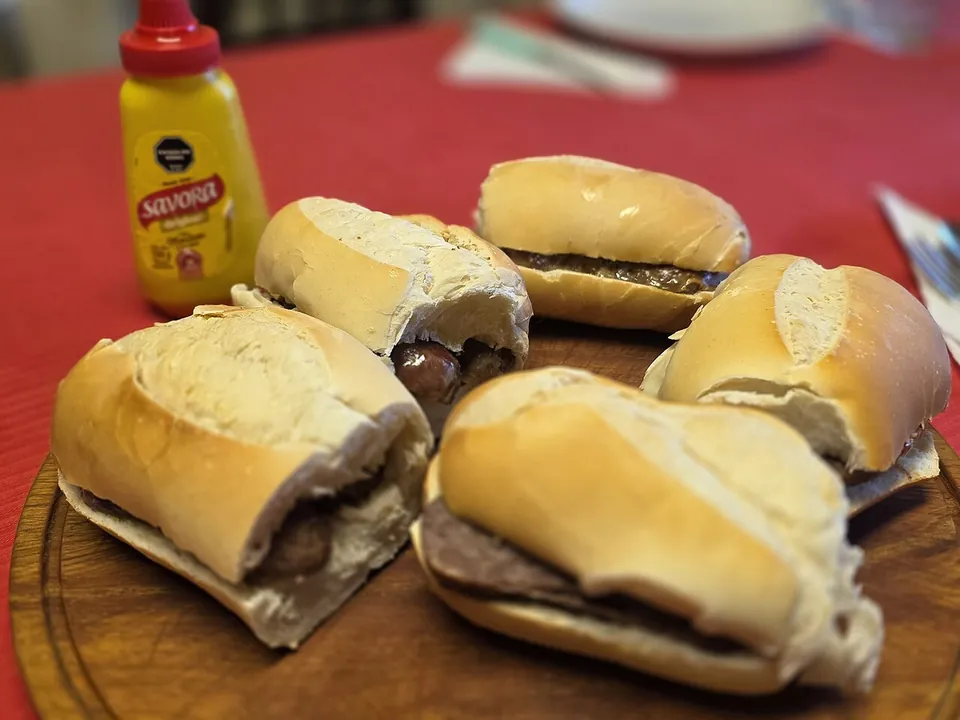
An Argentine street food that is nothing more than a grilled chorizo tucked into bread. The homely origin story—that gauchos invented it over campfires on the pampas—has been told and retold, but no written record from the time survives to support it.
Verification highlight popular claim → verdict → evidence
Popular tradition credits 19th-century gauchos with grilling chorizo over open fires and putting it in bread, but gauchos left no written records, so that account rests on oral tradition alone. A separate, more specific account holds that the name choripan itself was coined and popularized in 1950s Cordoba. A 1925 photograph from Argentina's national archive of a choripan cart in Buenos Aires is solid evidence the dish already existed as street food well before the 1950s Cordoba account, though it does not settle when the name was first used.
The three gates
- Ingredient-supply gate
- Pork and wheat bread were both introduced and established in the Rio de la Plata region during Spanish colonization, well before the 19th century, so no imported ingredient sets the dish's earliest possible date.
- Cooking-technique gate
- Chorizo sausage is grilled over an open fire (parrilla) and tucked into bread.
- Venue gate
- Grew out of gaucho and ranch-hand open-fire cooking culture into a street-food staple.
Overview
Choripán is a hand-held food of the Río de la Plata region: a chorizo (a fresh sausage) grilled over charcoal and tucked into a split roll. The ingredients could hardly be simpler—a pork sausage and bread. Both the pork and the wheat bread were long-established local staples that entered the Río de la Plata table in the Spanish colonial period and were part of everyday life from early on.
What gave this dish its outline was the shifting setting in which it was eaten. Gauchos and ranch hands, working the land, grilled sausages over the open charcoal fire of the asado and ate them then and there, tucked into bread, standing and one-handed. This casual way of eating, needing neither kitchen nor tableware, eventually moved out to the street corner. Its ease—viable without any kitchen—fit neatly into the form of the food cart. Choripán took on its clear shape as a dish when the campfire food of the countryside came out onto the streets of the city.
Its emergence is placed from the late nineteenth into the early twentieth century. Grilling a sausage over charcoal and tucking it into bread is no new trick, but for the moment it appeared as a street food of the city there is one firm piece of physical evidence.
How we know
The most often told origin of choripán is the nineteenth-century gaucho story: the men of the pampas grilled chorizo over an open asado and ate it tucked into bread by hand, and the dish traces back to that habit. It is an appealing tale, but there is a catch. The gauchos left almost no written records, and this origin survives only by word of mouth. No contemporary source lets us trace the year it began, and when it started remains unknown.
The historian Daniel Balmaceda offers a different view. The name choripán and the dish in its present form, he holds, spread and took hold in the 1950s at food carts in the Parque Sarmiento of the city of Córdoba (an anecdote is attached: Fidel Castro ate one at a riverside cart in 1959). But this is a story about the name and popularization, not about the origin of grilled chorizo in bread itself.
What shows the dish was already in the city before this naming account is a 1925 photograph of Buenos Aires held by Argentina's national archive (AGN), "Carrito de choripán, Buenos Aires" (inv. 165462). It records, as physical evidence, that a choripán cart stood in the city in 1925. Here one careful line was drawn: the word choripán in the photograph's caption may have been added later as a catalog entry, so it is not treated as evidence for the first appearance of the word. What the photograph reliably attests goes only as far as "the cart existed"; when the name came into use is handled separately.
So the two accounts are not set against each other but kept side by side. The origin of the dish itself cannot be dated, resting on oral tradition alone (the gaucho story), while the name is firmly attested in 1950s Córdoba (Balmaceda's account). And between them, a single photograph fixes beyond dispute that a cart was really there in 1925.
The full set of origin theories and the detailed verification log — traceable all the way to their sources — are available on the Japanese edition.
See the full origin theories and verification log (Japanese) →
Related dishes
Shares the key ingredient
- TonkatsuJapanC
- Tacos al pastorMexicoB
- FeijoadaBrazilB
- Barbecue ribsSouthern United StatesC
- CurrywurstBerlin (Germany)B
- Twice-cooked reheated pork (Huiguorou precursor)Sichuan, ChinaC
- ChicharrónPeru / Latin AmericaB
- ChicharrónMexicoB
- ChicharrónColombiaB
- BaoziChinaC
- Chop sueyUSA (Cantonese diaspora) / Guangdong (China)C
- Cochinita pibilYucatán (Mexico)C
- LechonCebu (Philippines)C
- SaloUkraineC
- Bak kut tehSingaporeC
- GolonkaPolandC
- GyrosGreeceB
- EisbeinBerlin (Germany)C
- SchweinshaxeBavaria (Germany)C
- Japanese-style twice-cooked porkJapanB
- ManchamantelesPuebla (Mexico)C
- PernilPuerto RicoC
- Char siuGuangdong (China)C