All dishes / 中東・北アフリカ
Döner kebab Period BOrigin theory CVerified
Some fields (dish name, region and gates) are shown from the Japanese-edition data.
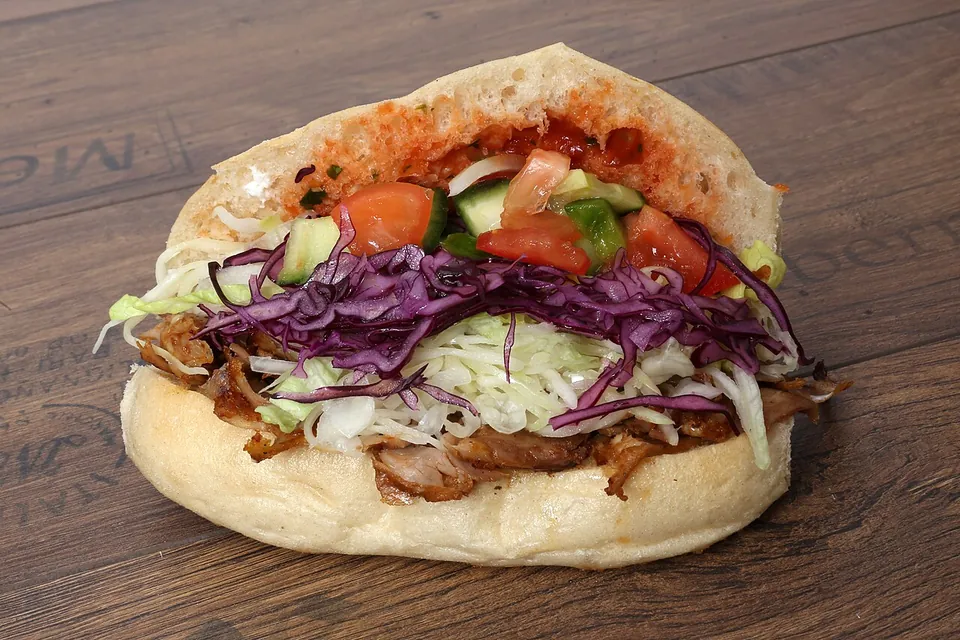
A vertical stack of meat turning slowly on its axis, seared on the outside and shaved off in ribbons: this now-familiar sight appeared only after the upright rotisserie was set turning in mid-nineteenth-century Anatolia. Family lore names a single inventor, but the man in the oldest surviving photograph is neither of the two candidates.
Verification highlight popular claim → verdict → evidence
Myth: Iskender Efendi of Bursa personally invented the vertical doner. Verdict: the earliest photographic evidence of vertical doner (James Robertson, 1853-55) shows a street vendor who is neither Iskender nor the rival claimant Hamdi of Kastamonu, undermining both individual-inventor claims. What is confirmed is that vertical rotisserie grilling emerged in mid-19th-century Ottoman Anatolia; who first did it remains unresolved.
The three gates
- Ingredient-supply gate
- Lamb and beef are native livestock. The limiting factor is the vertical rotisserie technology, which emerged in 19th-century Bursa and made vertical doner possible.
- Cooking-technique gate
- The shift from horizontal skewer-grilling (sis) to a vertical rotisserie that stacks meat on a rotating spit and shaves the surface -- this transition is the limiting factor.
- Venue gate
- shops / common people / eating out / urban residents
Overview
Döner kebab took its recognizable form in Anatolia, in what is now Turkey, around the middle of the nineteenth century (roughly 1850 to 1870), during the late Ottoman period. That the meat was turned onto a vertical axis in this era rests on solid scholarly footing, and the dating holds firm. Who first stood the spit upright, however, is a different question, and it has never been settled.
Lamb and beef were long at hand in Anatolia, and grilling meat on a skewer was an old habit here. Meat turned on a spit was nothing new: a fifteenth-century manuscript records the phrase "çevirme kebabı" (turning kebab), and Istanbul miniatures from around 1616 to 1620 show meat roasting over a horizontal spit turned outdoors.
What changed in the mid-nineteenth century was that this horizontal spit was set on end. According to the food historian Priscilla Mary Işın (Bountiful Empire, 2018), the vertical spit emerged in Istanbul shops as a way to pack more meat into a tight space. Stacking the meat high, turning it, and shaving off the cooked surface to serve one order at a time ties the method to the urban shop and eating-house, the world of food bought and eaten out. The word "döner kebap" itself first appears in print in 1908, already into the twentieth century.
How we know
Several traditions name the person who is supposed to have stood the spit upright. The most often repeated has İskender Efendi (Hacı İskender) of Bursa turning the horizontal roast vertical in the mid-nineteenth century and so completing the modern döner. The account descends through his family, the İskenderoğlu line, but no contemporary primary source backs it up; even Wikipedia flags the story as needing a primary source. İskender's name does survive in İskender kebab, a dish of shaved meat dressed with melted butter and tomato sauce, but that is a long way from crediting him alone with the vertical spit.
Nor is his the only such claim. Another tradition puts Hamdi Usta of Kastamonu ahead of him, around 1830, and neither account rises above family memory. The oldest physical trace, which ought to settle the rivalry, points to neither man. A photograph taken by James Robertson around 1853 to 1855 shows a street vendor cooking on a vertical döner spit, the earliest surviving image of the upright form, and as National Geographic notes, that vendor is neither İskender nor Hamdi.
What remains is not the name of the first cook but a firm outer date. The word appears in print by 1908; the oldest photograph dates to the 1850s. Together these place the upright döner in Anatolia by the middle of the nineteenth century. The story that hangs the invention on a single name is a tidy one, but the record carries it no further than that.
The full set of origin theories and the detailed verification log — traceable all the way to their sources — are available on the Japanese edition.
See the full origin theories and verification log (Japanese) →