All dishes / ラテンアメリカ
Panucho Period BOrigin theory CVerified
Some fields (dish name, region and gates) are shown from the Japanese-edition data.
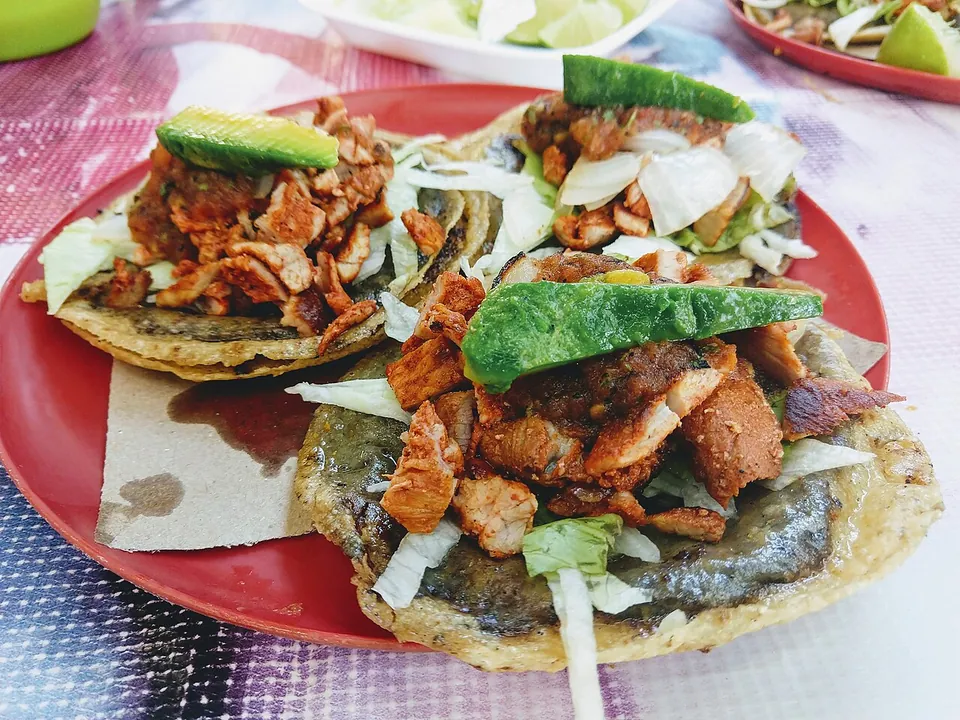
A Yucatán tortilla dish stuffed with black beans and fried. The tale that "Don Ucho invented it," the story behind its name, is a piece of folklore with little to support it in the record.
Verification highlight popular claim → verdict → evidence
Legend credits an innkeeper called Don Ucho in mid-19th-century Mérida with inventing the dish and its name (from "pan de Ucho"), first recorded in writing in 1861. But the story reads as folk etymology invented after the fact: the dish itself is rooted in older Yucatec Maya cooking (nixtamalized corn tortillas stuffed with beans), and no independent record confirms Don Ucho as a real inventor.
The three gates
- Ingredient-supply gate
- Corn and black beans are both native to the region; nixtamalized corn tortillas are a prerequisite.
- Cooking-technique gate
- Puffing a tortilla and stuffing it with black beans before frying.
- Venue gate
- A street food and market snack across the Yucatán.
Overview
Panucho is a snack from the Yucatán Peninsula of Mexico. A tortilla is toasted until it puffs, packed inside with black beans, and fried, then topped with chicken, turkey, or another garnish. It is a familiar sight in markets and on the street.
Corn and black beans, the heart of the dish, are old crops rooted in the soil of Yucatán. Both have grown in Mesoamerica since ancient times and have sustained people's daily tables. The technique that underlies panucho is the nixtamal process, treating corn with lime before toasting it into a tortilla. The Maya culinary vocabulary has a word, uah, for a corn bread made with beans, and panucho stands within this native lineage. From the colonial period into the modern era, its present form took shape in the hands of travelers along the roads and the crowds gathered in the markets.
How we know
The name panucho carries a story tied to a man. In the mid-nineteenth century, in the San Sebastián district of Mérida, in front of the chapel known as La Ermita, an innkeeper served late-night snacks to travelers passing along the Camino Real to Campeche. His name was don Eugenio, and people fondly called him "Don Ucho" (some sources spell it Don Hucho). At first he served bread with beans and egg, later switching to a corn tortilla. Travelers called it pan de don Ucho, "Don Ucho's bread," which in time shortened to panucho. So the story goes.
This anecdote was written down by the man of letters José Peón Contreras in the literary journal La Guirnalda (Mérida, 1860-61) and was later gathered into Renán Irigoyen Rosado's Leyendas de Mérida. It means that the name panucho was in print in Mérida by 1861 at the latest. Yet no other record confirms that a Don Ucho actually lived, and the cookery dictionary Larousse Cocina treats the tale as a legend.
There are readings of the name that lean on no personal story. One takes panucho simply as the Spanish word pan, "bread," with an affectionate suffix, a descriptive name. Another traces it to the Maya p'an uuch, "the stuffed, the filled," a name for the very style of packing in black beans. Both root the name not in one person's invention but in the native food of the Yucatec Maya, the nixtamal tortilla stuffed with black beans and fried.
A charming tale of a named man, and a dish grown from local tradition. The truth behind the name is unsettled, but that the food itself grew out of the Maya culinary tradition shows through whichever account you follow.
The full set of origin theories and the detailed verification log — traceable all the way to their sources — are available on the Japanese edition.
See the full origin theories and verification log (Japanese) →
Related dishes
Shares the key ingredient
- UgaliEast Africa (Kenya / Tanzania)C
- Tamale (tamal)MexicoC
- CornbreadSouthern United StatesC
- ArepaColombia / VenezuelaC
- Indigenous maize proto-layer (cornbread precursor: corn pone / ashcake)North America (Indigenous maize-cultivation range)B
- PupusaEl SalvadorC
- GritsAmerican SouthB
- PozoleMexicoC
- Proto-pozole (pre-pork pre-Columbian ceremonial pozole: ritual meats such as turkey/dog with nixtamalized maize proto-layer)Mesoamerica (pre-Columbian Mexico)C
- Indigenous corn-dough dish (humita family)Araucanía (Chile)B
- Brunswick stewSouthern United StatesC
- NachosPiedras Negras (Northern Mexico)B
- MukimoKenya (Kikuyu country)C
- PapSouth AfricaB
- Mukbil polloYucatán (Mexico)C
- KenkeyGhanaC