All dishes / ラテンアメリカ
Machaca Period BOrigin theory CVerified
Some fields (dish name, region and gates) are shown from the Japanese-edition data.
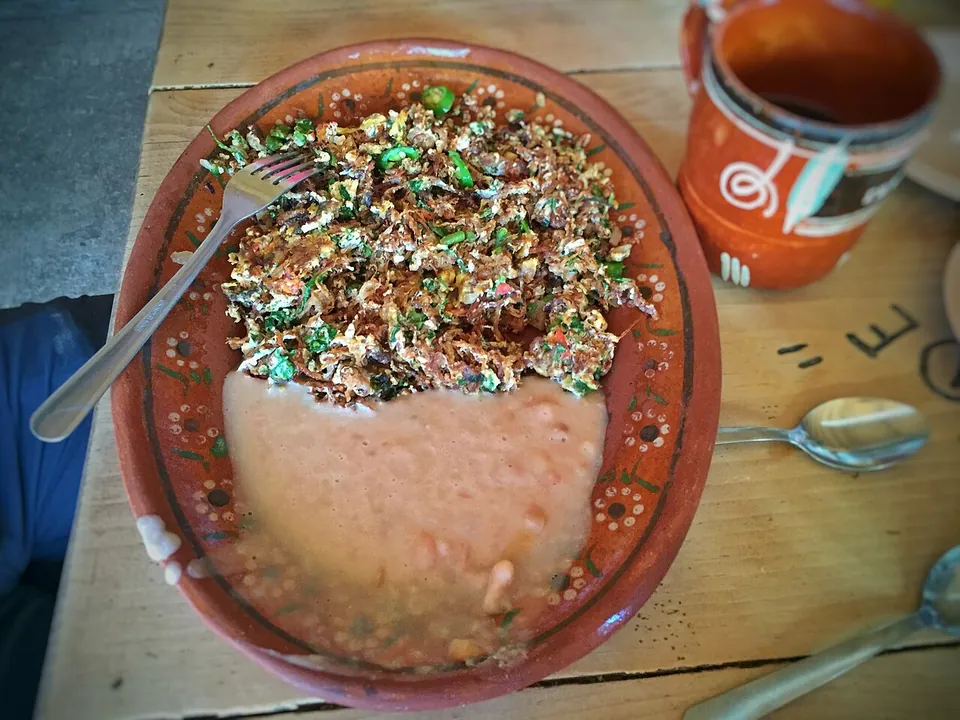
Dried beef pounded into shreds and fried up with eggs and tomato — machaca, the breakfast of northern Mexico, grew out of the work of keeping meat before there was refrigeration.
Verification highlight popular claim → verdict → evidence
Popular claims that machaca dates back to Aztec times or has existed since the 18th century compress the timeline. In fact, the current beef version could only form after Spanish colonization brought cattle to Mexico's northern ranching lands, where ranchers salted and sun-dried beef, then pounded it - a technique that itself continues an older Indigenous practice of pounding dried venison. Key source: Jesuit missionary Ignaz Pfefferkorn's firsthand 1755-67 account of salted, sun-dried beef in Sonora.
The three gates
- Ingredient-supply gate
- Cattle reached the northern ranching lands after the Spanish arrival (limiting factor); dried preservation is a prerequisite
- Cooking-technique gate
- Salted, sun-dried beef is pounded, shredded, and fried
- Venue gate
- A preserved food of the northern ranching belt that became a household breakfast
Overview
Machaca is a dish of northern Mexico made by pounding salted, sun-dried beef into fine shreds and frying it with eggs, tomato, chili, and onion. The name comes from machacar, 'to pound or crush,' and true to that name, the labor of breaking down the hard, dry meat is where the dish begins. In the homes of Sonora and Sinaloa, machaca con huevo, the version bound with eggs, is a standard breakfast.
Cattle came to this land with the arrival of the Spanish. In the sixteenth century, herds spread through the dry pastoral country of the north — the ranchos — and the region grew into one of Mexico's great cattle lands. With no means of refrigeration, herders and cowboys salted their beef and dried it under the strong sun into carne seca, a jerky that would keep. That hard meat was pounded loose in a mortar and fried with eggs and vegetables, and so a keeping-food turned into a daily breakfast.
Until cattle crossed the sea and arrived, beef machaca had no way of coming into being. The dish as it stands today took its shape within the pastoral culture of the north from the colonial period onward, before refrigeration spread.
How we know
Machaca sometimes comes trailing claims that it has been eaten 'since Aztec times' or is a 'tradition from the eighteenth century.' But a story that pushes this dish of pounded beef back into antiquity compresses the dates too far: cattle themselves were not in the pre-Spanish north.
Even so, to say that machaca was simply 'born after the Spanish brought cattle' is to tell only half of it. The craft of drying meat and crushing it was rooted in this land before cattle came. The indigenous peoples of the north had long known how to salt and dry the meat of deer and other game and grind it fine to keep it. When cattle arrived, people swapped the main ingredient of that craft from deer to beef. The technique carried on unbroken; only the meat changed. In time the settlers, too, took up the drying craft already present in this land — so the Oxford scholarship on the pastoral history of Latin America records.
That dried beef had settled into the north is borne out in a primary record. In the mid-eighteenth century, the Jesuit Ignaz Pfefferkorn, during his mission in Sonora, wrote down how salted, sun-dried beef was kept on the ranchos and at the missions. By at least that time, the life of drying beef had taken hold in the cattle country.
The continuity of the swap from deer to beef, and the line drawn by the arrival of cattle — the history of machaca holds both at once.
The full set of origin theories and the detailed verification log — traceable all the way to their sources — are available on the Japanese edition.
See the full origin theories and verification log (Japanese) →
Related dishes
Lineage Family, predecessor, variants
Shares the key ingredient
- PhoVietnamC
- Beef StroganoffRussiaC
- Chicago Italian beefChicago (USA)C
- Salt beef (the layer before canning)Ireland (Cork / Dublin)C
- AsadoRío de la Plata (Argentina / Uruguay)C
- Lomo saltadoLima (Peru)C
- BulgogiKorean Peninsula (South Korea)B
- ĆevapčićiBalkans (Serbia, etc.)C
- Proto-bulgogi (native grilled-meat proto-layer)Korean PeninsulaC
- Proto-goulash (pre-paprika herdsmen's meat stew proto-layer)HungaryC
- KharchoGeorgia (Caucasus)B
- Proto-rendang (pre-chili merendang proto-layer)West Sumatra (Minangkabau), IndonesiaC
- Nyama chomaEast Africa (Kenya, Tanzania)C
- Philly cheesesteakPhiladelphia (USA)B
- Pastel de chocloChileC
- NihariNorth India (Delhi / Awadh)C
- NikujagaJapanC
- Australian meat pieAustraliaC
- FajitasRio Grande Valley, Texas (USA)B
- Loco mocoHilo, Hawaii (USA)B
- KitfoGurage (Ethiopia)C
- Ropa viejaCubaC
- Ropa vieja (Iberian prototype)Canary Islands, SpainB
- TibsEthiopian HighlandsB
- BiltongSouth AfricaC
- Lok lakPhnom Penh (Cambodia)C
- Carne asadaNorthern Mexico (Sonora)C
- Hamburg steakHamburg (Germany)B
- Bò lúc lắc (Vietnamese shaking beef)Southern VietnamC
- Montreal-style smoked meatQuebec (Canada)D
- Kare-karePhilippinesC
- PastramiNew York (USA)D
- BraaiSouth AfricaC
- French dip sandwichLos Angeles, California (USA)C