All dishes / サブサハラ・アフリカ
Kenkey Period BOrigin theory CVerified
Some fields (dish name, region and gates) are shown from the Japanese-edition data.
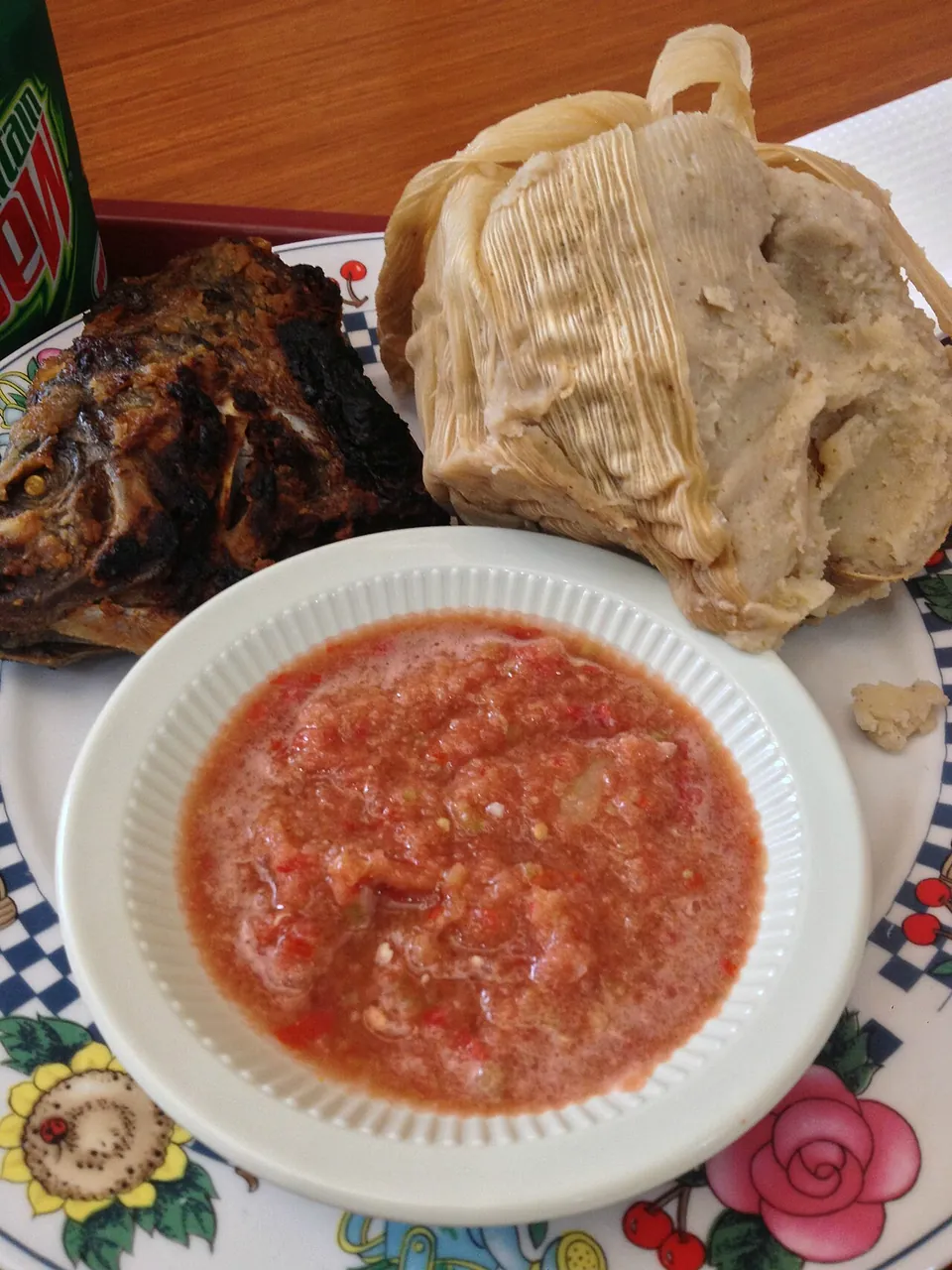
A tangy, steamed maize staple sold in the market towns of Ghana's coast. It looks like an age-old grain dumpling, yet at its core sits a New World grain that crossed the Atlantic and remade the local table over some four centuries.
Verification highlight popular claim → verdict → evidence
Maize is native to the Americas and reached West Africa via Portuguese trade only from the 16th century onward, which sets the earliest possible date for kenkey. A 1602 account of the Gold Coast is the earliest known written record describing the fermented-maize preparation. Exactly when Ga society first made this dish, prior to that record, still calls for further documentation.
The three gates
- Ingredient-supply gate
- Maize is native to the Americas and only reached West Africa after the 16th century; before that, native millet was used instead. Fermented maize dough is the dish's defining requirement.
- Cooking-technique gate
- Maize dough is fermented with lactic acid, partly cooked into a paste, then wrapped in husk or banana leaf and steamed.
- Venue gate
- An everyday staple of Ga and Fante society that also became a market food.
Overview
Kenkey is a Ghanaian staple made from lactic-fermented maize dough: part of the dough is gelatinized, then the whole is wrapped in maize husks or banana leaves and steamed. The Ga (Ga-Adangbe) call it komi, the Fante dokono, and it is eaten as a sour, springy dumpling alongside a fish or pepper sauce.
What holds this dish together is its lead ingredient, maize. Maize is a New World crop; it was not native to West Africa. Portuguese trade brought it across the Atlantic in the sixteenth century, and it spread along the coast from the Gambia River down toward São Tomé. Until that grain crossed the sea and reached these kitchens, the fermented maize dough at the heart of today's kenkey had no way of coming into being. By the later seventeenth century, maize had displaced the older millet and sorghum along the coast.
The place where kenkey rose from a household food to a market food was the coastal town of this same era. By around 1600 it was already established as something sold in urban markets. Traders, soldiers, and craftsmen without farmland of their own bought their grain cooked rather than cooking it themselves, and that urban way of living pushed kenkey, portable once wrapped and steamed, from a home-made dumpling toward a staple for sale. The Fante dokono branched off as its own variant only afterward.
How we know
A stubborn view holds that kenkey is a land's own ancient grain dumpling, carried down from long before maize arrived. The Ga and Fante did have a tradition of fermenting and steaming millet and sorghum that predates maize, and so kenkey is often told as that old tradition simply continuing.
The craft of wrapping fermented grain in leaves and steaming it was indeed old in this land. The catch is that the dish we now call kenkey is defined by fermented maize dough in particular, and maize appears in West Africa only in the sixteenth century. Miracle's study of the grain's introduction and spread across Africa (The Introduction and Spread of Maize in Africa, 1965) traces how it took hold along the coast through Portuguese trade. Maize entered an older method of steaming native grains and, in time, took the leading role. When it had displaced millet and sorghum along the coast by the later seventeenth century, the maize form of kenkey we know today came into view.
So kenkey is made of two layers laid one over the other: the antiquity of a cooking genre, steamed fermented grain, and the newness of a present-day form once maize was poured into that vessel. A recent study following Fante kenkey production at Yamoransa (Cogent Arts & Humanities, 2024) likewise describes work built around maize. The old craft does carry on. That it took in maize, a newcomer grain, and became today's kenkey belongs to the years after a sixteenth-century meeting across the Atlantic.
The full set of origin theories and the detailed verification log — traceable all the way to their sources — are available on the Japanese edition.
See the full origin theories and verification log (Japanese) →
Related dishes
Shares the key ingredient
- UgaliEast Africa (Kenya / Tanzania)C
- Tamale (tamal)MexicoC
- CornbreadSouthern United StatesC
- ArepaColombia / VenezuelaC
- Indigenous maize proto-layer (cornbread precursor: corn pone / ashcake)North America (Indigenous maize-cultivation range)B
- PupusaEl SalvadorC
- GritsAmerican SouthB
- PozoleMexicoC
- Proto-pozole (pre-pork pre-Columbian ceremonial pozole: ritual meats such as turkey/dog with nixtamalized maize proto-layer)Mesoamerica (pre-Columbian Mexico)C
- Indigenous corn-dough dish (humita family)Araucanía (Chile)B
- Brunswick stewSouthern United StatesC
- NachosPiedras Negras (Northern Mexico)B
- MukimoKenya (Kikuyu country)C
- PanuchoYucatán (Mexico)C
- PapSouth AfricaB
- Mukbil polloYucatán (Mexico)C