All dishes / サブサハラ・アフリカ
Ugali Period BOrigin theory CVerified
Some fields (dish name, region and gates) are shown from the Japanese-edition data.
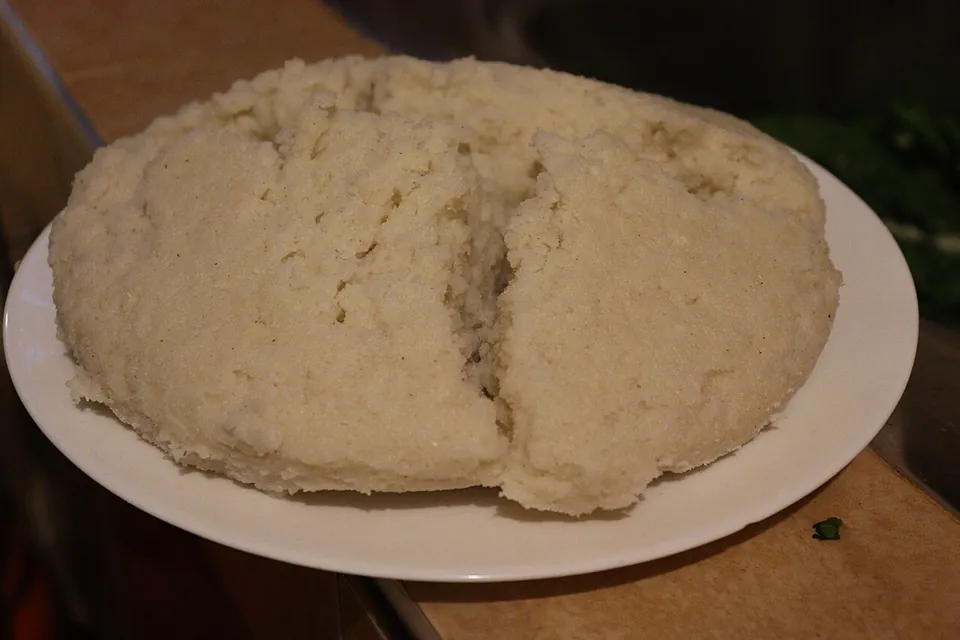
Ugali, the stiff porridge that feeds East Africa every day, is built around maize, a crop born in the Americas. Today's bowl is not an ancient African dish handed down from time out of mind; it is a staple of recent centuries, born when imported maize pushed aside the region's older grains.
Verification highlight popular claim → verdict → evidence
Ugali is often presented as an ancient African dish handed down since time out of mind. The porridge tradition is indeed old, but the maize in it is not: maize is a New World grain that reached the coast in the sixteenth and seventeenth centuries and spread inland as a staple only in the nineteenth and twentieth (Miracle 1965; McCann, Maize and Grace, 2005). The word itself first appears in print in Richard Burton's account of 1860 in the Journal of the Royal Geographical Society, which calls ugali "the thick porridge of boiled millet or maize flour, the staff of life in East Africa": millet or maize, the two still sharing one name because maize had not yet displaced the older grains.
The three gates
- Ingredient-supply gate
- The maize that makes present-day ugali is a New World grain. It reached the East African coast in the sixteenth and seventeenth centuries (Zanzibar around 1634) and became a staple inland only in the nineteenth and twentieth (Miracle 1965), so the maize porridge eaten today can be no older than that. The older porridges of sorghum and millet that came before it are treated separately, as its forerunner.
- Cooking-technique gate
- Grain is milled to flour and stirred into boiling water until it stiffens into a firm mass. Milling and hard stirring are all the dish asks for.
- Venue gate
- A home food, cooked by ordinary households as the everyday staple across a broad stretch of East and Southern Africa.
Overview
Ugali is an East African staple made by stirring grain flour into boiling water until it stiffens into a dense, dough-like porridge. A cook adds the flour to the pot and works it with a wooden paddle until it holds together in a firm mass. The habit of making this kind of porridge is older than maize itself: East African cooks once ground sorghum and millet, grains long grown in the region, into much the same thick porridge.
What changed the picture was the arrival of maize. Maize came originally from the Americas, and it reached the East African coast on Portuguese ships, arriving in the Zanzibar area as early as the sixteenth and seventeenth centuries. From there it took much longer still, into the nineteenth and twentieth centuries, before it became the daily staple of inland villages. Maize yielded more than the older grains, filling more stomachs from the same field, and that advantage let it slide in on top of the old porridge tradition.
The changeover was slow. A traveller crossing the East African interior in the mid-nineteenth century recorded ugali as a thick porridge cooked from millet or maize flour. Even then, in other words, the same name covered both a millet porridge and a maize porridge; maize had not yet displaced the older grains. Over time maize took the leading role, and the maize-flour porridge we know as ugali today spread across the region.
Ugali therefore has two layers: an old way of cooking porridge, and a new lead ingredient, maize, that replaced what went into it. Set the older millet-and-sorghum porridge apart as an earlier chapter, and today's dish comes into focus: a maize porridge that has put down deep roots as an everyday food across East and Southern Africa, the product of an imported crop rewriting an established way of eating.
How we know
Ugali often comes wrapped in a familiar line: that it is an ancient African dish, native to the land since time immemorial. That claim of deep local antiquity circulates widely in tourist guides and in popular books that celebrate national dishes.
But it misses something. The habit of cooking thick porridge is indeed old, yet the lead ingredient in today's ugali, maize, is a New World crop that reached East Africa only from the sixteenth century onward. In an East Africa that had no maize, a maize porridge like ugali had no way of existing. The line that today's ugali descends unchanged from antiquity confuses the old millet-and-sorghum porridge with the later maize porridge that took its name.
A vivid piece of testimony helps set the record straight. In 1860 the explorer Richard Burton, travelling the East African interior, set down one of the early printed appearances of the word ugali (The Lake Regions of Central Africa, Journal of the Royal Geographical Society Vol. XXIX), describing it as a thick porridge of boiled millet or maize flour, the staff of life in East Africa. The telling phrase is millet or maize: as late as 1860 ugali could still be made from either grain, which means maize had not yet fully replaced the older ones. A traveller who was there records, in a single line, a dish whose contents were not yet fixed.
So how did today's ugali actually come about? The leading scholarly view holds that the older sorghum and millet porridge provided the foundation, and that maize, arriving from the sixteenth century onward, replaced those grains on the strength of its higher yield to form the dish we know (Miracle's study of the spread of maize in Africa, 1965; McCann's history of maize, 2005). The porridge itself is genuinely old. But the maize-porridge form we recognize spread only after maize had taken hold in East Africa. Set the claim of great antiquity aside, and what remains is a story of recent centuries: an older grain porridge gradually rewritten by an imported crop.
The full set of origin theories and the detailed verification log — traceable all the way to their sources — are available on the Japanese edition.
See the full origin theories and verification log (Japanese) →
Related dishes
Lineage Family, predecessor, variants
Shares the key ingredient
- Tamale (tamal)MexicoC
- CornbreadSouthern United StatesC
- ArepaColombia / VenezuelaC
- Indigenous maize proto-layer (cornbread precursor: corn pone / ashcake)North America (Indigenous maize-cultivation range)B
- PupusaEl SalvadorC
- GritsAmerican SouthB
- PozoleMexicoC
- Proto-pozole (pre-pork pre-Columbian ceremonial pozole: ritual meats such as turkey/dog with nixtamalized maize proto-layer)Mesoamerica (pre-Columbian Mexico)C
- Indigenous corn-dough dish (humita family)Araucanía (Chile)B
- Brunswick stewSouthern United StatesC
- NachosPiedras Negras (Northern Mexico)B
- MukimoKenya (Kikuyu country)C
- PanuchoYucatán (Mexico)C
- PapSouth AfricaB
- Mukbil polloYucatán (Mexico)C
- KenkeyGhanaC