All dishes / ラテンアメリカ
Tamale (tamal) Period BOrigin theory CVerified
Some fields (dish name, region and gates) are shown from the Japanese-edition data.
That the Mesoamerican steamed dish tamales was in Indigenous hands long before Europeans arrived is beyond doubt. But the familiar taglines—'one of the world's oldest dishes, born eight thousand years ago,' 'first made by a goddess'—are tales that no source supports.
Verification highlight popular claim → verdict → evidence
Myth: tamales are 8,000-10,000 years old, tracing to an Aztec creation myth (Tzitzimitl sacrificing her grandson). Verdict: this conflates the age of maize/teosinte cultivation with the much later first appearance of the tamale itself in the record (San Bartolo murals, c.100 BC-AD 100; Teotihuacan residue analysis, c.300-350 CE). Independent evidence -- imagery (Taube 2004), archaeological residue analysis (Cagnato et al. 2025), and the Florentine Codex -- converges on a genuine pre-Columbian Mesoamerican indigenous origin, even though which specific civilization was first (Olmec/Maya/Toltec) remains unsettled.
The three gates
- Ingredient-supply gate
- The lead ingredient, maize, is native to Mesoamerica. No arrival constraint applies to the limiting ingredient.
- Cooking-technique gate
- Dough preparation and steaming via nixtamalization (lime treatment).
- Venue gate
- From ritual/communal offering food to everyday food
Overview
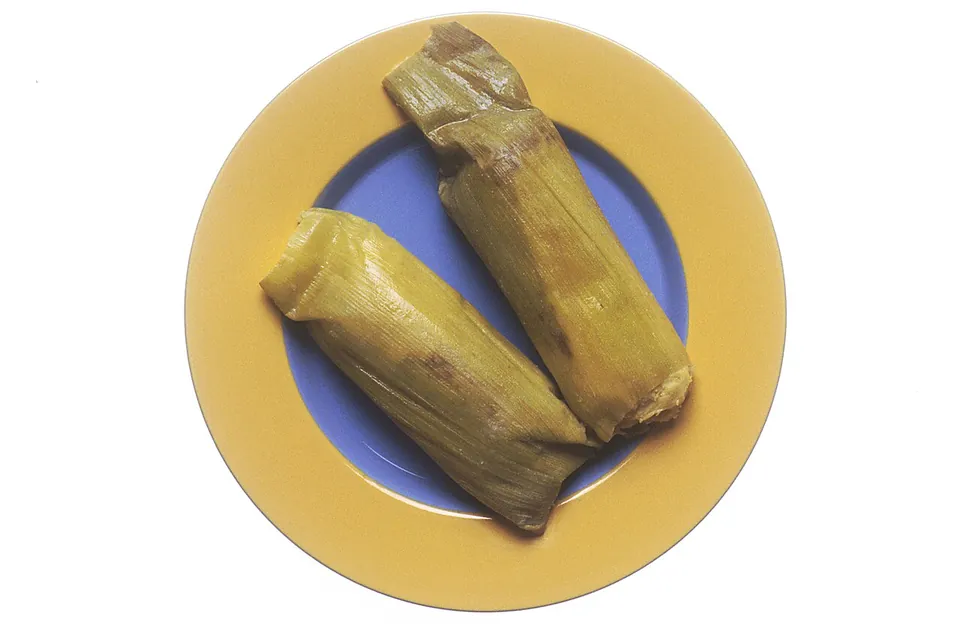
A tamale is a parcel of corn dough wrapped around a filling and steamed in its husk, a dish of Mesoamerica including Mexico. It was made as an offering for ritual, and as food to carry on journeys or into the fields, before it came down to the everyday table.
The corn at its centre is a crop native to Mesoamerica. From the time people settled this land and began to grow it, the main ingredient was long at hand.
The dough owes its existence to one piece of know-how. When corn is soaked in water mixed with lime and then ground, the skins of the kernels loosen, the dough binds well, and it takes on a quality suited to steaming. This treatment was already practised on the Pacific coast of Guatemala in the second millennium BC, and the tamale's dough stands on that old technique. The plainness of wrapping and steaming meant that the tamale was never confined to a particular court or class; it spread as food of the community.
How we know
Tamales carry two things worth pausing over: a tale to be unmade, and the line between what is known and what is not.
Take the tale first. Aztec myth tells that the goddess Tzitzimitl sacrificed her grandchild to make the first tamale. And a popular tagline circulates widely: that the tamale emerged eight to ten thousand years ago and is among the oldest dishes in the world. But a myth is not a record of how something began, and the figure of eight thousand years confuses the antiquity of corn cultivation itself with the time when the tamale as a dish appears in texts and images. The dish shows itself in the Maya murals at San Bartolo in Guatemala, dated around the turn of the first century AD, and in the traces of dough recovered from a dedicatory pit at Teotihuacan, dated to about the fourth century AD—the latter reported through recent synchrotron analysis (Cagnato et al. 2025).
On that footing, what is known is firm. The painted images, the dough residue from the pit, and the more than forty kinds of tamale recorded in the Florentine Codex compiled by Sahagún in the sixteenth century—three separate lines of evidence, image, material, and text, converge on the single point that Indigenous people were making this dish.
What stays unsettled is what lies beyond. Whether the Olmec, the Maya, or the Toltec made it first, and how far back it reaches—the sources disagree on both the date and the maker, and no single answer settles. The tamale comes down to us with the certainty of its origin and the vagueness of its founding date living side by side.
The full set of origin theories and the detailed verification log — traceable all the way to their sources — are available on the Japanese edition.
See the full origin theories and verification log (Japanese) →
Related dishes
Shares the key ingredient
- UgaliEast Africa (Kenya / Tanzania)C
- CornbreadSouthern United StatesC
- ArepaColombia / VenezuelaC
- Indigenous maize proto-layer (cornbread precursor: corn pone / ashcake)North America (Indigenous maize-cultivation range)B
- PupusaEl SalvadorC
- GritsAmerican SouthB
- PozoleMexicoC
- Proto-pozole (pre-pork pre-Columbian ceremonial pozole: ritual meats such as turkey/dog with nixtamalized maize proto-layer)Mesoamerica (pre-Columbian Mexico)C
- Indigenous corn-dough dish (humita family)Araucanía (Chile)B
- Brunswick stewSouthern United StatesC
- NachosPiedras Negras (Northern Mexico)B
- MukimoKenya (Kikuyu country)C
- PanuchoYucatán (Mexico)C
- PapSouth AfricaB
- Mukbil polloYucatán (Mexico)C
- KenkeyGhanaC