All dishes / 北米
Cornbread Period BOrigin theory CVerified
Some fields (dish name, region and gates) are shown from the Japanese-edition data.
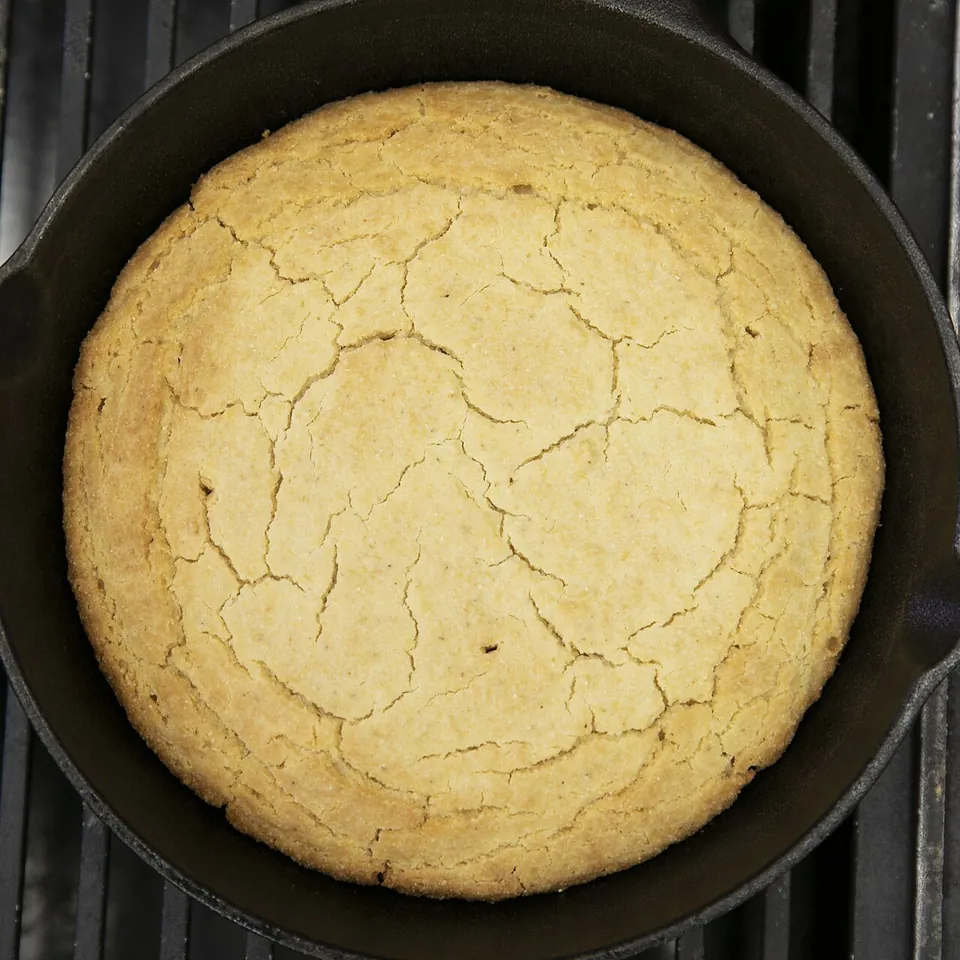
The claim that cornbread was "invented by African Americans" or "invented by the Scotch-Irish" credits one culture with what was really the work of several. Indigenous cornmeal cooking formed the base; enslaved Africans and Southern settlers each added to it. And the plain unleavened pone belongs to a different stage than the risen cornbread we picture today.
Verification highlight popular claim → verdict → evidence
Often told as a single-culture invention (credited solely to either African American or Scots-Irish cooks), but the sources point to a multicultural process: an Indigenous maize-meal base, adapted by enslaved African Americans and carried on by Southern settlers, later modernized with chemical leavening. Key sources: Amelia Simmons, American Cookery (1796); the Oxford English Dictionary (cornbread, 1775); Allison Burkette on the Algonquian origin of the word pone.
The three gates
- Ingredient-supply gate
- Maize is native to North America; Indigenous peoples cultivated and ground it since ancient times, so there is essentially no hard floor set by ingredient access. The real limiting factor is leavening and cooking technique.
- Cooking-technique gate
- Grinding coarse cornmeal and baking it (on a griddle or in an oven). The now-familiar risen style became common only once chemical leaveners spread in the 19th century.
- Venue gate
- home kitchens. Social common people. everyday food. Southern settlers and African Americans.
Overview
Cornbread settled into the American South during the colonial period of the seventeenth and eighteenth centuries, carried forward from Indigenous cooking. The plain form's arrival in the South is well grounded, though when the modern risen version came together is less clear.
Maize, the main ingredient, was a long-established crop in North America, grown by Indigenous peoples and ground into meal for eating well before Europeans arrived. Wheat grew poorly in the Southern climate, so European settlers took up this cornmeal cooking and made it their own. Coarse cornmeal baked on a griddle or in an oven yields a plain bread. When chemical leavening spread in the nineteenth century, a risen version joined the older one.
The setting is the Southern household and the countryside. The unleavened form, cornmeal and water, took root in everyday life as a staple side dish and a dish brought to church gatherings. Its makers were not one people: enslaved Africans adapted it, and Southern settlers carried it on. Where the local maize, cooking inherited from Indigenous peoples, and the daily life of ordinary Southerners overlapped, cornbread took shape.
How we know
Cornbread is often trailed by an argument over who invented it. It is an African American dish, some say; no, it is Scotch-Irish. Pinning its origin on any single culture is folklore that the record does not support. The reality is more tangled. Indigenous cornmeal cooking formed the base; enslaved Africans adapted it; Southern settlers carried it on; and chemical leavening later modernized it. There was no lone inventor, but a sequence of groups each adding a hand.
The base leaves traces in the language. "Pone" comes from the Algonquian apan and turns up as appone and ponap in records from the 1610s (John Smith, 1612; William Strachey, 1612). The linguist Allison Burkette followed how the word was borrowed again and again along the Atlantic coast, at each fresh contact with Indigenous peoples. The compound "cornbread" itself is first recorded by the Oxford English Dictionary in 1775 (Janet Schaw), and the first printed recipe using cornmeal appears in 1796, in Amelia Simmons's American Cookery, the first cookbook by an American. Called johnnycake and Indian slapjack, it shows that settlers had fixed cornmeal cooking into print culture by the close of the eighteenth century at the latest.
A second source of confusion is mistaking the age of the genre for the age of the current form. The plain unleavened pone, ashcake, and hoecake belong to an old layer reaching back to the colonial period. But the risen cornbread a modern reader pictures is another thing. Making a batter rise takes a chemical leavener. The first, pearl ash (potassium carbonate), was in use from about 1780 to 1840; baking soda and saleratus followed in the 1840s and 1850s; Horsford's baking powder was patented in 1856; and wide acceptance came only late in the nineteenth century. The modern version, buttermilk or eggs raised with baking soda, could not have come into being until that leavening had spread.
So cornbread has no single birth year. The plain pone made with local maize reaches back to the colonial period; the risen modern form took shape only after the nineteenth-century leaveners. To trace its origin to one inventor or one culture flattens a layered history.
The full set of origin theories and the detailed verification log — traceable all the way to their sources — are available on the Japanese edition.
See the full origin theories and verification log (Japanese) →
Related dishes
Lineage Family, predecessor, variants
Shares the key ingredient
- UgaliEast Africa (Kenya / Tanzania)C
- Tamale (tamal)MexicoC
- ArepaColombia / VenezuelaC
- PupusaEl SalvadorC
- GritsAmerican SouthB
- PozoleMexicoC
- Proto-pozole (pre-pork pre-Columbian ceremonial pozole: ritual meats such as turkey/dog with nixtamalized maize proto-layer)Mesoamerica (pre-Columbian Mexico)C
- Indigenous corn-dough dish (humita family)Araucanía (Chile)B
- Brunswick stewSouthern United StatesC
- NachosPiedras Negras (Northern Mexico)B
- MukimoKenya (Kikuyu country)C
- PanuchoYucatán (Mexico)C
- PapSouth AfricaB
- Mukbil polloYucatán (Mexico)C
- KenkeyGhanaC