All dishes / ラテンアメリカ
Nachos Period AOrigin theory BVerified
Some fields (dish name, region and gates) are shown from the Japanese-edition data.
Many dishes have a disputed, unresolved origin, but nachos are the rare case whose inventor and date both come down to us. Even so, the notion that 'no rival origin story exists at all' has softened: later inquiry found the restaurant's name and the question of earlier precedents both wavering.
Verification highlight popular claim → verdict → evidence
Popular claim: nachos have a single, undisputed origin story. Verdict: largely confirmed but with unresolved detail -- around 1943 in Piedras Negras, Mexico, waiter Ignacio Anaya improvised fried tortillas topped with cheese and jalapenos for US military wives when the cook was away, an account corroborated by his son and later researchers. However, the exact restaurant is disputed (Victory Club vs. El Moderno, per a 1961 interview), and some accounts suggest the cheese-and-chip combination already existed informally in the border region before Anaya named and popularized it. Key sources: Texas Highways; Adan Medrano, citing anthropologist Mario Montano.
The three gates
- Ingredient-supply gate
- Corn and chili peppers were native New World crops. The limiting factor was the 20th-century pairing of fried tortilla chips with cheese.
- Cooking-technique gate
- Fried tortillas topped with melted cheese and quickly baked or broiled, a fast way to serve.
- Venue gate
- A snack served at a restaurant on the US-Mexico border for American customers.
Overview
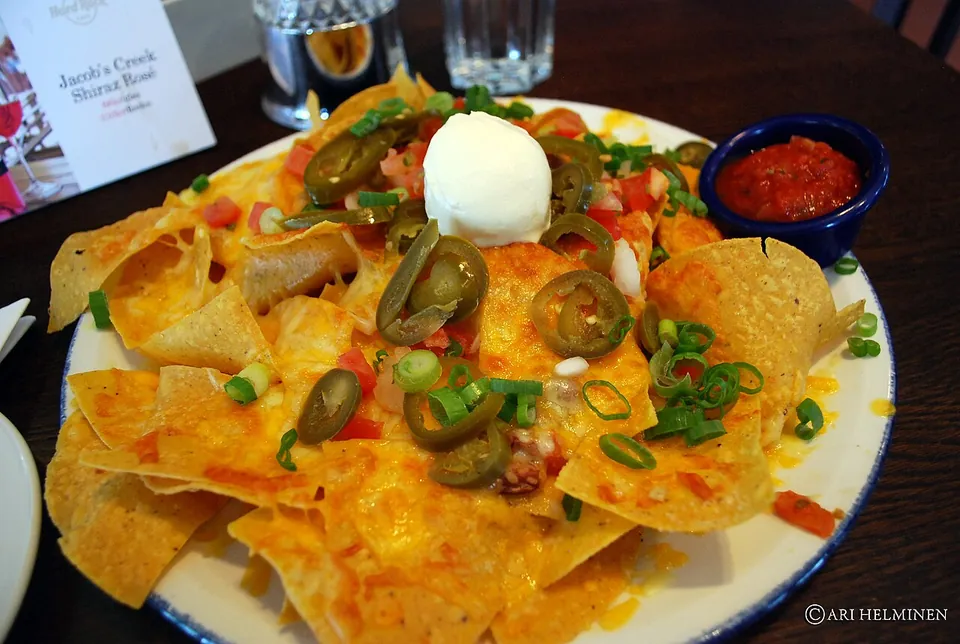
Nachos are a snack from northern Mexico: fried tortilla chips topped with melting cheese, scattered with jalapeño, and quickly heated. The dish took shape in the early 1940s, in a town right on the border between the United States and Mexico.
The corn and the chili peppers at its heart are old crops deeply rooted in the New World, on local tables from early on. That the dish still does not reach back before the twentieth century is because the pairing and serving method — frying tortillas into chips, adding melting cheese, and bringing it quickly to the guest — were first joined there. When Ignacio Anaya, caught without a cook, grated Wisconsin cheese over a plate of fried tortillas, laid jalapeño across the top, and slid it under the salamander to serve at once, that improvised plate drew those elements together for the first time.
The setting where it was served also tells its origins. It was born in a restaurant along the US–Mexico border, as a snack for guests coming from the United States. The border as a place, and the traffic of people moving across it, lie behind the making of this dish.
How we know
The origin of nachos fits neatly into a single anecdote. Around 1943, in the border town of Piedras Negras in Coahuila, Mexico, a party of women guests connected to the US military stationed at nearby Fort Duncan came in. The maître d'hôtel, Ignacio Anaya García, with no cook on hand, threw a plate together on the spot: fried tortillas grated over with Wisconsin cheese and topped with jalapeño, heated and served. It came to be called nachos after Nacho, the inventor's nickname.
This anecdote is not merely hearsay. The food anthropologist Mario Montaño interviewed Anaya himself, his son, and friends directly, leaving a chain of testimony that supports the inventor and the date of 1943. With both inventor and approximate date coming down in specific form, nachos are a rare instance of a clearly documented origin.
Even so, it is not seamless in every detail. The restaurant long named in the telling is the Victory Club, but Robb Walsh's The Tex-Mex Cookbook (2004), citing a 1961 interview with Anaya himself, holds that the setting was El Moderno. The restaurant's name wavers in the record. Montaño, further, read nachos as a 'deconstructed quesadilla': the pairing of fried tortilla with cheese was itself a local snack already present in the border region, and Anaya was the one who named it, reassembled it as a single dish, and spread it to the world. Neither Anaya's contribution nor the 1943 window is denied, but the strong claim that 'no rival origin story exists at all' loosens here.
The name's first appearance in print is another matter from the origin itself. The earliest known printing of the word nachos in English is in A Taste of Texas (1949), but the recipe there ran not under Anaya's name but under that of another person, Julian Cross. Anaya's own recipe would not reach print until St. Anne's Cookbook of 1954. The word's first appearance and the dish's origin, traced out, walk separate paths.
The full set of origin theories and the detailed verification log — traceable all the way to their sources — are available on the Japanese edition.
See the full origin theories and verification log (Japanese) →
Related dishes
Shares the key ingredient
- UgaliEast Africa (Kenya / Tanzania)C
- Tamale (tamal)MexicoC
- CornbreadSouthern United StatesC
- ArepaColombia / VenezuelaC
- Indigenous maize proto-layer (cornbread precursor: corn pone / ashcake)North America (Indigenous maize-cultivation range)B
- PupusaEl SalvadorC
- GritsAmerican SouthB
- PozoleMexicoC
- Proto-pozole (pre-pork pre-Columbian ceremonial pozole: ritual meats such as turkey/dog with nixtamalized maize proto-layer)Mesoamerica (pre-Columbian Mexico)C
- Indigenous corn-dough dish (humita family)Araucanía (Chile)B
- Brunswick stewSouthern United StatesC
- MukimoKenya (Kikuyu country)C
- PanuchoYucatán (Mexico)C
- PapSouth AfricaB
- Mukbil polloYucatán (Mexico)C
- KenkeyGhanaC