All dishes / 北米
Brunswick stew Period BOrigin theory CVerified
Some fields (dish name, region and gates) are shown from the Japanese-edition data.
Brunswick stew is a Southern American community dish that Virginia and Georgia both claim to have invented. One claim collapses under an 1871 restaurant menu; the other rests on a single letter written in 1907.
Verification highlight popular claim → verdict → evidence
Rival claims: the dish originated in Brunswick County, Virginia (1828) or in Brunswick, Georgia (1898). Verdict: both rejected as later-invented traditions lacking contemporary evidence -- the earliest print use of 'Brunswick stew' is an 1845 Charleston Southern Patriot piece, and an 1871 Georgia restaurant menu itself labels the dish 'Virginia Brunswick Stew,' refuting the Georgia claim outright. Who first attached the name 'Brunswick' remains unknown (David S. Shields, food historian).
The three gates
- Ingredient-supply gate
- Corn, beans, tomatoes, and hunted meat (squirrel, game, chicken) are all New World natives long available in the American South (corn naturalized roughly 1000 years ago); the food-supply gate is always satisfied. The limiting factor is not an ingredient but the venue -- becoming fixed as a named community dish.
- Cooking-technique gate
- Long simmering in an iron kettle (outdoor cauldron).
- Venue gate
- A communal dish served at Southern regional gatherings and hunting-camp cookouts.
Overview
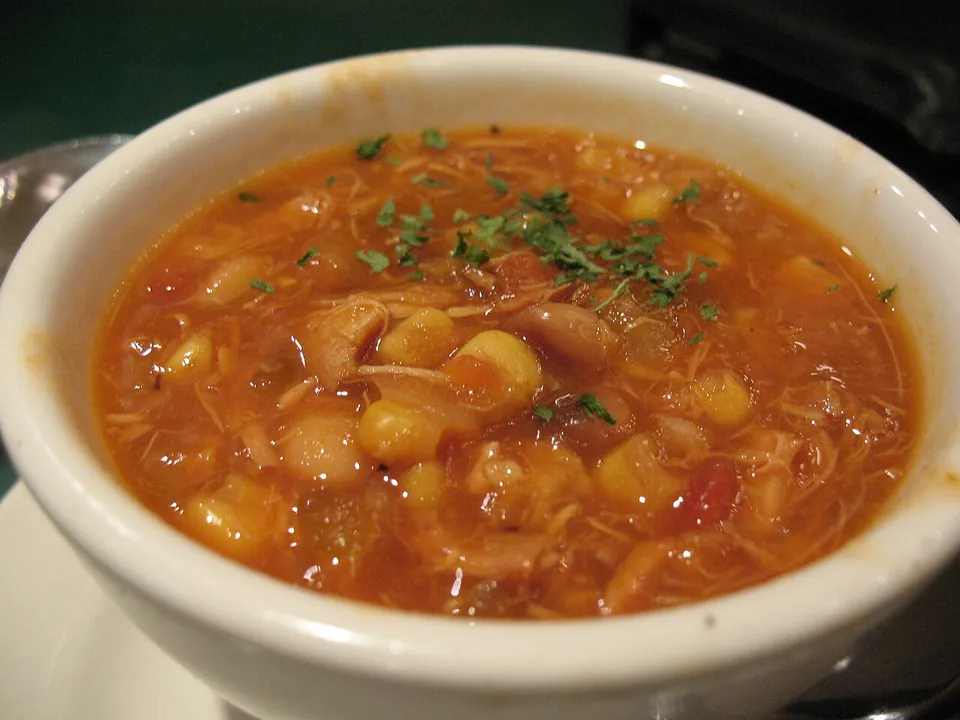
Brunswick stew simmers corn, lima beans, and tomatoes together with chicken and other meats in a large iron pot, cooked slowly over an open fire. It took root in the American South as the food of community gatherings and hunting parties, ladled out of a big kettle for a crowd. In its older form the meat came from the hunt—squirrel and small game—and chicken became the standard only later.
The corn, beans, tomatoes, and game that go into the pot were all long-established products of the American South. Corn in particular had roughly a thousand years of history in the region and was on everyday tables from early on. So the stew itself is old: cooks in the South had been making this kind of long-simmered pot for generations. What set it apart as a single, named dish came later—when people began calling it "Brunswick stew" and gathering around it, again and again, at hunts and community feasts. The name and the occasion, repeated season after season, fixed the dish in the South's food culture.
How we know
Two states have long claimed to have invented Brunswick stew.
The Virginia story places its origin in Brunswick County in 1828, when Jimmy Matthews, an enslaved camp cook, is said to have made a squirrel stew for his enslaver, Creed Haskins, and the county name passed to the dish. In 1988 the Virginia legislature endorsed this account by proclamation. Yet no contemporary record supports the 1828 event. The whole story rests on a single letter written by a man named Brodnax in 1907—nearly eighty years after the fact.
Georgia, for its part, has displayed a plaque claiming that the first pot of Brunswick stew was cooked in a twenty-five-gallon kettle on St. Simons Island on July 2, 1898. But Georgia's own records undo the claim. As the food historian David S. Shields (Carolina Distinguished Professor at the University of South Carolina) has shown, the earliest surviving instance of the name "Brunswick stew" in print appears in the Charleston newspaper the Southern Patriot in 1845—more than fifty years before Georgia's 1898 date. Moreover, a menu issued in 1871 by Georgia's own Med Henderson restaurant listed the dish as "Virginia Brunswick Stew," that is, as a Virginia dish. Georgia was not where the stew began; it was a place that took the dish up. A contemporary account that a Georgia barbecue in 1880 had no Brunswick stew at all (from J. L. Herring) fits the same picture.
What is certain is that by 1845 the name was already in print, and by the following year, 1846, it was a settled label—described as what "some call Brunswick stew." The dish itself—a community pot of seasonal vegetables with corn, beans, and squirrel or game—was common across the Southeast long before it was named. In Shields's phrase, the quarrel between the two states is a contest "for second place." Both the Virginia 1828 origin and the Georgia 1898 origin are set aside, and what remains is a single unanswered question: who first attached the name "Brunswick" to this old stew, and when. That question is still open.
The full set of origin theories and the detailed verification log — traceable all the way to their sources — are available on the Japanese edition.
See the full origin theories and verification log (Japanese) →
Related dishes
Shares the key ingredient
- UgaliEast Africa (Kenya / Tanzania)C
- Tamale (tamal)MexicoC
- CornbreadSouthern United StatesC
- ArepaColombia / VenezuelaC
- Indigenous maize proto-layer (cornbread precursor: corn pone / ashcake)North America (Indigenous maize-cultivation range)B
- PupusaEl SalvadorC
- GritsAmerican SouthB
- PozoleMexicoC
- Proto-pozole (pre-pork pre-Columbian ceremonial pozole: ritual meats such as turkey/dog with nixtamalized maize proto-layer)Mesoamerica (pre-Columbian Mexico)C
- Indigenous corn-dough dish (humita family)Araucanía (Chile)B
- NachosPiedras Negras (Northern Mexico)B
- MukimoKenya (Kikuyu country)C
- PanuchoYucatán (Mexico)C
- PapSouth AfricaB
- Mukbil polloYucatán (Mexico)C
- KenkeyGhanaC