All dishes / ラテンアメリカ
Salbutes Period COrigin theory BVerified
Some fields (dish name, region and gates) are shown from the Japanese-edition data.
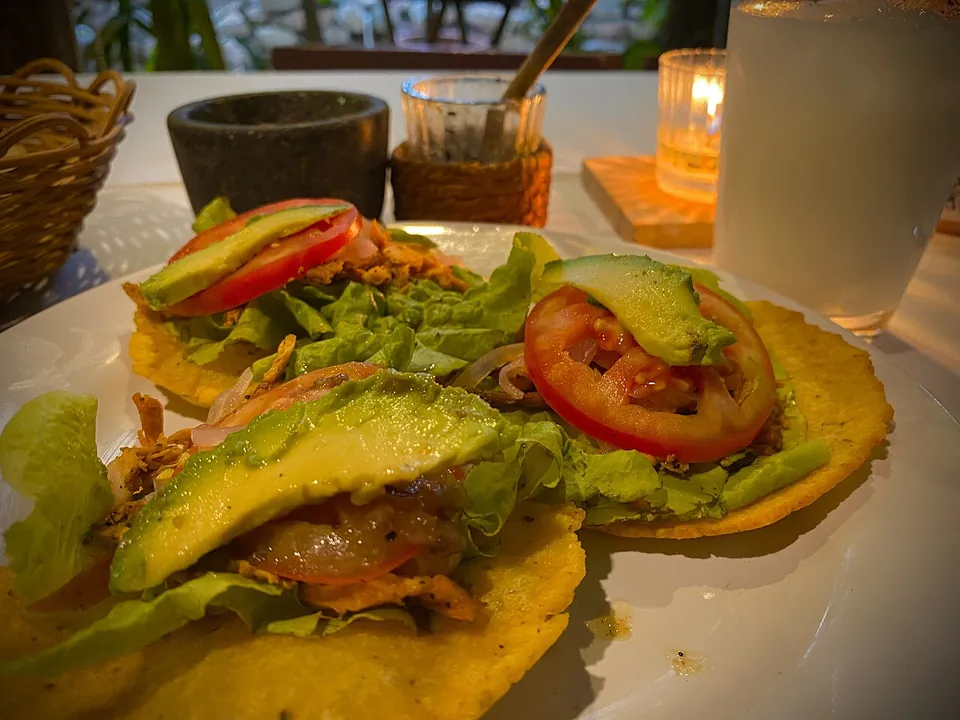
A small, puffed tortilla, eaten hot off the fryer on a Yucatán street corner. The salbute was born on Maya land, where corn had long been the staple, when pork fat and poultry that arrived from across the sea were laid over that older foundation.
Verification highlight popular claim → verdict → evidence
Salbutes rest on two layers: a pre-Hispanic Maya base of nixtamalized corn masa, and a colonial-era addition of frying in pork lard, which sets the lower bound for the current puffed-fried form. The common claim that salbutes are simply 'panuchos without beans' is rejected -- the two are distinct techniques and dishes (panuchos stuff beans into a pre-baked tortilla before frying; salbutes are fried while the dough is still raw and unstuffed) -- though no single inventor or origin point for salbutes has been identified (Real Academia Espanola; Larousse Diccionario Enciclopedico de la Gastronomia Mexicana; Miguel Guemez Pineda).
The three gates
- Ingredient-supply gate
- Corn and turkey were native and available in the pre-Hispanic era; versions with pork and other colonial-era ingredients appear only after European contact.
- Cooking-technique gate
- Frying puffed masa dough (distinct from panuchos' bean-stuffed technique).
- Venue gate
- Street food and home snacks.
Overview
The salbute is a snack loved on the streets and in the homes of Mexico's Yucatán Peninsula. A round of dough the size of a palm is fried until it puffs, then topped with chicken, turkey, venison or pork, along with lettuce, tomato and pickled red onion. The name comes from the Maya language: zaal, light, joined with but, filling, as the dictionaries have it. That word light points to the airy mouthfeel of the puffed, fried dough.
At its foundation lies corn, long rooted in this land. The Maya made corn their staple, softening it in an alkaline cook with lime, grinding it into masa by the nixtamal method, and setting thin tortillas on the daily table. Corn itself was an old crop grown here, and turkey too was a native fowl, raised and eaten from early on.
The present form, in which the dough is fried and puffed, settled later. Pork, and its fat, manteca, brought to Yucatán after the Spanish arrived, made this frying possible. To the once-baked tortilla a new move was added, the fry, and with the pork and poultry topping, the shape we call salbute was set. The craft of making the tortilla is Indigenous, but today's dish, fried and puffed and eaten so, was born where these two streams met.
A close cousin is the panucho, but it is a different dish. The panucho is a tortilla baked first, stuffed with black beans, then fried; the salbute is fried at the dough stage and puffed, with no beans inside. That difference, the beans and the way of puffing, is what tells the two apart.
How we know
The salbute is often described as a panucho without the beans, a simplified panucho. But from the side of the dictionaries and of food history, that reading is not accurate.
The panucho carries an origin tale of its own: that a man known as Don Hucho began it at La Ermita de Santa Isabel in Mérida. The salbute has no matching story of a first maker. It is not a dish that traces to a single founder, but one that spread across the region as everyday food of the people. A more recent claim names the village of Seyé as a single birthplace, tied to a salbute fair, but even the account that reports it holds back, and it credits a group of market women rather than one inventor, so it does not fix a single point of origin.
What separates the two dishes is the order of the cooking itself. The panucho takes a baked tortilla, packs black beans inside, then fries it. The salbute is fried while still dough and puffed, with no beans. Even the name, that light filling, points not to stuffing beans but to the light rise of the dough. The dictionary of the Real Academia Española, the Larousse Diccionario enciclopédico de la Gastronomía Mexicana, and Miguel Güémez Pineda, a linguist of Yucatecan speech, all agree on the same two-layered making: pre-Hispanic corn dough and the colonial-era fry in pork fat, laid one over the other. Once the confusion with the panucho is undone, where the very first salbute was made still cannot be fixed in the record.
The full set of origin theories and the detailed verification log — traceable all the way to their sources — are available on the Japanese edition.
See the full origin theories and verification log (Japanese) →