All dishes / 西欧
Stroopwafel Period BOrigin theory CVerified
Some fields (dish name, region and gates) are shown from the Japanese-edition data.
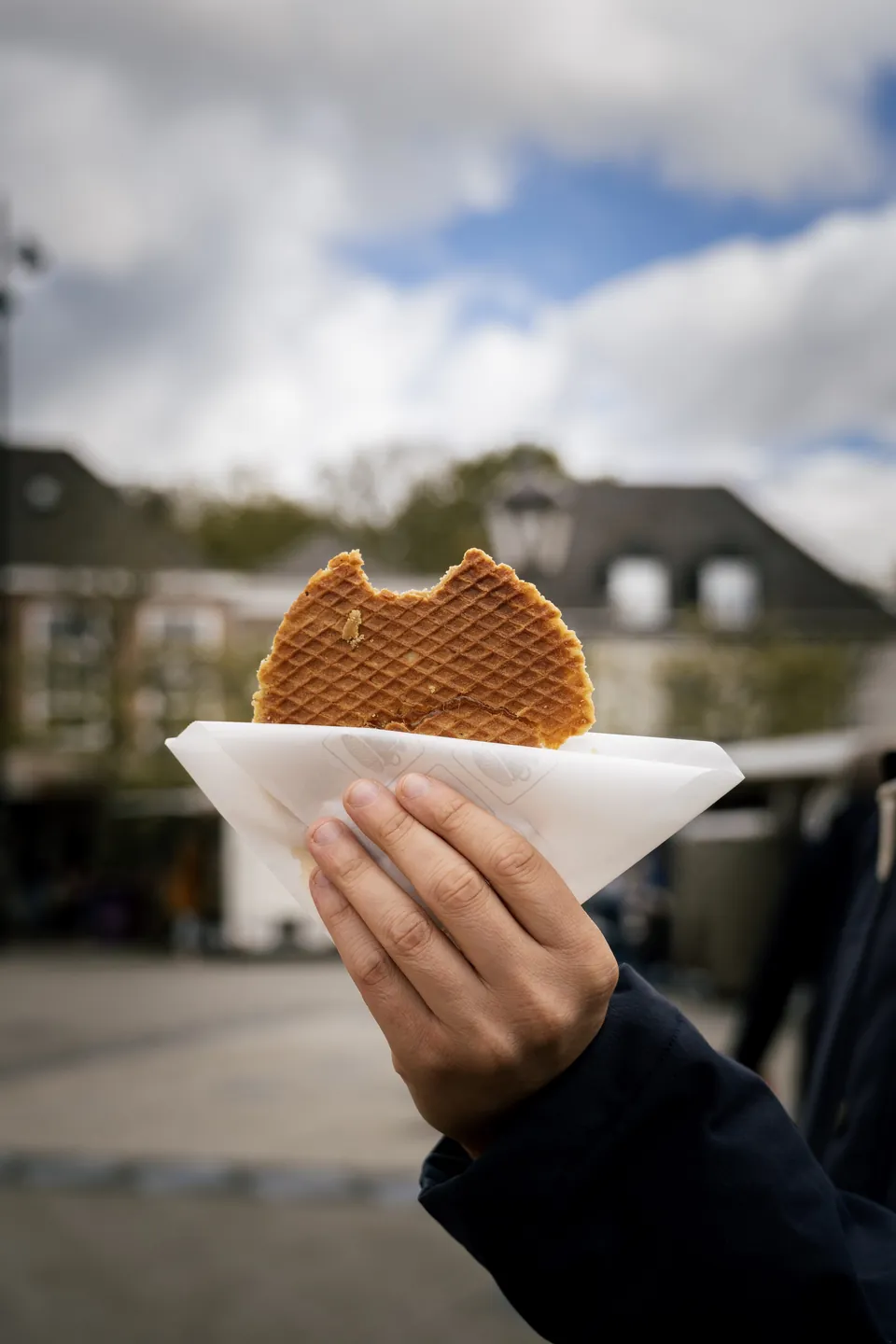
A thin waffle split into two disks with an amber syrup pressed between them—this treat from Gouda in the Netherlands comes with a famous story that a single craftsman invented it in 1810. But when Gouda's own historians looked into it, the anecdote did not add up.
Verification highlight popular claim → verdict → evidence
No surviving source has been confirmed for the earliest telling of the Gouda-origin story, so the founding period and exact details still call for further documentation.
The three gates
- Ingredient-supply gate
- Wheat was locally available. The dish depended on a cheap, widespread supply of cane molasses/caramel syrup.
- Cooking-technique gate
- Baking thin waffle wafers and sandwiching syrup between two of them.
- Venue gate
- Gouda's confectioners and markets.
Overview
The stroopwafel is a baked treat born in the old Dutch city of Gouda. A thinly baked waffle is split horizontally into two disks while still hot, and a sweet caramel-like syrup (stroop) is pressed between them. Set over a hot drink, the steam softens the syrup just enough, and it seeps into the waffle.
Wheat, the backbone of the batter, was a long-established staple on Dutch tables. Alongside it, amber syrup began to circulate in everyday kitchens: cane-derived molasses and caramel syrup became cheap and easy to obtain, and Gouda's pastry bakers glued together offcuts and crumbs from bakeries with this syrup to make an inexpensive sweet. The oldest surviving recipe, from 1840, is exactly such a thing made from scraps—an armenkoeken, or "poor man's cake."
In Gouda the groundwork that supports this treat fell into place step by step. A factory supplying syrup opened in 1837, and in 1853 the town's first gasworks began operating to provide the gas needed to bake the batter evenly. The first pastry baker to appear clearly in the record is Adriaan de Groot, who began working with irons for syrup waffles in 1864. In this way the form of the treat took shape in mid-nineteenth-century Gouda.
How we know
The stroopwafel comes with an invention tale told for generations. The Gouda baker Kamphuisen, in 1810, is said to have baked crumbs and offcuts in a waffle iron, split them into two, and pressed a sweet syrup between them—the beginning of it all. It is a tidy story, complete with the inventor's name and the year of its birth.
But as Gouda's local historians looked into the account, seams began to show. First, the inventor's name itself wavers—sometimes Gerard, sometimes Pieter Willem, never settling—and the year 1810 and the claim of an individual invention trace back only to the origin story that the still-running Kamphuisen family brand tells about itself, with no independent record to support it from behind. De Korte (2012) further points out that baking this treat requires a gas oven. Gouda's first gasworks did not appear until 1853, which does not square with an invention date of 1810. The first craftsman to appear clearly in the record, as Scheygrond (1988) traced, comes only as late as Adriaan de Groot in 1864.
So the local historians do not tell it as the work of a single genius inventor. There was a reason the record is thin. The guild that had registered craftsmen had already been abolished, the pastry shops were small independent businesses that left no litigation records, and Gouda of the time had not even a local newspaper. The only firm footholds are the syrup factory of 1837, the gasworks of 1853, the oldest recipe of 1840, and the craftsman record of 1864. It cannot be ruled out that the treat was made before Kamphuisen set up shop, but the inventor cannot be narrowed to a single person. The familiar 1810 invention tale recedes as a founding legend arranged after the fact, and the true beginning remains in the fog.
The full set of origin theories and the detailed verification log — traceable all the way to their sources — are available on the Japanese edition.
See the full origin theories and verification log (Japanese) →
Related dishes
Shares the key ingredient
- PierogiPolandC
- EmpanadaRío de la Plata (Argentina)C
- BliniRussiaB
- PirozhkiRussiaB
- CheburekiCrimea (Crimean Tatar)C
- BelyashiVolga-Ural (Tatar / Bashkir)C
- JalebiNorthern IndiaB
- Fortune cookieCalifornia (USA)C
- LamingtonQueensland (Australia)C
- ChimichangaTucson, Arizona (USA)C
- BuuzMongoliaB
- YantıkCrimea (Crimean Tatar)C
- VarenykyUkraineC
- MandaziEast Africa (Swahili Coast)C
- LángosHungaryC
- Daoxiaomian (knife-cut noodles)Shanxi (China)C
- KhuushuurMongoliaB
- Dobos torteHungaryB
- SambusaEast Africa (Swahili Coast)B
- SarburmaCrimea (Crimean Tatars)B
- ThenthukTibet / NepalB
- ShumaiGuangzhou (China)B
- Jiaozi (gyoza)ChinaC
- Hohhot shaomaiHohhot (China)B
- OliebollenNetherlandsC
- MarquesitaYucatán (Mexico)D
- Halwa puriLahore (Pakistan)D
- Roti prataSingaporeB
- SopaipillaNew Mexico (USA)C
- CoyotaSonora (Northern Mexico)C
- RunzaMidwestern United StatesB
- BanshMongoliaC
- Kashyk-ash (къашыкъ-аш, Crimean Tatar spoon-dumpling soup)Crimea (Crimean Tatar)C
- KulebyakaRussiaB
- Spring roll (Chinese)ChinaC
- ChuchvaraUzbekistan (Samarkand / Fergana)C
- DamperAustraliaC
- SamsaCentral AsiaC
- HalushkyUkraineC
- BanitsaBalkans (Bulgaria)C
- Har gowGuangzhou (China)C