All dishes / 西欧
Speculaas Period COrigin theory BVerified
Some fields (dish name, region and gates) are shown from the Japanese-edition data.
The wooden mould presses a mirror-image into the dough, so the name must come from the Latin speculum, "mirror"—one of several charming stories about the origin of the word speculaas. All of them are after-the-fact inventions built on the look of the spelling, and linguists have set them aside.
Verification highlight popular claim → verdict → evidence
Folk etymologies linking the name to Latin speculum ('mirror', for the mirror-image the mold leaves in the dough), species/specerij ('spice'), or speculator ('overseer', for the all-seeing bishop St. Nicholas) are rejected by linguists as after-the-fact guesses from the spelling. The scholarly consensus instead derives speculaas from the older form speculatie, from Latin speculatio ('contemplation', later 'amusement'), first attested in 1749 in reference to the pastry. The carved-mold spiced biscuit itself is generally held to have taken its current form in 17th-century Flanders, once VOC trade made cinnamon, clove and nutmeg abundant enough for a spice-heavy recipe -- though, since this dating rests on retrospective inference rather than a strictly contemporary source, the exact century of origin is not fully settled.
The three gates
- Ingredient-supply gate
- Wheat was native; the defining spices such as cinnamon reached the Low Countries in abundance through Dutch East India Company (VOC) trade, which was the limiting factor.
- Cooking-technique gate
- Shaped in a carved wooden mold and baked.
- Venue gate
- A festive treat for Sinterklaas (St. Nicholas' feast), made at home and sold by bakers.
Overview
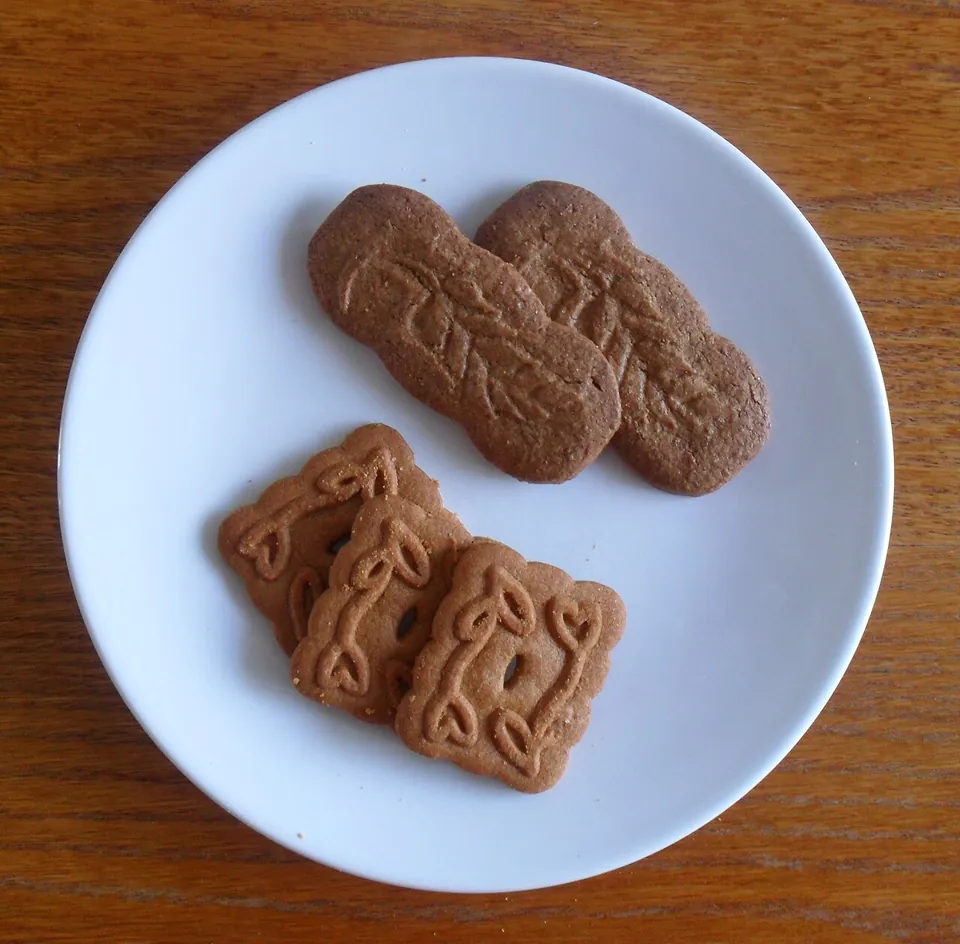
Speculaas is a thin, spiced biscuit stamped with a pattern from a carved wooden mould, baked in the Netherlands and Belgium for the feast of St Nicholas (Sinterklaas). It carries a strong scent of cinnamon and cloves, and its dough is made with sugar and wheat flour.
Wheat had long been grown in the Low Countries, and the technique of shaping dough in a wooden mould and baking it reaches back to fifteenth-century Flanders. What arrived in the seventeenth century was the spice. The Dutch East India Company (the VOC) auctioned cloves and nutmeg from the Moluccas and cinnamon from Ceylon in Amsterdam and shipped them across Europe in quantity. Once cinnamon and cloves reached Low Country kitchens in abundance, a spiced biscuit worked through with them could be baked in the form we know today.
That current form is thought to have taken shape in the seventeenth-century Spanish Netherlands (Flanders). The earlier sweets, made with rye flour and honey, gave way in this period to a dough of wheat flour and sugar. Lancelot de Casteau's L'Ouverture de cuisine (1604) already records a spiced biscuit. The seventeenth-century dating, however, is inferred backward from later texts and rests on thin primary evidence, so the date of its emergence is not firmly fixed. Baked as a festive sweet in homes and confectioners' shops, it became bound up with the feast of St Nicholas and took root there.
How we know
Several appealing stories have been handed down about where the name speculaas comes from. One traces it to the Latin speculum, "mirror"—because the mould casts a mirror-image of its pattern into the dough. Another links it to species or specerij, "spice." A third points to the Latin speculator, "the one who sees all," meaning Nicholas the bishop. Each chimes nicely with the shape of the biscuit and with the feast, and each sounds convincing.
Yet all of them were read back afterward from the look of the spelling. In his 1985 study "Hoe is 'speculaas' ontstaan?", the Dutch linguist F. de Tollenaere set aside speculum, speculator, species, along with spek+klaas ("Nicholas's bacon") and the notion of a boy bishop's inspection tour, dismissing them one by one as vernuftspelletjes—clever little word-games. The etymological reference etymologiebank likewise calls the speculum reading "highly unlikely" and finds the spek+klaas reading unsupported.
So what is the real source? A plainer but firmer answer remains. Speculaas goes back to the older form speculatie, which belongs with Middle Dutch speculatie ("contemplation," and later "amusement, fancy")—a word in the line of Latin speculatio. In the sense of a baked confection, speculatie appears in a text of 1749. The form speculaas itself is a newer spelling that arose in Holland at the end of the nineteenth century, when a dialect ending was mistaken for a diminutive and dropped. Not a mirror, not a bishop, but a word meaning "amusement" lies at the heart of this festive sweet's name. The dates 1749 and the late nineteenth century mark the first appearances of the word, not of the biscuit; the moulded spiced biscuit itself was being baked well before them.
The full set of origin theories and the detailed verification log — traceable all the way to their sources — are available on the Japanese edition.
See the full origin theories and verification log (Japanese) →