All dishes / 東欧
Blini Period BOrigin theory BVerified
Some fields (dish name, region and gates) are shown from the Japanese-edition data.
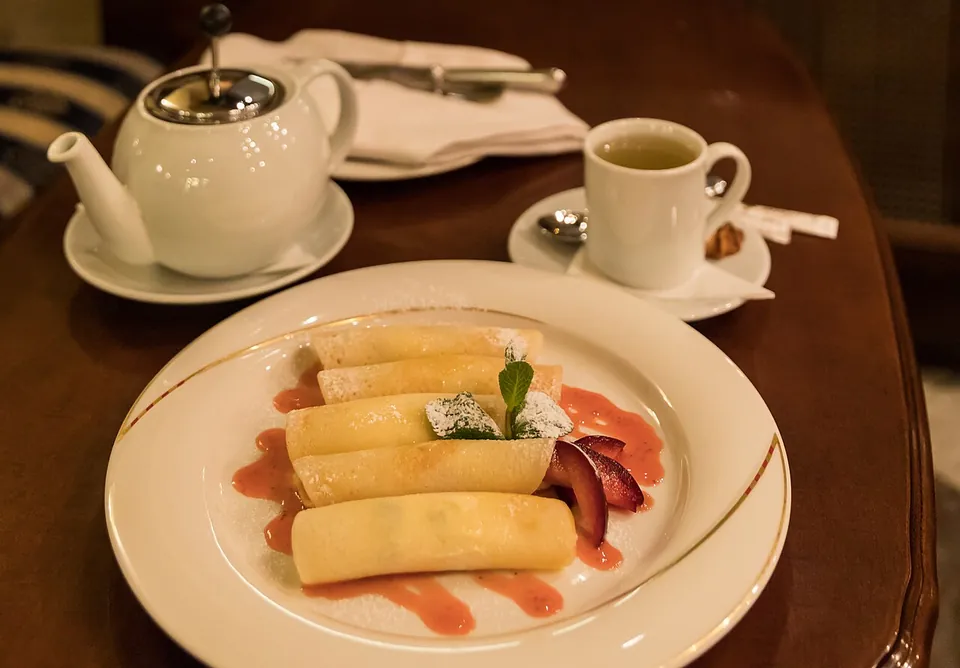
Blini, the round, golden thin cakes of Russia, are often said to descend from a sacred festival food that pagan Slavs shaped in the image of their sun god. But the dish is as plain as its name declares: a local grain food of milled flour, leavened and baked thin. It is the solar story that is the later embellishment.
Verification highlight popular claim → verdict → evidence
Popular claim: round, golden blini were a sacred food honoring the pagan Slavic sun god, especially at Maslenitsa. Verdict: refuted. The word's etymology (Vasmer: blin, from a root meaning "to grind") ties it to milling grain, not the sun, and no source from the pagan era describes blini as sun symbols -- the sun-worship story is a later romantic embellishment. Blini are, in fact, an old type of griddle-fried grain flatbread (comparable dishes existed in ancient Egypt, Greece, and Rome), but their documented history in Russia goes back only to the 16th century, when they appear in the Domostroi. Key sources: Vasmer's etymological dictionary; Domostroi (16th c.); The Moscow Times.
The three gates
- Ingredient-supply gate
- The main ingredient, flour, is local wheat. Wheat was established in Eastern Europe by 5300 BC and in Russia by 500 BC, so it places no constraint on the lower bound of 900 CE. The buckwheat flour that blini are known for belongs to a later layer: buckwheat reached Eastern Europe only in the 13th to 15th centuries (trade routes; archaeobotany, Hunt et al. 2018), and it is not rate-limiting for the earliest blini.
- Cooking-technique gate
- A fermented batter cooked thin on a pan (skovoroda).
- Venue gate
- Everyday home cooking among ordinary people in Slavic villages, and a dish for feast days as well: it belonged both to the daily table and to the fixed festivals of the year.
Overview
Blini are a Russian peasant flatbread: a batter of grain flour thinned with water or milk and baked thin in a frying pan (in Russian, the skovoroda). The best-known method uses a fermented batter, and blini are at once an everyday household food and a holiday food, baked in great quantity for Maslenitsa, the carnival before the Lenten fast.
What they are is written into their name. The Russian blin descends from the older form mlin and, further back, from a root meaning "to grind" or "to mill." It shares that root with melnitsa, a flour mill: the word means, quite plainly, "a thing made from milled grain."
The flour at the heart of the dish is wheat, a grain long rooted in these lands and long at hand for Russian farmers. Blini were no more than that grain, ground, raised with a leaven, and baked thin; the buckwheat blini familiar today are a form that joined the repertoire later. The method asked for no special equipment and could be finished in a village home, and that ease first rooted blini as a folk food before it was joined to the communal calendar of Maslenitsa. The type itself, ground grain baked into a thin cake, is old enough that close counterparts appear in ancient Egypt, Greece, and Rome.
In the written record, the old form mlin appears in the fourteenth century, the surname Blin in 1483, and the dish name itself in the sixteenth-century household manual Domostroi. Domostroi in particular lists blini at the holiday midday meal of the meat days, a contemporary source showing the dish plainly on the everyday tables of medieval Slavs. Not a sacred food of mysterious pedigree but a local leavened grain dish, born of the ordinary act of baking milled grain: that is the settled view today, resting on both the word's roots and the primary record.
How we know
Round and golden, blini often attract a grand origin story: that in pre-Christian times they were eaten as a sacred festival food shaped in the image of a pagan Slavic sun god, their beginning traced to an ancient cult of the sun. But the story lacks support on two counts: the word's roots and the old records.
First, the roots. According to Vasmer's etymological dictionary of Russian, blin goes back to the old mlin, 'to grind,' sharing a root with the verb molot, 'to grind.' What the word names is the grinding and baking of grain flour, not a symbol of the sun. Second, the records. The word enters the Russian record as the old form mlin in the fourteenth century, as the surname Blin in 1483, and as a dish name in the sixteenth-century Domostroi; no contemporary source ties it to sun worship or to Maslenitsa. Both the solar reading and the bond with the carnival came to be spoken of only in the Romantic reinterpretations of the nineteenth century and after.
This solar story is no amateur's fancy. The historian of Russian cuisine Darra Goldstein, too, remarks that being round and golden is just why the cake images the sun. Even so, no one can point to a source from the pagan age recording that it was baked as the sun. An interpretation, even one bearing a scholar's name, stays a matter of folkloric romance so long as no record backs it, and here the record does not bear the solar origin out.
A second ornament was draped over the dish later, and it still hangs there: the notion that buckwheat is the old, proper flour for blini and wheat a modern substitute. Buckwheat came late to the fields of eastern Europe. The archaeobotanical evidence gathered by Hunt and colleagues in 2018 puts its arrival there between the thirteenth and fifteenth centuries, around or after the fourteenth-century mlin and the surname Blin of 1483. Blini were being baked from local wheat well before that, and buckwheat blini joined them only once the crop had travelled the trade routes into eastern European villages. The flour taken to be the oldest turns out to be the newest.
What has been set aside is only the origin story of a sacred food of the sun god. Blini themselves are, as the name says, a local food of milled grain baked thin; the sixteenth-century Domostroi records them at the holiday midday meal of the meat days, a primary source showing them plainly as an everyday dish of medieval Slavs. Keep the humble origin the name declares apart from the myth later draped over it, and what remains is no relic of an ancient rite but an ordinary daily dish of baked, milled grain. That is the settled view today.
The full set of origin theories and the detailed verification log — traceable all the way to their sources — are available on the Japanese edition.
See the full origin theories and verification log (Japanese) →
Related dishes
Shares the key ingredient
- PierogiPolandC
- EmpanadaRío de la Plata (Argentina)C
- PirozhkiRussiaB
- CheburekiCrimea (Crimean Tatar)C
- BelyashiVolga-Ural (Tatar / Bashkir)C
- JalebiNorthern IndiaB
- Fortune cookieCalifornia (USA)C
- StroopwafelGouda (Netherlands)C
- LamingtonQueensland (Australia)C
- ChimichangaTucson, Arizona (USA)C
- BuuzMongoliaB
- YantıkCrimea (Crimean Tatar)C
- VarenykyUkraineC
- MandaziEast Africa (Swahili Coast)C
- LángosHungaryC
- Daoxiaomian (knife-cut noodles)Shanxi (China)C
- KhuushuurMongoliaB
- Dobos torteHungaryB
- SambusaEast Africa (Swahili Coast)B
- SarburmaCrimea (Crimean Tatars)B
- ThenthukTibet / NepalB
- ShumaiGuangzhou (China)B
- Jiaozi (gyoza)ChinaC
- Hohhot shaomaiHohhot (China)B
- OliebollenNetherlandsC
- MarquesitaYucatán (Mexico)D
- Halwa puriLahore (Pakistan)D
- Roti prataSingaporeB
- SopaipillaNew Mexico (USA)C
- CoyotaSonora (Northern Mexico)C
- RunzaMidwestern United StatesB
- BanshMongoliaC
- Kashyk-ash (къашыкъ-аш, Crimean Tatar spoon-dumpling soup)Crimea (Crimean Tatar)C
- KulebyakaRussiaB
- Spring roll (Chinese)ChinaC
- ChuchvaraUzbekistan (Samarkand / Fergana)C
- DamperAustraliaC
- SamsaCentral AsiaC
- HalushkyUkraineC
- BanitsaBalkans (Bulgaria)C
- Har gowGuangzhou (China)C