All dishes / 西欧
Erwtensoep (Dutch pea soup) Period BOrigin theory CVerified
Some fields (dish name, region and gates) are shown from the Japanese-edition data.
The story that erwtensoep was born from one harsh winter and started life as a dish sold at skating stalls on the frozen canals is a later invention, found only in tourist blurbs and food blogs, with no support in the historical record.
Verification highlight popular claim → verdict → evidence
Pea soup itself is ancient, but the thick Dutch 'snert' with smoked sausage took its current form in the early modern period. The word 'snert' first appears in 1768, and is recorded meaning pea soup from 1806. Stories tying the dish's origin to one specific harsh winter or to ice-skating food stalls are unsupported later legends that the sources reject.
The three gates
- Ingredient-supply gate
- Split peas are a native crop; the dish depends on the preserved supply chain of dried peas and smoked sausage (rookworst).
- Cooking-technique gate
- Long, slow simmering of peas until thickened.
- Venue gate
- Home kitchens, and winter street stalls tied to skating culture.
Overview
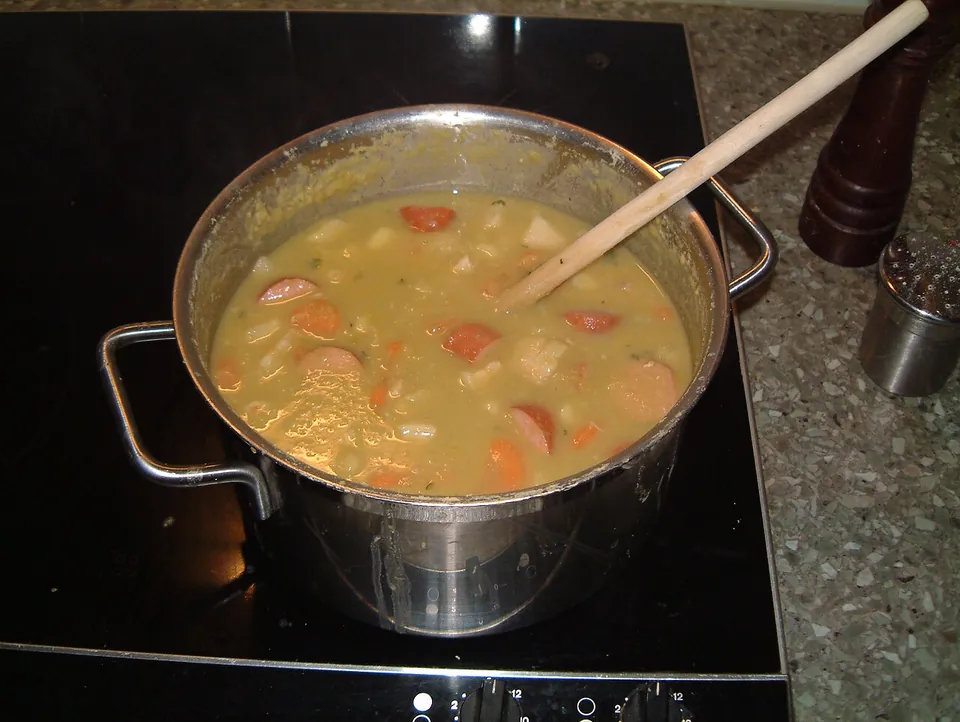
Erwtensoep is the Dutch winter staple made by simmering dried split peas until thick, with a smoked sausage (rookworst) and pork submerged in it. The ideal is a soup thick enough for a spoon to stand up in, and it is praised for that density with a second name, snert.
The lead ingredient, the pea, is a long-established crop rooted in Dutch soil. By around 500 BCE peas were grown and eaten across the Mediterranean, and they have been cultivated in the Low Countries for a thousand years. Dried, they keep for a long time, and they were on the everyday table from early on.
Two things had to come together for the thick Dutch form to settle. One was the winter-long supply of keeping ingredients: dried peas and smoked sausage that could be stored and traded through the cold months. The other was the method of simmering the peas for hours until the soup thickens to a spoon-standing consistency. As a bowl that warms the body in the cold season, it was handed down in homes and served at winter stalls.
How we know
Erwtensoep comes with a well-worn origin story: that this thick soup was born and took hold in one severe sixteenth-century winter, and that it began as fare at the skating stalls (koekenzopie) set up on the frozen canals and waterways.
No contemporary record supports either anecdote. They appear only in tourist and food-blog writing, not in scholarly editions or the official heritage inventory. As for the tie to skating stalls, several accounts state plainly that it is a recent custom and was not always so. What is really at work is a seasonal character — a keeping food for winter — retold, at some point, as a specific founding event.
What the sources show reaches back further and runs deeper. Pea soup itself is an ancient dish: the fifth-century-BCE comic playwright Aristophanes, in the Knights and the Birds, describes street vendors in Athens selling hot pea soup, humble popular food. The oldest recipe for pea soup written in Dutch goes back to a fifteenth-century manuscript (KANTL Gent 15, edited by Braekman in 1986) and a printed book of around 1514, but that was a plain Lenten vegetarian pea soup or porridge, cooked with onion, oil, saffron and cumin — a different thing from today's snert with its smoked sausage and pork. The word snert first appears in Dutch texts in 1768, at first only in a figurative turn of phrase; it is recorded in the sense of pea soup itself in 1806 (Etymologiebank / WNT).
The genre of pea soup runs unbroken from antiquity, and within it the thick Dutch form with smoked sausage sank into place in the early modern period. Rather than shrinking its history to a single hard winter or a skating stall, it follows the record better to see the density and the local flavour settling over a long continuity.
The full set of origin theories and the detailed verification log — traceable all the way to their sources — are available on the Japanese edition.
See the full origin theories and verification log (Japanese) →