All dishes / 西欧
Espresso and cappuccino Period BOrigin theory BVerified
Some fields (dish name, region and gates) are shown from the Japanese-edition data.
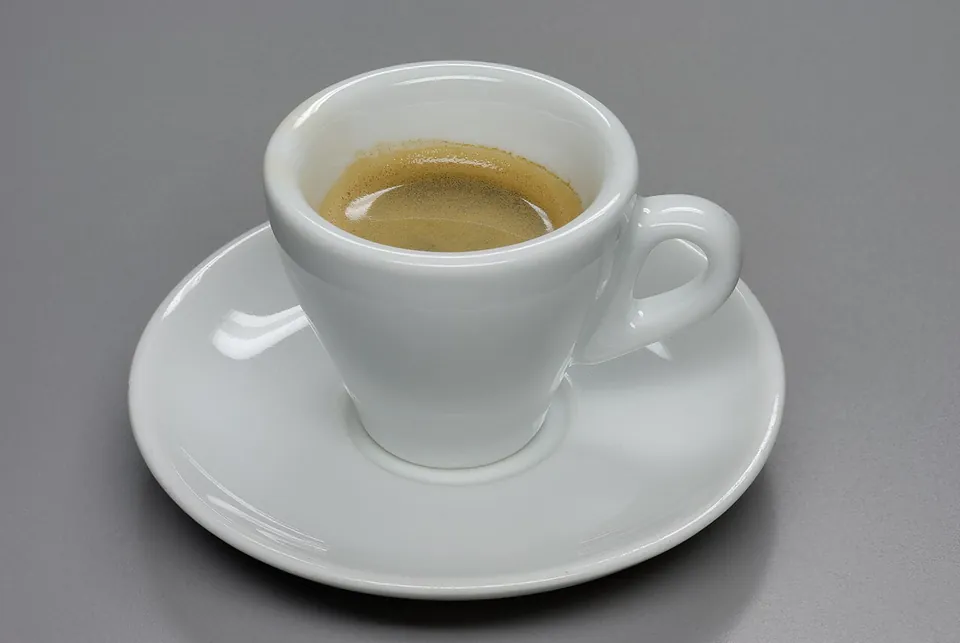
Modern espresso, crowned with its fine layer of crema, took its recognizable form in 1948, the year Achille Gaggia sent his lever machine into the world. The novelty of this dark, concentrated cup lies not in the history of the bean but in the march of the machine that forces hot water through the grounds under pressure.
Verification highlight popular claim → verdict → evidence
Popular claim: marketing legends around espresso's invention (such as stories tying it to wartime engineering) explain the dish's origin. Verdict: what actually sets the date is documented machine history, not an ingredient -- coffee beans were already in circulation, but crema-topped espresso as we know it could not exist before pressurized brewing technology matured, reaching its modern form only with Gaggia's lever machine in 1948. Key sources: Bezzera and Gaggia patent records; Smithsonian Magazine's history of the espresso machine.
The three gates
- Ingredient-supply gate
- —
- Cooking-technique gate
- What held espresso back was the pressurized brewing machine rather than any ingredient; crema first appeared with Gaggia's 1948 lever machine.
- Venue gate
- cafes frequented by the urban trading class
Overview
Espresso—and above all its present form, capped with a layer of crema—took shape in Italy between the early twentieth century and 1948. Unusually, its story can be traced as a history of mechanical refinement.
Coffee beans had long been widely available, so the real protagonist is the machine that drives hot water through the ground coffee at high pressure. In 1884, at the Turin exposition, Angelo Moriondo showed a steam-driven machine and won a bronze medal. In 1901 Luigi Bezzera filed a patent for a mechanism that brewed one cup at a time through a handled portafilter, and in 1905 Desiderio Pavoni turned it into a product, the Ideale. The pressures of this era, however, ran only around 1.5 to 2 atmospheres—too low to raise that familiar foam.
The turning point came from Gaggia. In 1938 he patented the principle of applying high pressure without relying on steam, the Lampo. A second patent followed in 1947 for a spring-loaded lever and piston that pushed the water through. Then, in 1948, the first lever machine built on this design, the Tipo Classica, appeared. Its piston pressure reached 8 to 10 atmospheres, and for the first time crema rose on the surface of the short, concentrated extraction. Crema is the mark that distinguishes a good espresso, and the cup wearing that layer of foam entered the world in this year. Later, the Faema E61 of 1961 made 9 atmospheres from an electric pump standard, leading on to today's machines.
Cappuccino is this espresso layered with steamed, frothed milk. Its distant ancestor is the Viennese Kapuziner, a coffee with cream and sugar recorded in a text of 1805. The name, drawn from the color of a Capuchin monk's hood, came to be used in Italy as cappuccino; it appears in English print in 1948. Together with espresso, its modern form settled into place around the middle of the twentieth century.
How we know
Espresso is less a myth to be exposed than a rare case in which one can date, year by year, how a machine gave rise to the style of a cup. Because of this the story of its emergence holds steady, with little friction among the sources.
The high point of the tale lies in Gaggia's patents. Here the account is often compressed into a single leap: that in 1938 he invented the lever machine. But the patent record splits both the years and the substance apart. The 1938 patent is for the principle of high-pressure extraction without steam, not for the lever mechanism itself. The spring-loaded lever-and-piston patent follows in 1947, and the first lever machine to carry it, the Tipo Classica, reached the world in 1948. Crema, too, first appeared only after this machine arrived. A museum devoted to brewing machines and a history of the extraction machine drawn by Smithsonian Magazine from expert interviews each convey this same sequence independently.
The inspiration for Gaggia's machine is sometimes traced to a military jeep. This is an origin anecdote that the Gaggia company itself spread as advertising, and it does not move the year the machine actually appeared.
Espresso is an unusual drink, one whose novelty is measured not by the history of the bean but by the history of the machine. Crema, a visible layer of foam, becomes the marker dividing before from after, and that boundary falls on the firm date of 1948.
The full set of origin theories and the detailed verification log — traceable all the way to their sources — are available on the Japanese edition.
See the full origin theories and verification log (Japanese) →