All dishes / 東欧
Draniki Period BOrigin theory CVerified
Some fields (dish name, region and gates) are shown from the Japanese-edition data.
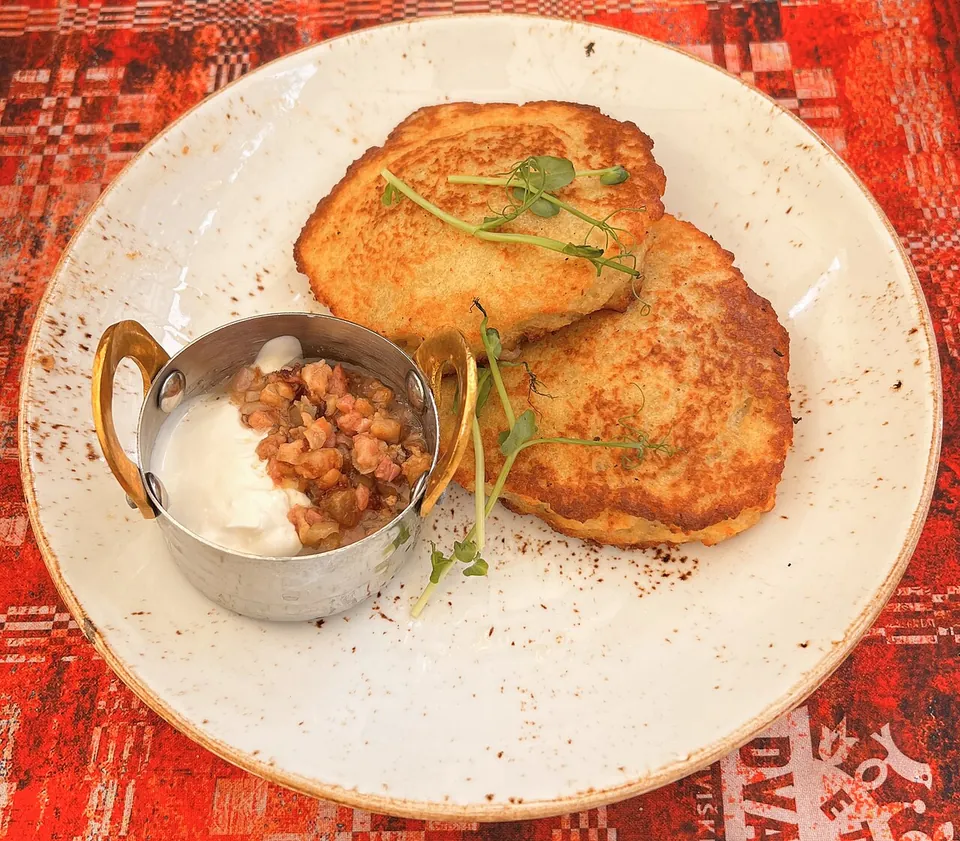
Grated raw potato fried in oil, draniki is Belarus's most homely pancake. It is often spoken of as a distinctly Belarusian dish, yet it is really a pan-Slavic peasant food that arose across much of Eastern Europe once the potato became a staple there.
Verification highlight popular claim → verdict → evidence
Popular claim: draniki is a uniquely Belarusian national dish. Verdict: unconfirmed as a distinctly Belarusian invention -- the same grated-potato pancake appears across the region at the same period under other names (Ukrainian deruny, Russian and Polish placki ziemniaczane, Jewish latkes), and no source pins down a single point of origin; the "national dish" framing is a modern branding of a food shared across Slavic peasant cultures. The earliest known print record is Jan Szyttler's cookbook Kucharz dobrze usposobiony (Vilnius, 1830).
The three gates
- Ingredient-supply gate
- The starring potato is a New World crop; it only spread widely into Eastern Europe in the 18th-19th centuries, which sets the physical lower bound for this dish.
- Cooking-technique gate
- Grating potatoes and pan-frying them in oil.
- Venue gate
- From everyday rural food to a symbol of Belarusian national cuisine.
Overview
Draniki are made by peeling and grating potatoes, binding them with a little flour, adding chopped onion, and frying the mixture into thin cakes in oil. The name itself describes the method, coming from the Slavic root drat / dzerts, 'to grate'. Crisp and fragrant from the pan, with the chewy softness of potato, it is an everyday food of the countryside.
The potato, this dish's main ingredient, is native to the Andes of South America; it took firm root on Eastern European tables between the late eighteenth and early nineteenth centuries. Once the crop had spread through the countryside, the simple act of grating potatoes and frying them in oil became a daily routine, and draniki became an everyday dish. Its earliest appearance in print is in Jan Szyttler's cookbook Kucharz dobrze usposobiony, published in Vilnius in 1830 and widely read across the Polish, Lithuanian and Belarusian lands. That date marks only that the dish existed by then; it is not the year the dish was born.
Draniki began as everyday country fare and later rose to the standing of a national symbol of Belarus. That a plain home dish came to be spoken of as an emblem of the land is itself the interesting part of its history.
How we know
The story most widely told about draniki is that it is a Belarusian dish with a distinctly Belarusian origin. The record, however, shows this grated-potato cake fried in oil spread at much the same time far beyond Belarus, to Ukraine (deruny), Russia, Poland (placki ziemniaczane), Lithuania and the Jewish home (latkes). No single country's exclusive invention can be established from the sources.
Since the very name comes from the act of grating, the same dish could arise independently wherever potatoes had spread. The attribution of draniki as a national dish of Belarus came to the fore within the twentieth-century making of national cuisines and tourism, and it does not prove a birthplace. The origin does not converge on a single point but stands in several lands at once.
The date of the dish, on the other hand, can be pinned down fairly firmly. The potato's establishment as a staple in Eastern Europe, in the late eighteenth and early nineteenth centuries, sets the lower bound, and Szyttler's 1830 cookbook confirms the dish existed by then. The birthplace cannot be fixed, yet the period is clear.
The full set of origin theories and the detailed verification log — traceable all the way to their sources — are available on the Japanese edition.
See the full origin theories and verification log (Japanese) →
Related dishes
Shares the key ingredient
- Vada pavMumbai (India)C
- PoutineQuebec (Canada)C
- Proto-ajiaco (pre-chicken Muisca highland stew proto-layer)Bogotá highlands (Cundinamarca)C
- Pani puriNorth IndiaC
- Aloo kachoriIndia (Rajasthan / North India)C
- VichyssoiseFrance / USA (disputed)B
- Olivier saladMoscow (Russia)C
- Bacalhau à BrásLisbon (Portugal)C
- Caldo verdeMinho (Portugal)C
- Pav bhajiMumbai (India)C
- Abgoosht (dizi)IranC
- Jansson's temptationSwedenC
- California burritoCalifornia (USA)C
- Shepherd's pieEnglandB
- StamppotNetherlandsC
- Sindhi biryaniSindh (Pakistan)C
- Patties (Sri Lankan)Sri LankaC
- OkroshkaRussiaC
- Potato chipsUnited StatesB