All dishes / 西欧
Bacalhau à Brás Period BOrigin theory CVerified
Some fields (dish name, region and gates) are shown from the Japanese-edition data.
This Lisbon dish carries the name of its supposed creator, 'Brás.' But records older than the tale of a single inventor have begun to tell a different parentage.
Verification highlight popular claim → verdict → evidence
A popular story credits a tavern keeper named "Brás" in late-19th-century Bairro Alto with inventing the dish. But a manuscript recipe for a similar cod-and-egg dish, dated to 1715, predates that legend by over a century, and a 1936 cookbook lists the dish under a purely descriptive name ("scrambled cod with eggs") with no mention of a creator. The dish more likely evolved gradually out of older cod-and-egg preparations, with no single inventor.
The three gates
- Ingredient-supply gate
- Salt cod arrived via Atlantic trade networks; potatoes only spread in Portugal from the late 18th century on, after arriving from the New World.
- Cooking-technique gate
- Scrambling shredded salt cod, fried shredded potato, and egg together until just set.
- Venue gate
- Served in Lisbon eateries (tascas), especially in the Bairro Alto district.
Overview
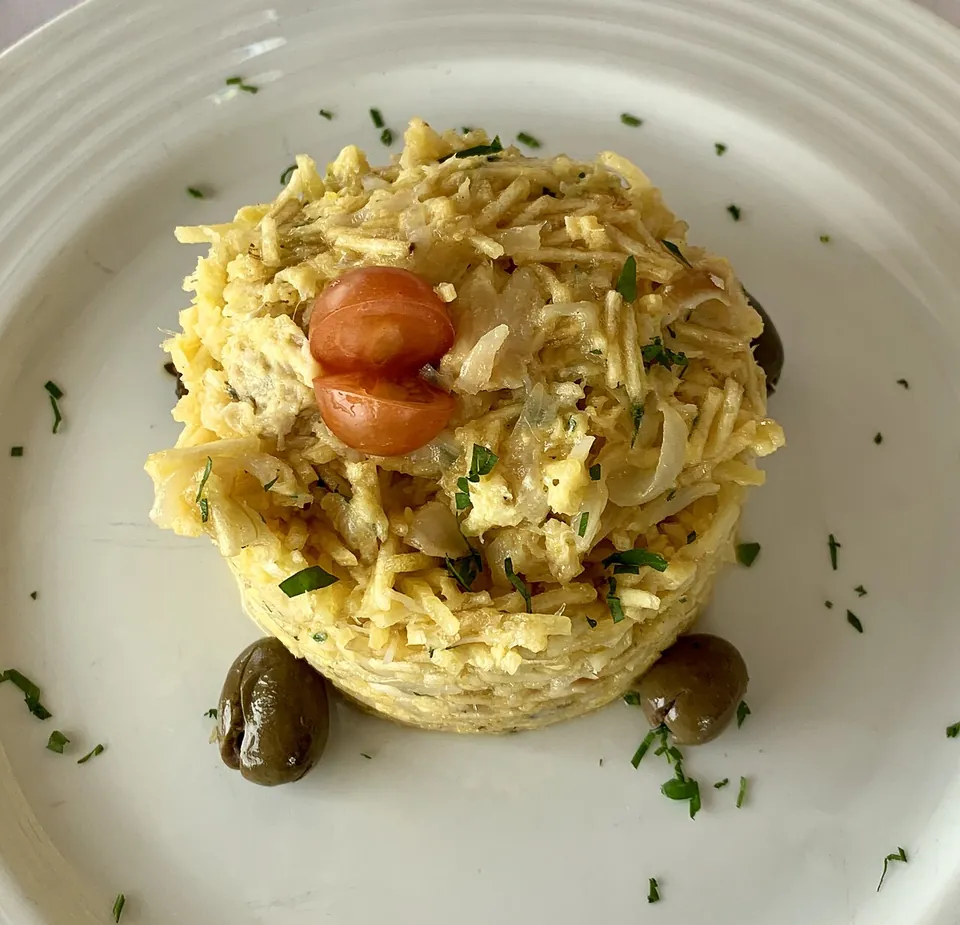
Bacalhau à Brás is a Portuguese dish in which soaked salt cod, matchstick potatoes, and eggs are scrambled together and brought to a soft, barely-set finish. It is said to have taken its present form in the taverns (tascas) of Bairro Alto, Lisbon's old quarter, in the later nineteenth century.
Salt cod had become indispensable to the Portuguese table through the Atlantic trade. The other lead ingredient, the potato, came from the New World, and only toward the end of the eighteenth century did it become widely eaten in Portugal. The form we know now, with fried potato folded through, could not appear until the tuber had spread across the country. Soaked cod, matchstick potato, and egg—three ingredients brought together, and the handwork of scrambling them in a single pan into a soft mass—give the dish its outline.
The setting where it was served was the plain, working-class eatery. Cheap salt cod, and the unstinting labour of soaking and shredding it, took root as food for the streets of Lisbon.
How we know
A story about the name follows this dish everywhere. 'Brás' (in the older spelling Braz) was the proprietor of a Bairro Alto tavern in the later nineteenth century, and he, so the telling goes, was the sole creator of the dish. He is said to have belonged to the large community that migrated from Spanish Galicia to Lisbon.
Yet no source has been found that confirms who this Brás actually was, or when and how he devised the dish. On the contrary, a dish made the same way—soaked cod and eggs scrambled together—appears in records far older than the Brás tradition. A manuscript written around 1715 by Francisco Borges Henriques (National Library of Portugal, Cod. 7376) records it as 'frigideiras de bacalhau,' and the mid-eighteenth-century book of Lucas Rigaud shows soaked cod combined with egg and butter. That is some 150 years before Brás is supposed to have kept his tavern.
Trace the naming, and it points the same way. A 1936 Portuguese cookbook (by Olleboma) carries the dish, but there the name is not Brás; it is 'bacalhau mexido com ovos'—cod scrambled with eggs. The name 'Brás' seems to have been fixed to the finished dish after the fact.
Set side by side, another face emerges. Bacalhau à Brás branched off, little by little, from older cod dishes made much the same way; it was never a dish that required a single inventor. The sweet story of who came first fades before the older manuscripts.
The full set of origin theories and the detailed verification log — traceable all the way to their sources — are available on the Japanese edition.
See the full origin theories and verification log (Japanese) →
Related dishes
Shares the key ingredient
- Vada pavMumbai (India)C
- PoutineQuebec (Canada)C
- Proto-ajiaco (pre-chicken Muisca highland stew proto-layer)Bogotá highlands (Cundinamarca)C
- Pani puriNorth IndiaC
- Aloo kachoriIndia (Rajasthan / North India)C
- VichyssoiseFrance / USA (disputed)B
- Olivier saladMoscow (Russia)C
- Caldo verdeMinho (Portugal)C
- Pav bhajiMumbai (India)C
- Abgoosht (dizi)IranC
- Jansson's temptationSwedenC
- California burritoCalifornia (USA)C
- Shepherd's pieEnglandB
- StamppotNetherlandsC
- Sindhi biryaniSindh (Pakistan)C
- Patties (Sri Lankan)Sri LankaC
- OkroshkaRussiaC
- Potato chipsUnited StatesB
- DranikiBelarusC