All dishes / 北米
Potato chips Period BOrigin theory BVerified
Some fields (dish name, region and gates) are shown from the Japanese-edition data.
The potato chip, we are told, was invented in a fit of pique by cook George Crum at Saratoga Springs in 1853. No record from the time supports that story. Thin, deep-fried slices of potato appear in print decades earlier.
Verification highlight popular claim → verdict → evidence
Popular legend: chef George Crum invented the potato chip in 1853 at Saratoga Springs, out of spite for a customer (often named as Vanderbilt) who complained his fried potatoes were cut too thick. Verdict: refuted -- Moon's Lake House was not purchased until 1854; an 1849 New York Herald article already praised a Saratoga cook's fried-potato slices four years before Crum's supposed invention; Vanderbilt was traveling in Europe that summer; and the Crum-Vanderbilt story itself first surfaces in a 1950s-60s corporate advertisement, roughly a century later. Thin-sliced, salted, deep-fried potatoes actually appear in print decades earlier, in William Kitchiner's The Cook's Oracle (1817) and Mary Randolph's The Virginia House-Wife (1824) -- so no single inventor can be credited.
The three gates
- Ingredient-supply gate
- Potatoes are a New World crop, but by 19th-century America they were already a common food. The technical requirement was thin-slicing and deep-frying at high heat.
- Cooking-technique gate
- Thin slicing and high-temperature deep-frying, later scaled up with machine production and bagged distribution.
- Venue gate
- From a restaurant dish to a mass-market snack product.
Overview
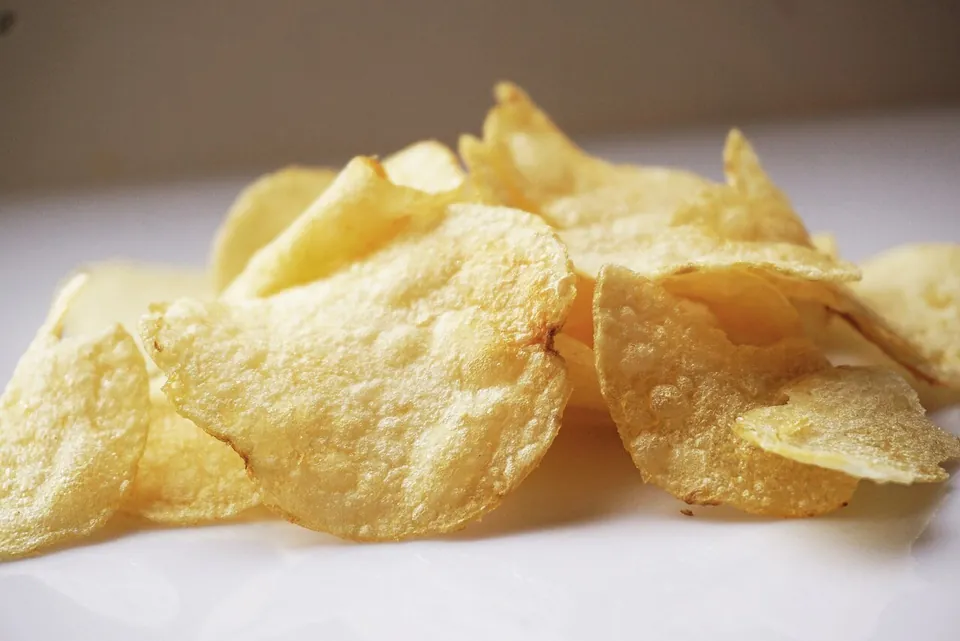
A potato chip is a potato sliced paper-thin, fried hot in oil, and salted. The ingredients are plain; what decides the result is the cutting and the frying. The slices have to be even and thin, and the oil hot enough to drive off the moisture in one go and crisp the potato through. Only once that knack was settled did the chip take the form we know.
Its first clear appearance in print is in The Cook's Oracle, by the English physician and cookery writer William Kitchiner. The 1817 first edition, and more plainly the 1822 edition, carries a dish of potatoes cut into slices or shavings and fried, down to the direction to salt them. This is the earliest confirmed picture of the salted, deep-fried slice of potato. On the American side, Mary Randolph's The Virginia House-Wife (1824) carries the same preparation. On both shores of the Atlantic, the same handiwork had taken hold side by side.
Saratoga Springs, the New York spa town, is the place most often tied to the dish. The fried potato slices served in its restaurants in the mid-nineteenth century won a following, and in time the restaurant dish spread outward into a snack food. Once machines for mass production and bagged distribution were in place, the chip settled in as a snack for everyone. But try to fix a single moment of invention anywhere along that spread, and the record suddenly runs thin.
How we know
The dish carries a famous origin tale. In 1853, at Moon's Lake House in Saratoga Springs, cook George Crum is said to have sliced potatoes wafer-thin and fried them to spite a customer who complained his fried potatoes were too thick. The prank, so the story goes, was a hit. The customer is often named as the railroad magnate Cornelius Vanderbilt.
The tale keeps colliding with the contemporary record. The dates do not line up: Moon did not buy the Lake House until 1854, a year after the 1853 anecdote. The thin fried potato itself is older. The New York Herald of July 1849 already reported the fried potatoes that a Saratoga cook named Eliza had made her name on, four years before Crum's supposed feat. The named customer will not stand either: Vanderbilt spent that summer travelling in Europe and could not have been there. And the pairing of Crum with Vanderbilt turns out to trace to advertisements the St. Regis Paper Company ran in the 1950s and 1960s, some 120 years after 1853. Crum's name first appears alongside the dish no earlier than 1885.
So the whole frame of a single cook inventing the chip in one evening comes apart. Kitchiner in 1817 and 1822, and Randolph in 1824, place the preparation well before 1853. It is only the notion of a sudden invention by one named person that the record does not bear out; the age and reality of the dish itself are untouched. If anything, the salted fried slice had taken hold in several places at once. So who really came first? The food historian Dave Mitchell concludes that no one can say. The name of the inventor is lost, and the question has no answer.
The full set of origin theories and the detailed verification log — traceable all the way to their sources — are available on the Japanese edition.
See the full origin theories and verification log (Japanese) →
Related dishes
Shares the key ingredient
- Vada pavMumbai (India)C
- PoutineQuebec (Canada)C
- Proto-ajiaco (pre-chicken Muisca highland stew proto-layer)Bogotá highlands (Cundinamarca)C
- Pani puriNorth IndiaC
- Aloo kachoriIndia (Rajasthan / North India)C
- VichyssoiseFrance / USA (disputed)B
- Olivier saladMoscow (Russia)C
- Bacalhau à BrásLisbon (Portugal)C
- Caldo verdeMinho (Portugal)C
- Pav bhajiMumbai (India)C
- Abgoosht (dizi)IranC
- Jansson's temptationSwedenC
- California burritoCalifornia (USA)C
- Shepherd's pieEnglandB
- StamppotNetherlandsC
- Sindhi biryaniSindh (Pakistan)C
- Patties (Sri Lankan)Sri LankaC
- OkroshkaRussiaC
- DranikiBelarusC