All dishes / 南アジア
Pav bhaji Period COrigin theory CVerified
Some fields (dish name, region and gates) are shown from the Japanese-edition data.
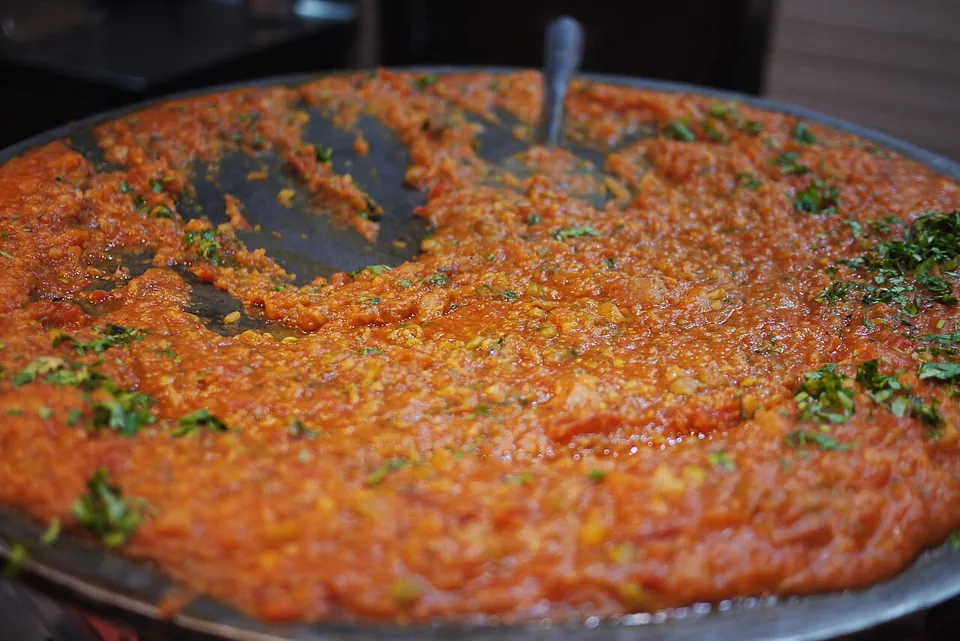
A thick spiced mash of vegetables served with a soft, butter-griddled bun, pav bhaji is one of Mumbai's signature street foods. A popular story traces its birth to the distant American Civil War, but no contemporary record backs that tale, and a growing body of food writing argues the dish took shape only in the mid-twentieth century.
Verification highlight popular claim → verdict → evidence
The popular story crediting 1850s-60s American Civil War cotton-boom mill workers does not hold up: no contemporary record supports it. Food writer Vir Sanghvi argues the dish as a distinct named street food only emerged in the late 1950s-1960s; the earliest dateable print record found so far is 1980. Main source: Meera Taneja, Indian Regional Cookery (1980).
The three gates
- Ingredient-supply gate
- The limiting ingredients, potato and tomato, are New World crops that reached India via Portuguese trade routes. They only became cheap and abundant enough to become urban workers' food in the latter half of the 19th century.
- Cooking-technique gate
- Vegetables mashed and cooked down, seasoned with spices, and served with butter-toasted bread (pav).
- Venue gate
- From late-night street food for Mumbai's cotton-mill workers to the city's signature street food.
Overview
Pav bhaji is built from onions, tomatoes, potatoes and cauliflower, cooked down with spices and mashed flat on a hot griddle into a rich, sauce-like bhaji (vegetables). Alongside it comes the pav: a small, soft roll browned in butter on both sides. The pav descends from bread the Portuguese brought to India, and it has long been a fixture of Mumbai's tables.
The setting is Mumbai, once Bombay. A single griddle is enough to turn the dish out quickly at a stall, and it can be eaten standing, bun in hand. It appeared on the street as a cheap meal of mashed vegetables and bread, made for city workers who had only a short break to fill an empty stomach. The potatoes and tomatoes worked into the mash reached India by way of the Portuguese, and once these New World vegetables became cheap and plentiful they were ordinary sights in Mumbai's markets.
When exactly the city's stalls fixed this combination as a distinct dish called pav bhaji is far less clear. The idea of pairing a cheap vegetable mash with pav may well have roots in older urban food culture, but the moment it hardened into a named dish is contested: the received account puts it in the late nineteenth century, while others place it squarely in the mid-twentieth.
In time pav bhaji outgrew its role as a late-night snack, turning up at home and at festivals, and it is now known across India as a dish that stands for Mumbai.
How we know
The most widely repeated origin story for pav bhaji ties it to the American Civil War. In the 1860s, so the tale goes, the war cut off cotton from the American South, and Bombay's cotton trade boomed to fill the gap. Mill workers, and traders waiting late into the night for cotton-price telegrams, snatched a quick meal in the rush; that, the story says, was the first pav bhaji.
The account is vivid, and it has been told and retold in the press (in outlets such as Live Mint and the Madras Courier). The backdrop of a Bombay flush with cotton money does lend it a certain plausibility.
Lately, though, the story has drawn sharp doubt. The food writer Vir Sanghvi sees pav bhaji stalls emerging across Bombay only in the late 1950s and 1960s. In his reading, the anecdote said to anchor the tale, of traders waiting for American cotton-price telegrams at the exchange, belongs to the 1960s, when New York cotton prices filled the Bombay papers, and has likely been confused with the 1860s Civil War cotton boom. Sardar Pav Bhaji in Tardeo, the emblematic old stall, opened only in 1966, and no earlier document names pav bhaji, nor does any primary source point to an inventor.
In the end, no primary source names a founding shop, a creator or a firm date of origin. The link to the Civil War has never been checked in a scholarly setting; it remains an appealing received account and no more. Even if the dish as a genre reaches back into nineteenth-century urban life, placing the emergence of pav bhaji as an established dish in the mid-twentieth century fits the surviving evidence better. Who first griddled a pav bhaji, and when, is still unknown.
The full set of origin theories and the detailed verification log — traceable all the way to their sources — are available on the Japanese edition.
See the full origin theories and verification log (Japanese) →
Related dishes
Shares the key ingredient
- Vada pavMumbai (India)C
- PoutineQuebec (Canada)C
- Proto-ajiaco (pre-chicken Muisca highland stew proto-layer)Bogotá highlands (Cundinamarca)C
- Pani puriNorth IndiaC
- Aloo kachoriIndia (Rajasthan / North India)C
- VichyssoiseFrance / USA (disputed)B
- Olivier saladMoscow (Russia)C
- Bacalhau à BrásLisbon (Portugal)C
- Caldo verdeMinho (Portugal)C
- Abgoosht (dizi)IranC
- Jansson's temptationSwedenC
- California burritoCalifornia (USA)C
- Shepherd's pieEnglandB
- StamppotNetherlandsC
- Sindhi biryaniSindh (Pakistan)C
- Patties (Sri Lankan)Sri LankaC
- OkroshkaRussiaC
- Potato chipsUnited StatesB
- DranikiBelarusC