All dishes / 南アジア
Pani puri Period BOrigin theory CVerified
Some fields (dish name, region and gates) are shown from the Japanese-edition data.
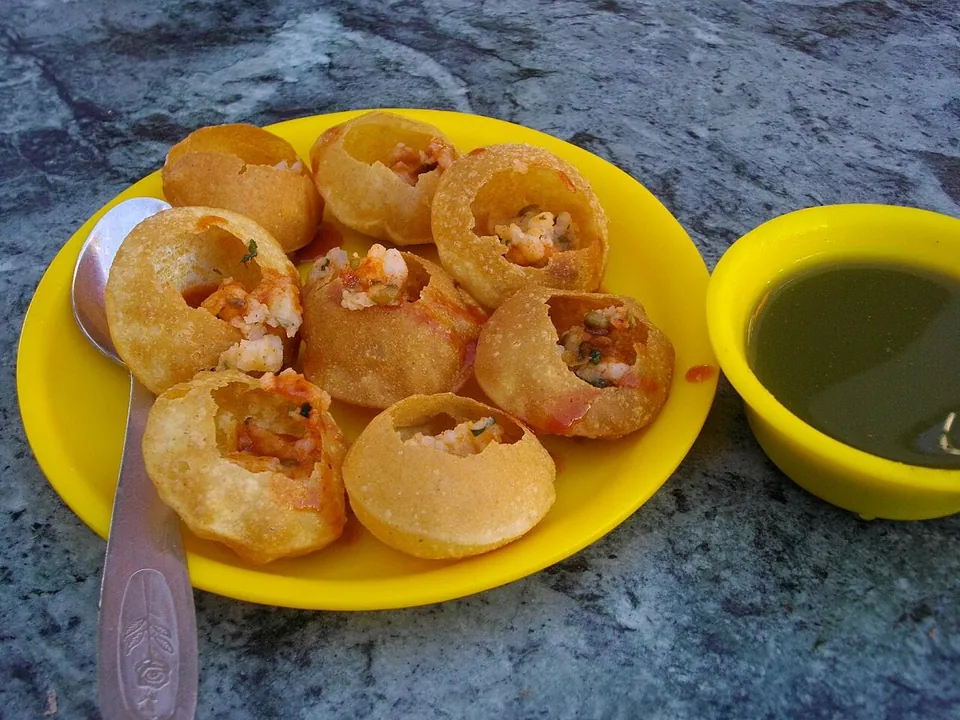
A North Indian street snack: a bite-sized fried shell filled with spiced water and eaten in one gulp. The widely told story that Draupadi, the bride of the epic Mahabharata, first made it is a recent internet-born fabrication that does not square with the historical record.
Verification highlight popular claim → verdict → evidence
Popular claim: pani puri was invented by Draupadi in the Mahabharata. Verdict: debunked -- potatoes are a New World crop unknown to the epic's setting, and reporting traces the claim to an internet joke that spread online. A separate folk claim traces the snack to ancient Magadha as "phulki," but this rests on oral tradition rather than documented history. What the record does support is that pani puri grew out of the broader chaat street-food tradition and only took its present form after potatoes reached North India. Food historian Pushpesh Pant argues that searching for one true point of origin is itself the wrong question, since closely related snacks -- such as Bengal's phuchka -- share the same lineage without any evidence showing which came first.
The three gates
- Ingredient-supply gate
- Provisional: the fried shell (puri) uses native semolina/wheat. The potato filling is a New World crop, so the dish postdates its arrival; the potato's arrival year is the limiting factor.
- Cooking-technique gate
- Provisional: the technique of frying dough into a hollow, puffed shell (puri), paired with a spiced water (pani).
- Venue gate
- Provisional: urban street chaat stalls in North India, later spreading pan-India.
Overview
Pani puri is a snack sold on the streets of North India. It goes by different names from place to place — golgappa, puchka, gupchup. A shell small enough to pinch between the fingers is cracked open, packed with potato and chickpea, and filled with a cold spiced water sharp with tamarind and mint, then thrown into the mouth before it can spill. Handed out one after another at the stall, it is the very picture of the city's stand-and-eat fare.
Its present form is not an especially old thing. The potato at the core of the filling was not a crop native to South Asia; it came across the sea from the New World and spread from there. Until the potato had settled onto South Asian tables, a pani puri stuffed with it had no way to line the streets.
Among food historians, today's pani puri is seen as an offshoot of chaat, the snack fare that spread from the court out into the streets. It branched off from chaat's way of building flavor with spice and sourness, and found its present shape after the potato had become common. Then, in the twentieth century, as people moved from place to place in search of work, what had been the food of one corner of North India spread to street corners across the whole of India.
From a local snack to a pan-Indian one
The dish's twentieth-century spread across India tracks the movement of people who carried their home fare with them. A snack of one region became, within a few generations, a snack of the nation.
How we know
The most colorful story told of pani puri's beginning is a scene from the epic Mahabharata: Draupadi, newly married, improvising the snack from whatever was on hand for her five Pandava husbands.
But this tradition has no support as history. Above all, the potato that today's pani puri cannot do without was a crop carried from the New World, and did not yet exist in the ancient world the epic describes. As for the claim that the epic itself mentions pani puri — trace it back and it is a single joke posted to a question-and-answer site, which spread across the internet unverified around 2018 and came, at some point, to be repeated as an "ancient origin." No old primary source bears it out.
There is another telling: that it was born in the ancient kingdom of Magadha (in present-day Bihar) as a small food called phulki. This one is not flatly denied, but there is no record that fixes an inventor or a date, and it does not rise above folklore.
The line that can actually be traced runs later. It branched off from chaat, the snack fare that spread from the court into the streets, took its present form after the potato had rooted itself across the land, and scattered across all of India with the movement of people in the twentieth century — that is the range the records reach. Some food historians hold that to press further back and pin "the true origin" to a single point is itself a fruitless exercise. Rather than the bright story of an epic bride at the beginning, it is the modern path of a street snack, slowly changing shape, that lies far closer to the record.
The full set of origin theories and the detailed verification log — traceable all the way to their sources — are available on the Japanese edition.
See the full origin theories and verification log (Japanese) →
Related dishes
Shares the key ingredient
- Vada pavMumbai (India)C
- PoutineQuebec (Canada)C
- Proto-ajiaco (pre-chicken Muisca highland stew proto-layer)Bogotá highlands (Cundinamarca)C
- Aloo kachoriIndia (Rajasthan / North India)C
- VichyssoiseFrance / USA (disputed)B
- Olivier saladMoscow (Russia)C
- Bacalhau à BrásLisbon (Portugal)C
- Caldo verdeMinho (Portugal)C
- Pav bhajiMumbai (India)C
- Abgoosht (dizi)IranC
- Jansson's temptationSwedenC
- California burritoCalifornia (USA)C
- Shepherd's pieEnglandB
- StamppotNetherlandsC
- Sindhi biryaniSindh (Pakistan)C
- Patties (Sri Lankan)Sri LankaC
- OkroshkaRussiaC
- Potato chipsUnited StatesB
- DranikiBelarusC