All dishes / 東欧
Chakhokhbili Period BOrigin theory CVerified
Some fields (dish name, region and gates) are shown from the Japanese-edition data.
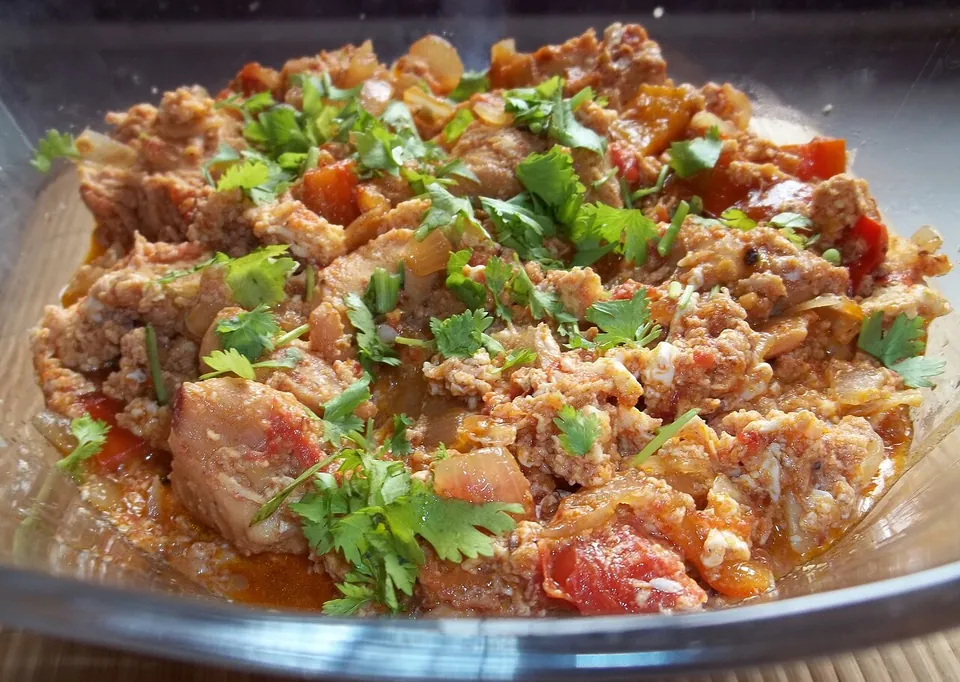
Chakhokhbili is a Georgian home dish of chicken and tomato braised in oil. Its name comes from an old word for pheasant, and it carries a legend tracing it to a fifth-century king—but the tomato braise we know today came into being only in the nineteenth century, once New World tomatoes had taken root along the Black Sea coast.
Verification highlight popular claim → verdict → evidence
Legend holds that the dish began in the 5th century when a pheasant hunted by King Vakhtang Gorgasali fell into a hot spring and cooked itself. This cannot be true of the dish as eaten today: a chicken-and-tomato stew is impossible before tomatoes reached the Caucasus in the 19th century. The hot-spring story instead reflects an older ancestor dish made with pheasant and pomegranate sauce, not the tomato-based version. Main sources: Georgia.travel's official account and a Soviet-era household cookbook recipe (1939/1952 editions).
The three gates
- Ingredient-supply gate
- Chicken and herbs were already available locally; the current tomato-based stew form only became possible once the New World tomato reached the Black Sea coast.
- Cooking-technique gate
- The meat is fried in oil, then simmered into a stew.
- Venue gate
- A home-cooked dish, also eaten as a picnic or outing food.
Overview
Chakhokhbili is a Georgian home and outing dish: chicken fried in oil with onions, then braised with tomato and finished with herbs such as coriander. The name goes back to khokhobi, the Georgian word for pheasant, still telling us that this was once a dish of birds taken in the hunt. Chicken, herbs, and onions have long been on Caucasian tables, and braising a game bird was itself rooted in the land.
What defines today's chakhokhbili is the acidity and sweetness of tomatoes cooked down red. Tomatoes are native to the New World, and they spread as food through the Caucasus and Georgia over the course of the nineteenth century, working their way into gardens and market stalls along the Black Sea coast. Once the tomato had settled into life there, the braise built around it appeared—and readily available chicken took over the leading role from the pheasant a hunter had to bring down. The method Georgian kitchens follow today, chicken fried in oil and then simmered with onion and tomato purée, reaches print later still, in the 1952 edition of the Soviet household cookbook Kniga o vkusnoi i zdorovoi pishche (The Book of Tasty and Healthy Food).
Before the tomato, the dish's forerunner is thought to have been a game-bird braise: pheasant dry-fried without oil and simmered with a native sourness such as narsharab, a reduction of pomegranate juice. Under the same name, the source of the acidity shifted from pomegranate to tomato—and in that shift lies the dish's modern turning point.
How we know
Chakhokhbili has long carried a tale of Vakhtang Gorgasali, the fifth-century king who founded Tbilisi. The story goes that a pheasant the king had hunted fell into a hot spring and cooked, and that this was the beginning of the dish. Bound up with the legend of Tbilisi's founding, the tale pushes the dish's pedigree back fifteen hundred years.
But this legend cannot simply be read as the founding date of chakhokhbili as we know it. That a genre of braised game birds is old is one thing; that today's chicken-and-tomato braise is old is another. The tomato is a New World crop that spread as food into the Caucasus only in the nineteenth century, and a braise built around that fruit could not have existed in an earlier Georgia. Nor is there any contemporary, independent record to support the claim of a fifth-century date.
Georgia's national tourism office explains that the dish was originally a pheasant dish, that before the tomato its sourness came from narsharab (reduced pomegranate), and that tomatoes came into use only from the nineteenth century. A study of the food plants and fungi of Georgia and the Caucasus, published in the Journal of Ethnobiology and Ethnomedicine, places the establishment of New World crops on the same line.
The year the tomato entered Georgian gardens and the year the chicken-and-tomato braise reached print are not the same. In Kniga o vkusnoi i zdorovoi pishche, the Soviet household cookbook, the first edition of 1939 lists chakhokhbili by name among canned national dishes and goes no further; the working recipe—chicken cut small and fried in oil, then simmered with onion, tomato purée, vinegar and wine—appears in the 1952 edition. The tomato made its way onto Caucasian tables in the course of the nineteenth century, and the printed recipe caught up with it in the middle of the twentieth.
The dish's oldest layer as a game-bird dish, which the name preserves, is genuine; the chicken-and-tomato form is a modern one. The king's legend folded together the age of the genre and the making of the present dish. An old origin tale about a bird of the hunt, and the scholarly view that today's form settled after the nineteenth-century arrival of the tomato, are two things to be read apart.
The full set of origin theories and the detailed verification log — traceable all the way to their sources — are available on the Japanese edition.
See the full origin theories and verification log (Japanese) →
Related dishes
Shares the key ingredient
- Pasta al pomodoroSouthern ItalyB
- Pizza MargheritaNaples (Italy)D
- ShakshukaMiddle East / North AfricaC
- Jollof riceWest AfricaC
- Butter chickenDelhi (India)C
- Khao SoiB
- GazpachoAndalusia (Spain)C
- LecsóHungaryC
- Chana masalaNorth India (Punjab)C
- RatatouilleProvence, France (Nice)C
- Thieboudienne (ceebu jën)SenegalC
- ChakalakaSouth AfricaC
- KedjenouIvory CoastB
- Caprese saladCapri (Italy)C
- SaloonaPersian Gulf (Bahrain and Kuwait)C
- Shan khauk hswè (Shan noodles)Myanmar (Shan State)C
- American pizzaUnited StatesC
- FrancesinhaPorto (Portugal)D
- KachumberGujarat (Western India)C
- SalmorejoAndalusia (Spain)C
- Greek salad (horiatiki)GreeceC
- Shopska saladBalkans (Bulgaria)B
- Melanzane alla parmigianaItalyC