All dishes / 北米
Buffalo wings Period BOrigin theory CVerified
Some fields (dish name, region and gates) are shown from the Japanese-edition data.
The story goes that the Buffalo wing was born in 1964, at the Anchor Bar in Buffalo. Yet no one has ever managed to name the single place that served it first.
Verification highlight popular claim → verdict → evidence
Popular story: the hot-sauce-tossed wing was invented in 1964 at Buffalo's Anchor Bar by Teressa Bellissimo. Verdict: unconfirmed as a single-inventor origin -- Calvin Trillin's 1980 New Yorker investigation found the Bellissimo family telling mutually contradictory versions of the story, and rival vendor John Young was selling a similar wing dish even earlier; no single 'first restaurant' claim holds up under scrutiny. Key sources: Calvin Trillin, The New Yorker (1980); Buffalo History Museum.
The three gates
- Ingredient-supply gate
- Chicken is an Old World bird but was already widely raised in the United States, and chili peppers are native to the New World. Both were easy to obtain by the 20th century, so neither sets a physical lower bound. The 20th-century American meat trade also put cheap wings within reach of restaurants in quantity, so supply does not bound the date either.
- Cooking-technique gate
- The wings are cut in two, deep-fried plain, and tossed in a vinegar-based hot sauce of butter and cayenne. No special machinery is involved and the method was already established by the 20th century, so it sets no lower bound.
- Venue gate
- Bar and tavern food for a working-class, popular crowd, eaten out on the premises rather than at home; from a local Buffalo dish it travelled outward with American sports-viewing culture until it was eaten across the country.
Overview
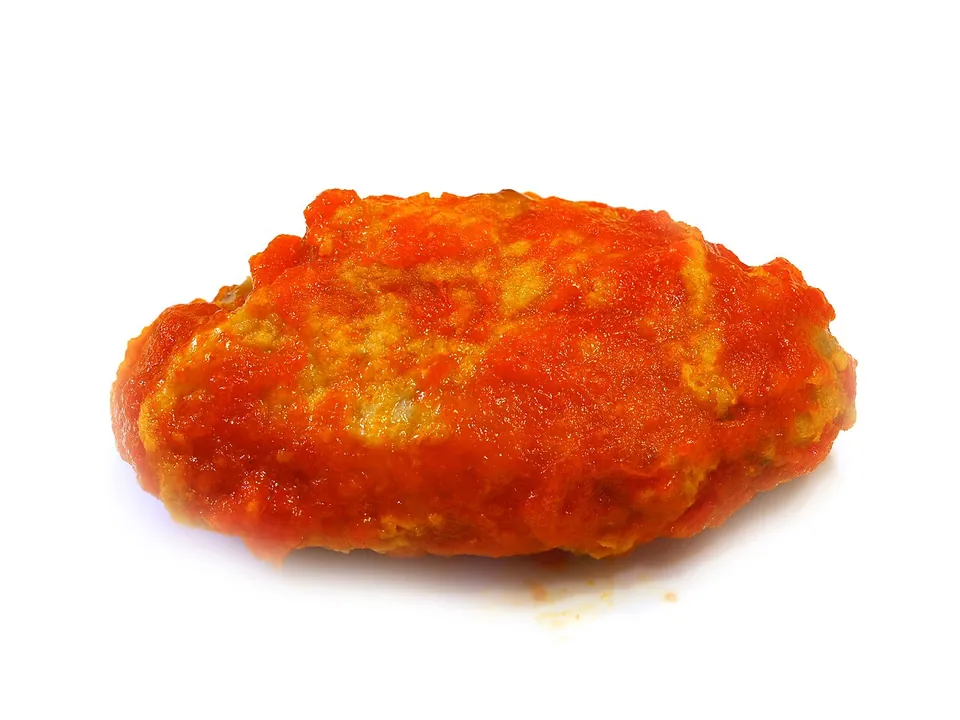
The Buffalo wing is a dish from Buffalo, in western New York State. Chicken wings are split in two and deep-fried, then tossed in a tart, spicy sauce of melted butter cut with cayenne and vinegar. The classic serving comes with celery sticks and a blue-cheese dip on the side.
The dish took its present shape in the early 1960s. Chicken wings and cayenne were both cheap, everyday things in mid-century America, and no special tool or skill was needed to cook them, so the question was never one of when they could first be made. The wing is the odd part left over after the thigh and breast are taken, and for a long time it was treated as a throwaway cut sold cheap. Frying that cheap wing in a bar, coating it in hot sauce, and setting it down as something to eat with beer is where the appeal lay, and that appeal grew out of a particular way of American life.
The setting was the late-night city bar. You watched sports on the television, ate with your fingers, and washed it down with beer. Along with that habit, the Buffalo wing spread from the taverns of Buffalo to bars across the country. It was less invented than raised, a bar-room late-night snack that grew into a dish of its own.
How we know
The most famous origin story runs like this. In 1964, Teressa Bellissimo, who ran the Anchor Bar, split some wings in two, fried them, and tossed them in a spicy sauce to feed her son and his friends when they turned up late at night. But the tale has a weakness: its details shift each time it is told. In 1980 the writer Calvin Trillin went all the way to Buffalo to interview the Bellissimo family, and the same household gave him versions that did not match. The father, Frank, said a mistaken meat delivery had left them with a surplus of wings; the son, Dominic, said it was a free snack for regulars at midnight, when a Friday of abstaining from meat had ended. The two accounts of how it began do not agree. And a few years on, in 1969, a local paper that profiled the Anchor Bar said nothing about wings at all. The bar seems to have made them its signature only later.
Another name comes up. A man named John Young was serving wings around 1961, earlier than the Anchor Bar, frying them whole in batter and dressing them in a homemade, tomato-based "mumbo sauce." He is said to have opened his own place in 1966 and even advertised wings in the phone book, the first to make a business of them. But his wings differed from the present hot-sauce style in both sauce and method. Which preparation you call the origin changes the answer.
Go back further and the fried chicken wing itself is older still. A Buffalo hotel menu from 1857 lists "Chicken Wings, fried." The local history museum concludes that the "first place" depends entirely on how you define "first": the oldest to serve them, the one that fixed the present style, or the first to sell them commercially. No one disputes that the Anchor Bar carried the name "Buffalo wing" out into the world. Even so, no firm record survives that points to a single inventor.
The full set of origin theories and the detailed verification log — traceable all the way to their sources — are available on the Japanese edition.
See the full origin theories and verification log (Japanese) →