All dishes / 東アジア
White cut chicken Period BOrigin theory CVerified
Some fields (dish name, region and gates) are shown from the Japanese-edition data.
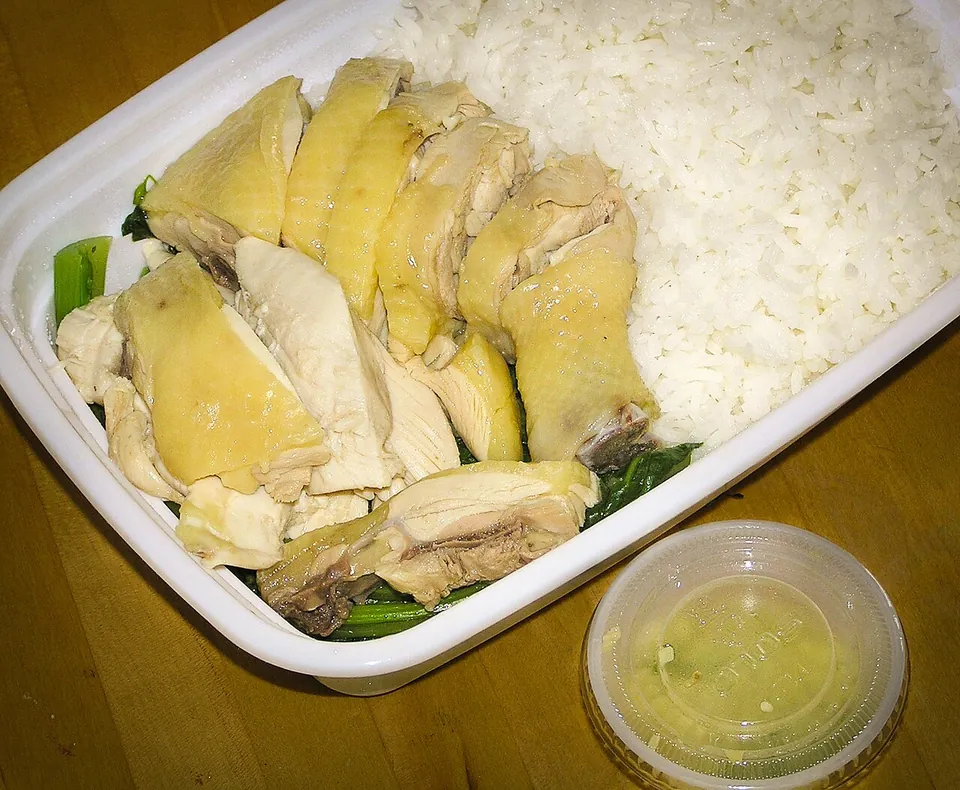
Poached chicken, cut up and eaten with ginger and scallion: the Cantonese white cut chicken. This almost austere dish has no inventor's tale, and the old legend that traces it back to the Warring States period gives way once you follow the sources.
Verification highlight popular claim → verdict → evidence
Myth: the dish dates back to the Warring States-era Chu kingdom's lu ji (露雞/魯雞). Verdict: refuted — the very academic paper cited for this claim (Xing & Su, 2022) states no direct evidence exists and that most scholars place the origin in the Qing dynasty. Key source: the dish's first confirmed appearance in writing is Yuan Mei's Suiyuan Shidan (隨園食單, 1792), recording 白片雞.
The three gates
- Ingredient-supply gate
- Chicken is native; the dish calls for good-quality local breeds such as Qingyuan chicken.
- Cooking-technique gate
- The chicken is poached at low temperature (steeped rather than boiled) to preserve the texture of skin and meat.
- Venue gate
- A staple of Cantonese homes and restaurants, and an offering at ancestral rites.
Overview
White cut chicken (bai qie ji) is a Cantonese dish of a whole chicken poached at low heat, as if steeped rather than boiled, then cut up on the bone and eaten with a ginger-and-scallion condiment. Keeping the water below a rolling boil and letting the heat work gently leaves the skin glossy and the flesh moist. The seasoning is minimal, so the quality of the bird decides whether the dish succeeds.
For that reason, choosing the chicken is everything. A good local bird, such as the sanhuang or the Qingyuan variety, is the premise of the dish. The chicken was a long-established farm animal in Guangdong, on everyday tables from early on. The care goes not into sourcing the ingredient but into judging the temperature of the water.
The dish first appears in writing in the Qing era. The earliest firm record is the 'bai pian ji' in the Suiyuan Shidan, compiled by the Jiangnan literatus Yuan Mei in the fifty-seventh year of Qianlong (1792), where he praises the plain taste of a plump chicken cut into white slices and notes it as a quick, convenient dish even a wayside inn could make. It was called bai zhan ji in Jiangnan and bai qie in Guangdong, and from the nineteenth century onward it took its place, alongside the Qingyuan bird, in Guangdong's siu mei roast-meat shops, growing into a dish emblematic of Cantonese cooking. Local gazetteers do say the Qingyuan bird had been raised since the Song dynasty, but that is the age of the breed, not the age of the dish.
How we know
White cut chicken has no famous origin story. No celebrated cook devised it, no palace produced it, and no single tale of invention is told. There is, however, one legend about its age.
It holds that white cut chicken was already eaten in the state of Chu during the Warring States period, as 'lu ji.' Claiming an origin that reaches back to the fifth century BC, the story sounds venerable. But the 'lu ji' found in old texts is a word for a chicken dish, and nothing ties it to the particular method of white cut chicken, the quiet low-heat poaching and cooling. A study of the dish's history (Xing and Su, 2022) states that no direct evidence supports this Warring States origin, and that most researchers place the dish in the Qing era. It was an exaggeration of age, taking the antiquity of chicken cookery as a genre and transferring it wholesale onto the origin year of this one dish.
Back on firm ground, white cut chicken was first set down in writing in the 1792 Suiyuan Shidan, and, as the same study confirms, Yuan Mei was the first person to record white cut chicken in words. From there it took some two centuries for the Qingyuan bird and the steeping technique to come together into a dish emblematic of Guangdong. Having no showy origin tale is not a weakness. It tells, plainly, of a folk dish that grew without any single inventor, on nothing more than local ingredients and the control of heat.
The full set of origin theories and the detailed verification log — traceable all the way to their sources — are available on the Japanese edition.
See the full origin theories and verification log (Japanese) →
Related dishes
Shares the key ingredient
- Chicken tikka masalaUnited KingdomC
- Wat (pre-chili Ethiopian stew, earlier layer)Ethiopian HighlandsC
- AjiacoBogotá, ColombiaB
- Jerk chickenJamaicaC
- Soto ayamJava (Indonesia)C
- ShkmeruliGeorgiaB
- Khao man gaiThailandB
- Hainanese chicken riceHainan (China) → SingaporeC
- MoambeCongo (Central Africa)C
- Nyembwe chicken (Poulet nyembwe)Gabon (Central Africa)C
- Chicken yassaSenegalC
- Chicken KievKyiv (Ukraine)C
- Circassian chicken (Çerkez tavuğu)Turkey (Ottoman court) / CaucasusB
- Sopa de limaYucatán (Mexico)C
- Ohn no khao swèMyanmarC
- Kedjenou layer (canari steam-braise)Côte d'IvoireC
- WaterzooiFlanders (Belgium)C
- Soup currySapporo (Japan)B