All dishes / 中東・北アフリカ
Circassian chicken (Çerkez tavuğu) Period BOrigin theory BVerified
Some fields (dish name, region and gates) are shown from the Japanese-edition data.
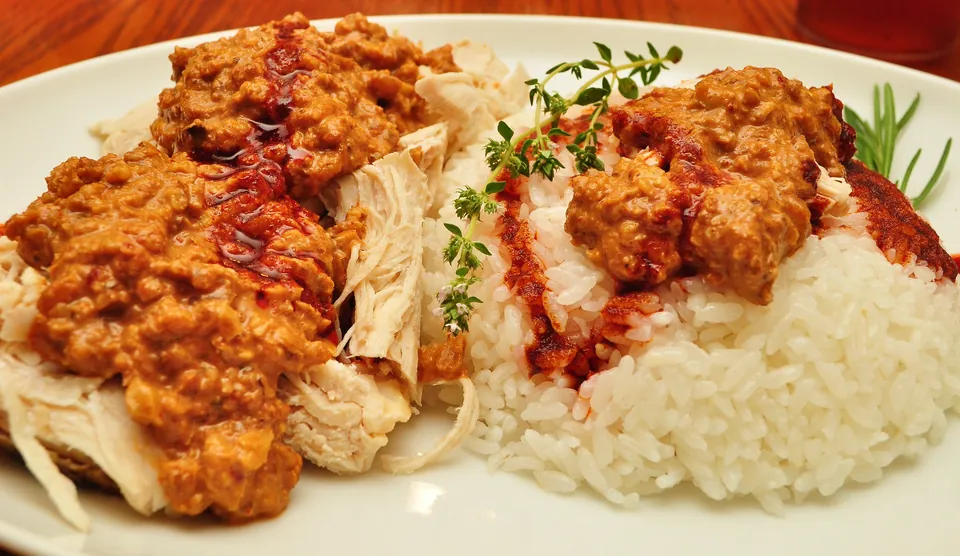
Çerkez Tavuğu, brought by the Circassians of the Caucasus, binds shredded chicken with ground walnuts in a cold sauce. A main dish that reached the Ottoman table in the nineteenth century, it went on to become a staple Turkish meze.
Verification highlight popular claim → verdict → evidence
This is a Caucasian dish (ground walnuts, chicken, and bread in a sauce) said to have been carried into Anatolia by the mass emigration that followed the Russo-Circassian War of the 1860s. It is recorded in the 1883 Ottoman cookbook Ev Kadini (Ayse Fahriye) by Aysse Fahriye -- the earliest documented appearance, per Library of Congress catalog records -- consistent with a path from 1860s emigration to documentation by the late 19th century. The account that Circassian women brought it into the Ottoman court via the harem at Topkapi Palace, where it was refined before spreading to everyday meze, complements rather than contradicts the immigrant-origin account. A claim that it entered Ottoman cuisine as early as the early 17th century lacks documentary support and is rejected.
The three gates
- Ingredient-supply gate
- Chicken, walnuts, and bread were all already native to the region, so the food-supply constraint is loose. The real limiting factor was not an ingredient but the presence of a community of bearers — Circassian immigrants.
- Cooking-technique gate
- The dish depends on a cold walnut-sauce technique from the Caucasus, in which ground walnuts are thickened with bread (or hardtack).
- Venue gate
- It moved from Circassian immigrant households into Ottoman court kitchens (via the harem), and from there into everyday meze.
Overview
Circassian chicken (Çerkez Tavuğu) is a dish that comes from the Circassians of the Caucasus. Poached, shredded chicken is coated in a cold sauce of ground walnuts thickened with bread or stale bread. Chicken, walnuts and bread were all familiar ingredients long present in this region.
This dish took root in Anatolia only after the people who carried it arrived. In the 1860s the war between Russia and the Circassians set off a mass migration; between 1863 and 1865, by some counts up to half a million people resettled in Ottoman territory. Among the foodways they carried into Anatolia and Istanbul was this dish of ground walnuts and chicken.
Once in Ottoman lands, the dish did not stay only on the household table. Its name appears in the cookbook Ev Kadını, published in Istanbul in 1883, and it came to be served at court banquets as well. From home cooking to a palace main dish, and then to a meze eaten by ordinary people, it spread while changing its setting. The cold walnut sauce came from the Caucasus, and the dish sits in a sisterly line with the Georgian satsivi.
How we know
The origin of Circassian chicken is told through two accounts that complement rather than contradict each other. At its core is the view that the dish comes from the Circassians of the Caucasus. The mass migration that followed the Russo-Circassian War of the 1860s carried this dish of ground walnuts and chicken into Anatolia; this thread is supported both by migration history (up to about 500,000 people resettled in Ottoman territory between 1863 and 1865) and by its record in a late-nineteenth-century Ottoman cookbook.
The heart of that record is the cookbook Ev Kadını, published in Istanbul in 1883, whose author was Ayşe Fahriye. The catalog of the Library of Congress holds this edition, and it makes firm that the name Çerkez Tavuğu had entered the written record by that year. The date lines up neatly with the arc of the origin account: from the migration of the 1860s to its appearance in print at the end of the century.
At the same time, a few confusions and misdated stories have clung to the dish. Some recipe collections claim it was taken into Ottoman cuisine as early as the beginning of the seventeenth century, but no contemporary record supports that. And the suprême de faisan à la Circassienne served at an 1856 banquet celebrating the Crimean victory was a name from French cookery's manner of garnish, a different dish from this chicken and walnuts; only the similar ring of the name leads people to speak of them as one.
The second account does not deny the Circassian origin but rounds it out. On this view, Circassian migrant women brought the dish in by way of the harem of Topkapı Palace, where it was refined in the court kitchens into a banquet main dish before spreading to the meze of ordinary people. The name kept its Circassian attribution while the dish was adapted at court after its arrival. The people of origin were Circassian; the stage of refinement and spread was the Ottoman court, and the two accounts divide the story between them in just this way.
The full set of origin theories and the detailed verification log — traceable all the way to their sources — are available on the Japanese edition.
See the full origin theories and verification log (Japanese) →
Related dishes
Shares the key ingredient
- Chicken tikka masalaUnited KingdomC
- Wat (pre-chili Ethiopian stew, earlier layer)Ethiopian HighlandsC
- AjiacoBogotá, ColombiaB
- Jerk chickenJamaicaC
- Soto ayamJava (Indonesia)C
- ShkmeruliGeorgiaB
- Khao man gaiThailandB
- Hainanese chicken riceHainan (China) → SingaporeC
- MoambeCongo (Central Africa)C
- Nyembwe chicken (Poulet nyembwe)Gabon (Central Africa)C
- Chicken yassaSenegalC
- Chicken KievKyiv (Ukraine)C
- Sopa de limaYucatán (Mexico)C
- White cut chickenGuangdong (China)C
- Ohn no khao swèMyanmarC
- Kedjenou layer (canari steam-braise)Côte d'IvoireC
- WaterzooiFlanders (Belgium)C
- Soup currySapporo (Japan)B