All dishes / サブサハラ・アフリカ
Pondu (saka saka) Period BOrigin theory BVerified
Some fields (dish name, region and gates) are shown from the Japanese-edition data.
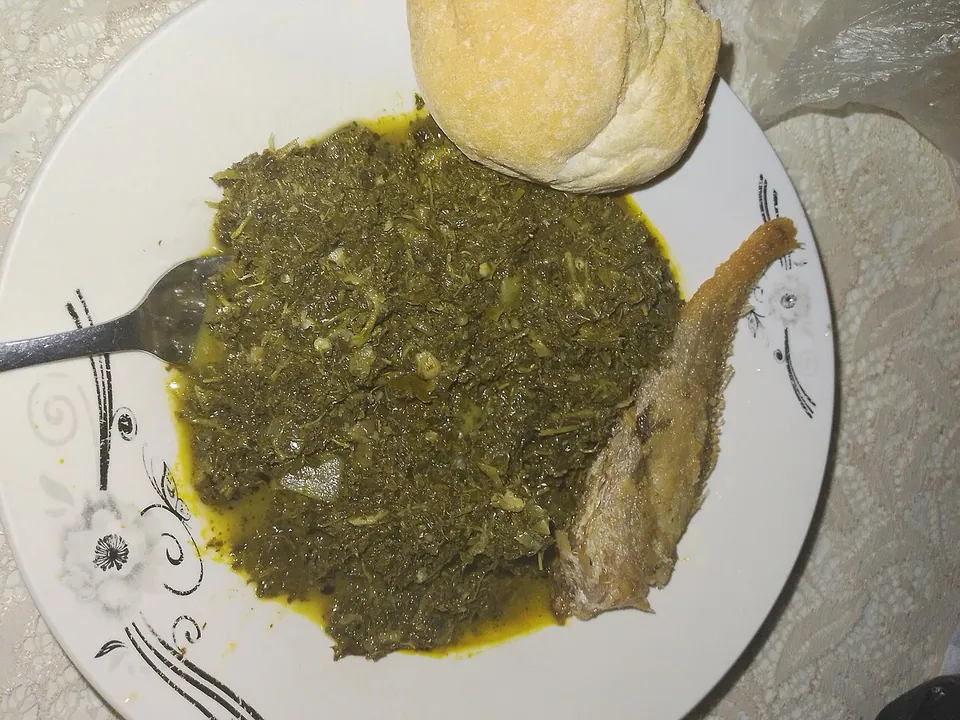
Pondu (saka saka), indispensable on the tables of the Congo Basin, is a greens dish of cassava leaves pounded and simmered at length. No tale survives of who first made it, or of where it began.
Verification highlight popular claim → verdict → evidence
No single inventor or founding legend is recorded for pondu; it is a native Central African dish that could only take its current form after cassava - a New World crop brought by the Portuguese - reached and took root in the Congo Basin in the 16th-17th century. Key source: an 1887 Kongo-language dictionary (Bentley) that records 'ntoba,' a cassava-leaf dish, showing the practice was already established in the old Kingdom of Kongo before Belgian colonization.
The three gates
- Ingredient-supply gate
- Cassava is a New World crop; the limiting factor was cassava reaching and taking root in Central Africa.
- Cooking-technique gate
- Cassava leaves are pounded and simmered for a long time.
- Venue gate
- Everyday home cooking in the Congo Basin.
Overview
Pondu is an everyday dish of central Africa, spanning the Democratic Republic of the Congo, the Republic of the Congo and Angola. In some regions it is called saka saka. Its centrepiece is cassava leaves, pounded soft in a mortar, cooked long with palm oil, and given savour by dried fish and the like. That the leaves, and not only the starchy root, are eaten as greens is a food culture particular to this region.
Cassava was not originally a central African crop. A New World plant native to Brazil, it was brought to the Congo Basin by the Portuguese in the sixteenth century in the course of transatlantic trade. Hardy in drought and poor soil and high-yielding, it had become a staple of the Kingdom of Kongo by the seventeenth century and grew into a pillar that sustained the population.
Once the root had taken hold as a staple, the leaves too became a kitchen ingredient. Pounding and long simmering is local know-how: it draws off the toxic compounds while making the tough, fibrous leaves fit to eat. In this way pondu took shape as a greens dish made over and over in the households of the Congo Basin. Its setting is neither court nor market but the daily table, and that plainness tells its origins well.
How we know
Pondu carries no story of who devised it or when it was born. No single inventor, no year of origin, no anecdote of provenance has come down. It is a household greens dish passed on by word of mouth, and written records reach back no further than the colonial era of modern times.
Even so, it is clear what this dish could not have preceded. Its centrepiece, the cassava leaf, could only be had once a Brazilian crop had crossed the Atlantic and taken root in central Africa. The Portuguese carried the plant to the Congo Basin, and by the seventeenth century it had become a staple of the Kingdom of Kongo—and only after that settling could a dish of the leaves come into being.
The eating of the leaves was set down in writing more than two centuries after the crop had taken root. A dictionary of the Kongo language, compiled in 1887 by the missionary W. Holman Bentley from the speech of San Salvador, the old capital of the Kingdom of Kongo, carries two entries: Ntoba, a dainty dish of cassava leaves, and Lembe, the cassava leaf. In the closing decades of the nineteenth century, years before the Belgian Congo came into being, this way of eating the leaves had already settled into the language. A botanical survey of the Bas-Congo region in the Belgian Congo, published in 1910 by Gillet and Pâque, notes the same practice among local people. No earlier record has been found that ties the dish's beginning to one maker or a particular year. Later food research, too, reports that across Zaire, Congo and central Africa the leaves are eaten as a principal vegetable, and have been called pondu and saka saka (Achidi et al., 2005).
So the first bowl cannot be tied to one maker or a single year. This is not because the dish is obscure, but because it is the result of people working out, little by little in the course of daily life, how to eat the leaves after a new crop had taken root in their land. That no tale of origin survives is itself a way of telling how pondu came to be.
The full set of origin theories and the detailed verification log — traceable all the way to their sources — are available on the Japanese edition.
See the full origin theories and verification log (Japanese) →