All dishes / 東南アジア
Hainanese chicken rice Period BOrigin theory CVerified
Some fields (dish name, region and gates) are shown from the Japanese-edition data.
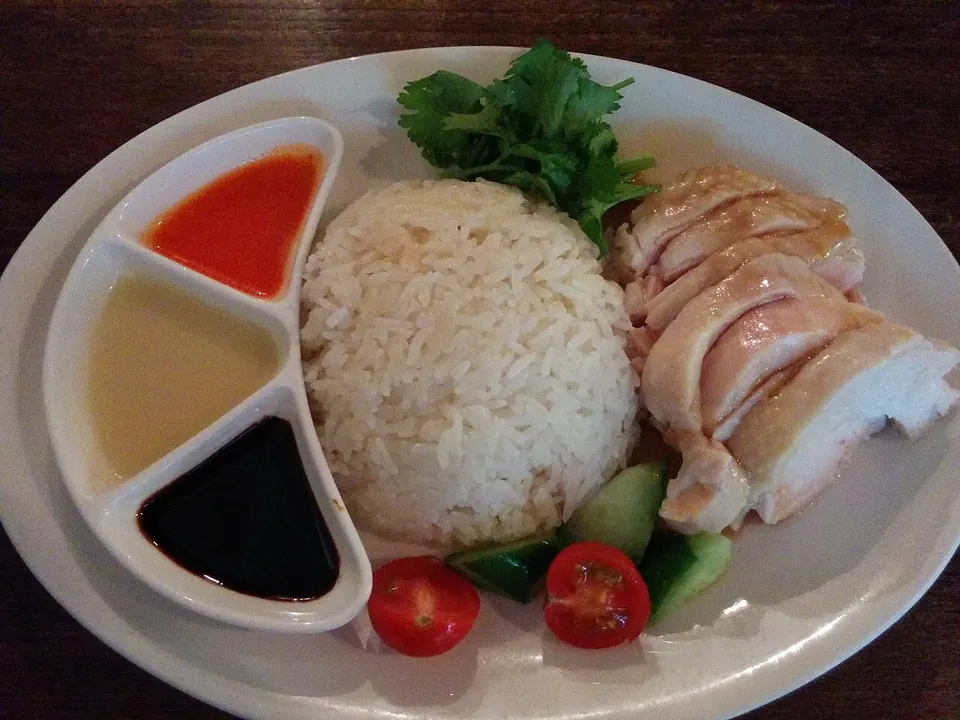
A glistening chicken with rice cooked in its own broth. Hainanese chicken rice is often called Singapore's national dish, yet the name gives away its roots: they lie on the Chinese island of Hainan, and its present form was refined by migrants who carried it across the sea into Southeast Asia.
Verification highlight popular claim → verdict → evidence
Myth: the dish was invented by a single named founder (Wong Yi Yuan, Yet Con, or Swee Kee). Verdict: not supported as sole invention -- these only mark the earliest known shops, not an inventor; the dish descends from Hainan's Wenchang chicken, localized by Hainanese migrants in Singapore/Malaya in the 1920s-1940s. The Singapore vs. Malaysia origin dispute remains unresolved, since both were part of British Malaya before 1965. Key sources: NTU academic repository, Singapore Intangible Cultural Heritage, NLB Singapore Infopedia.
The three gates
- Ingredient-supply gate
- Both chicken and rice are native staples (unlikely to be the limiting ingredient).
- Cooking-technique gate
- The chicken is poached whole just below boiling point, and the rice is cooked in the resulting broth and chicken fat with ginger, garlic, and pandan.
- Venue gate
- urban eating houses, coffee shops, and hawker centers. popular/working class. eating out. Hainanese Chinese immigrants.
Overview
Hainanese chicken rice is a whole chicken poached slowly in water kept just below the boil, served alongside rice cooked in that poaching broth and rendered chicken fat, scented with ginger, garlic, and pandan. In Singapore it is a fixture of the hawker centres and coffee shops, one of the plates people reach for every day.
Both the chicken and the rice have long been local to this region. What defines the dish is the way the bird is coaxed to tenderness in gently simmering water so its savour is not driven off, and how that savoury broth and fat are then drawn into the rice as it cooks. This method of cooking is the technique carried down at the heart of the dish.
The prototype goes back to Wenchang chicken, a chicken dish from the island of Hainan. From the late nineteenth into the early twentieth century, migrants leaving Hainan for the Nanyang—the Chinese term for Southeast Asia—brought the dish with them, and from the 1920s through the 1940s they set up stalls and eating houses in Singapore and elsewhere. Cantonese techniques and local touches such as pandan were folded in, and the Hainanese chicken rice we know today took shape. Hainan is the common source from which a family of chicken-rice dishes branched out—into Singapore, Malaysia, and Thailand's Khao Man Kai—and this dish stands at the trunk of that tree.
How we know
The big question—where Hainanese chicken rice came from—has a settled answer. The prototype is the Wenchang chicken dish of Hainan island, and Hainanese migrants raised it into its present form across Southeast Asia in the first half of the twentieth century. Singapore's National Heritage Board record of intangible cultural heritage, a study from Nanyang Technological University, and Singapore's National Library Infopedia all agree on this line of descent. Because the Wenchang breed of chicken was not available abroad, migrants substituted local birds and kept only the practice of cooking the rice in the poaching broth—a clear trace of the transplant remains.
What is not settled is a different question: who, or which shop, made it first. A street vendor named Wang Yiyuan is said to have sold balls of chicken rice wrapped in banana leaf in the 1920s; the eating house Yet Con is said to have opened in 1940; Moh Lee Twee of Swee Kee is credited with popularising it from 1949. Several individuals and shops are named as the originator.
But these opening dates are the earliest datable signs that chicken rice existed as food sold to the public—not proof that any one person invented the present form. Moh Lee Twee himself trained under Wang Yiyuan rather than creating the dish from nothing. It is more accurate to see today's Hainanese chicken rice not as one person's invention but as the gradual work of many operators refining it, from the street stalls of the 1920s to the shophouses of the 1950s.
What complicates the pedigree further is a tug-of-war between nations. Hainanese chicken rice is widely known as Singapore's national dish, while Malaysia also claims to have devised it. In 2009 a Malaysian tourism minister declared it uniquely Malaysian and said other countries had hijacked it (later explaining the remark had been misquoted); in 2018 a finance minister also weighed in on the dish. As the sociologist Janine Chi argued in a 2014 paper, this is a contest over turning food into a national brand—gastronationalism. Yet Hainanese migrants settled across the whole of British Malaya, and Singapore and Malaysia only separated in 1965. Before that they were a single sphere, so there is no way to decide whose invention it was.
The trunk—that it came from Hainan—holds firm, while the branch tips—who was first, whose country it belongs to—remain open. In that lies the pedigree of a popular dish raised by migrants.
The full set of origin theories and the detailed verification log — traceable all the way to their sources — are available on the Japanese edition.
See the full origin theories and verification log (Japanese) →
Related dishes
Cross-links Sister dishes & same-name dishes (separate lineage)
- Spread from hereKhao man gaiThailandB
- Diffusion prototypeWenchang chicken riceWenchang, Hainan (China)C
Shares the key ingredient
- Chicken tikka masalaUnited KingdomC
- Wat (pre-chili Ethiopian stew, earlier layer)Ethiopian HighlandsC
- AjiacoBogotá, ColombiaB
- Jerk chickenJamaicaC
- Soto ayamJava (Indonesia)C
- ShkmeruliGeorgiaB
- MoambeCongo (Central Africa)C
- Nyembwe chicken (Poulet nyembwe)Gabon (Central Africa)C
- Chicken yassaSenegalC
- Chicken KievKyiv (Ukraine)C
- Circassian chicken (Çerkez tavuğu)Turkey (Ottoman court) / CaucasusB
- Sopa de limaYucatán (Mexico)C
- White cut chickenGuangdong (China)C
- Ohn no khao swèMyanmarC
- Kedjenou layer (canari steam-braise)Côte d'IvoireC
- WaterzooiFlanders (Belgium)C
- Soup currySapporo (Japan)B