All dishes / 東南アジア
Gado-gado Period BOrigin theory CVerified
Some fields (dish name, region and gates) are shown from the Japanese-edition data.
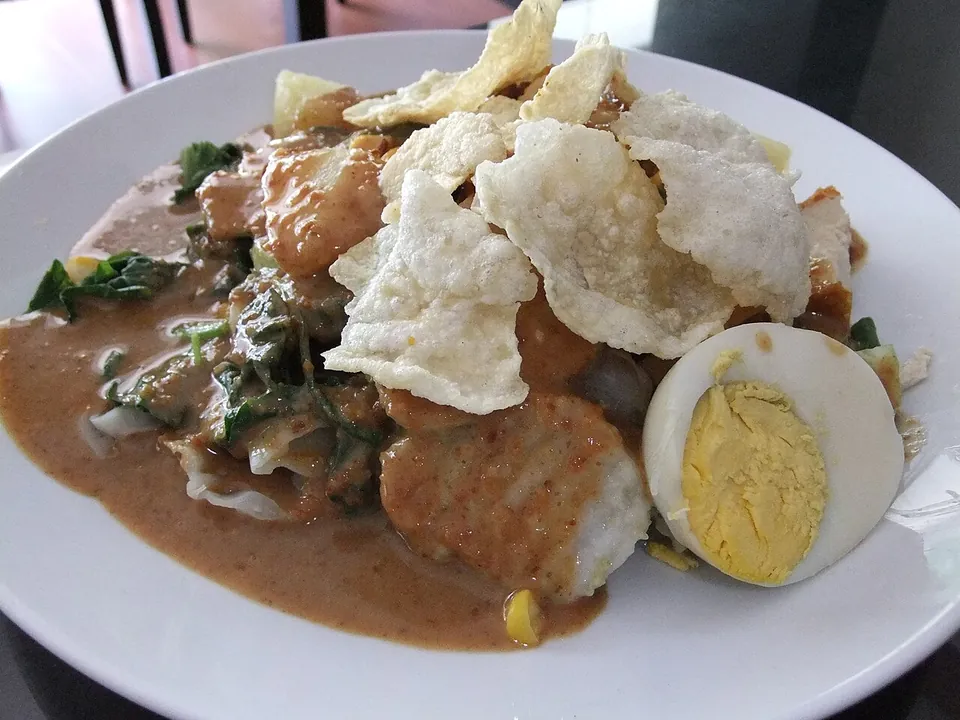
Gado-gado, a Javanese salad of boiled vegetables bound in a rich peanut sauce. The neat, oft-repeated tale that its name comes from a Portuguese word for livestock feed turns out to be a chance resemblance, at odds with the etymology the dictionaries have traced.
Verification highlight popular claim → verdict → evidence
The claim that the name 'gado-gado' derives from Portuguese 'gado' (livestock/fodder) is rejected: both the OED and Wiktionary trace it instead to a Betawi/Javanese reduplication of 'gado' (as in nggadho, 'eat without rice'), making the Portuguese resemblance a false cognate. Peanuts themselves are a New World crop that reached Java through Portuguese trade, setting a hard lower bound (around 1700) for a peanut-sauce dish built on an older native boiled-vegetable salad (pecel/urap); who exactly adapted that salad into gado-gado -- Betawi/Sundanese cooks, Chinese residents reworking pecel, or the Portuguese-descended community of Tugu village -- remains an open, unresolved question.
The three gates
- Ingredient-supply gate
- Provisional: peanuts are a New World crop that reached Southeast Asia via Portuguese/Spanish trade, setting a hard physical lower bound; a peanut-based sauce could not exist before that arrival.
- Cooking-technique gate
- Provisional: roasting and grinding peanuts into a sauce.
- Venue gate
- Provisional: Javanese markets, street stalls, and home-style mixed salads.
Overview
Gado-gado is an Indonesian dish of boiled or steamed vegetables, served with hard-boiled egg and tempeh and dressed in a sweet-savory peanut sauce. It has long been eaten in the markets, at the street stalls, and in the homes of Jakarta and western Java. Its very form, an assortment of ingredients tossed together on one plate, is echoed in its name: a Betawi word meaning 'to eat without rice' is held to be the source.
The peanut at the heart of this dish was originally a South American plant. As Europeans widened the trade that linked the New World to the rest of the globe, the peanut traveled by sea aboard Portuguese and other ships and reached Southeast Asia between the sixteenth and eighteenth centuries. Only once the peanut had crossed the sea and taken root in Java could the roasted, ground, thick sauce of today's gado-gado come into being.
The habit of dressing vegetables to eat them, however, was older than the peanut in Java. The boiled-vegetable salads known as pecel and urap are just such dishes: long-established local foods, on everyday tables from early on. Gado-gado grew where a peanut sauce settled over this lineage of vegetable dishes. It stands at the meeting point of an old way of eating and a new ingredient.
How we know
One well-turned story has long been told about where the name gado-gado comes from. Portuguese freed slaves who settled in the village of Tugu, near Jakarta, are said to have thrown together whatever vegetables were on hand, a heap that looked rather like livestock feed, and so, the tale goes, the name derives from gado, the Portuguese word for cattle.
But the path the word has actually taken, as traced by the dictionaries, does not line up with the story. Both the Oxford English Dictionary and Wiktionary place the origin of gado-gado in a reduplication of the Betawi and Javanese gado, that is, nggadho, 'to eat without rice.' It has no genealogical link to the similar-looking Portuguese gado; the two merely happen to sound alike. The livestock-feed story is a later reading of meaning into that coincidence.
Setting the name aside, the broad view of the dish's own development largely agrees. Gado-gado grew from the local boiled-vegetable salads of western Java, pecel and urap, by taking on a peanut sauce; this far the accounts concur. Where they part is in the detail of who carried that change. Some tell of a food the local people had long eaten growing of its own accord; others of Chinese residents of Betawi reworking pecel to suit their own taste; still others of the food of the Portuguese-descended settlers of Tugu casting its shadow. All agree, at least, in that none of it could hold together before the peanut had reached this land. The name first appears in print in 1924, in a report of the Netherlands Indies public health service, the earliest instance known. That marks not the moment the dish was born, but the time when a plate already rooted was at last written down.
The full set of origin theories and the detailed verification log — traceable all the way to their sources — are available on the Japanese edition.
See the full origin theories and verification log (Japanese) →
Related dishes
Shares the key ingredient
- SuyaNigeria (Hausa)C
- SatayJava (Indonesia)C
- Muamba nsusuRepublic of the Congo (Central Africa)B
- MaafeSenegalC
- NdoléCameroon (Central Africa)C