All dishes / 西欧
Anglo-Indian curry (curry powder) Period BOrigin theory BVerified
Some fields (dish name, region and gates) are shown from the Japanese-edition data.
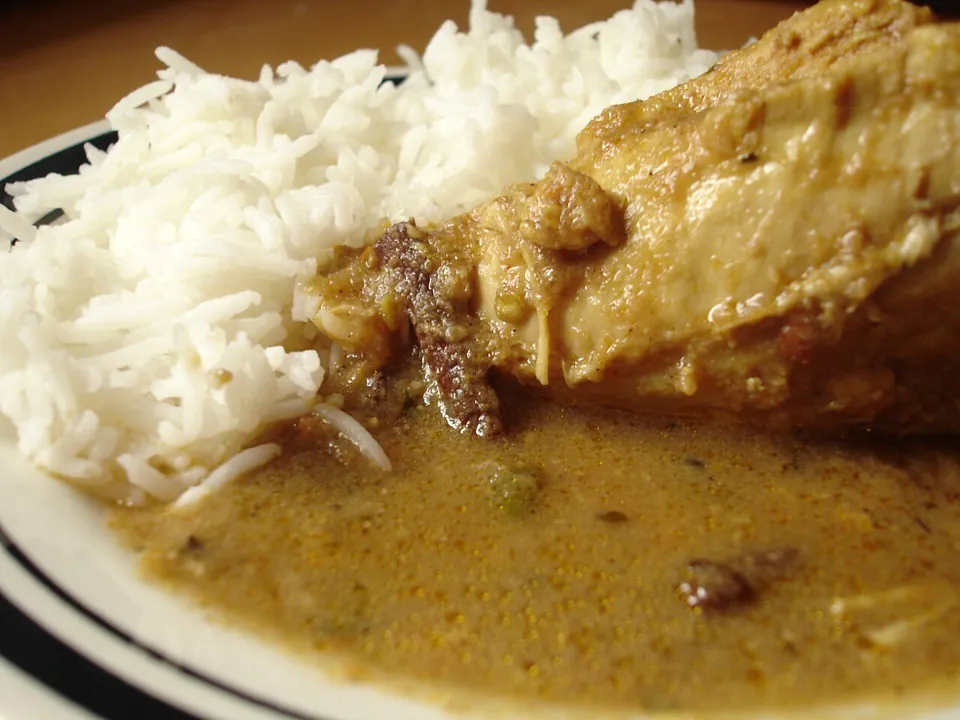
British curry is often imagined as a single Indian dish carried whole to Britain. In truth it is an adaptation: in the colonial era the British fixed a blend of spices in a bottled powder and rebuilt the dish to suit their own kitchens.
Verification highlight popular claim → verdict → evidence
Myth: British curry is simply India's single native "curry" dish transplanted unchanged to Britain. Verdict: rejected -- there was no standardized "curry powder" or single "curry" dish in India; curry powder is a British colonial invention that reconstructed and standardized Indian cooking. Key source: Lizzie Collingham, Curry: A Tale of Cooks and Conquerors (Oxford University Press, 2006), corroborated by an 1784 Morning Post advertisement for Sorlie's curry powder (British Library).
The three gates
- Ingredient-supply gate
- Commercial "curry powder" -- a fixed blend of Indian spices standardized in Britain -- sets the lower bound; the earliest commercial curry powder was advertised in late-18th-century London.
- Cooking-technique gate
- The traditional British technique of thickening sauce with a wheat-flour roux.
- Venue gate
- Spread from the tables of colonial returnees and administrators to the British middle class.
Overview
The lead role in British curry is played not by any one dish but by a single jar — the commercial curry powder. The many sauces that Indian households ground and blended fresh, spice by spice, for each day's cooking, the British collapsed into one powdered blend. Turmeric, coriander, cumin and the rest were combined in advance, bottled, and sold. Only once this jar of powder stood on the shop shelf, so that anyone could buy the same blend, could the British middle class reproduce 'curry' at home.
The traces of that commercialisation can be followed in London newspaper advertisements. In December 1773 the Norris Street Coffee House in the Haymarket advertised 'ready dressed curey and rice' and 'India pilaws.' Curry served as a dish was already an article of trade by then. The powder itself came a little later: in 1784 Sorlie's of Piccadilly put a commercial curry powder on sale. In the earlier cookbooks, Hannah Glasse's first edition of 1747 gave a plain preparation with only pepper and coriander; turmeric and ginger enter from the fourth edition of 1751. These records suggest the blend took its shape gradually, on the British side.
The finishing method, too, was British. Where an Indian sauce builds body and flavour from the spices themselves, the British version thickens the liquid with a flour roux. Curry was placed on the continuation of a kitchen well practised in making gravy. So the spices became a pre-mixed powder, the sauce took on a British thickness, and an Indian dish was transposed into the logic of the British table.
Those who spread it were the officials and soldiers returning from British India. From the tables of men trying to reproduce at home the flavour they had learned on posting, curry spread as a domestic dish. And this British curry later crossed to Japan by way of the Royal Navy and became the parent of Japanese curry rice. This one plate was the bridge that ran between the spiced cooking of India and the curry rice of Japan.
How we know
Curry is one Indian dish, and it passed to Britain as it was — this long-told understanding does not hold up under the scrutiny of food history. There was, to begin with, no standardised spice called 'curry powder' in India and no single dish called 'curry.' Curry was an English-side umbrella term that gathered India's many stewed dishes under one name, borrowed from the Tamil kaṟi (sauce). The bottled curry powder, for its part, was an invention worked up for the British market with a simplified blend — a different thing from the masala ground fresh across India every day. Cecilia Leong-Salobir's study of food culture in colonial Asia (2011) sets out both of these discrepancies plainly.
The dates of commercialisation can be checked against London primary sources. The earliest advertisement for a commercial curry powder is Sorlie's of 1784, the actual copy of which survives in the Morning Post held at the British Library. Earlier still, the Public Advertiser of December 1773 carries the Norris Street Coffee House advertisement, where ready-dressed curry and rice were already for sale. Curry as a dish had become an article of trade in Britain a full eleven years before the powder. The first record of a sale does not mark the origin itself, but these two advertisements fix the span of time over which curry was commercialised in Britain.
Lizzie Collingham's Curry: A Tale of Cooks and Conquerors, among other works of food history, places British curry as a British reconstruction of Indian cooking. Not a native Indian dish carried over intact, but something the British fixed inside a jar and rebuilt with a flour thickening — that view is now the settled one.
The full set of origin theories and the detailed verification log — traceable all the way to their sources — are available on the Japanese edition.
See the full origin theories and verification log (Japanese) →