All dishes / 東南アジア
Satay Period BOrigin theory CVerified
Some fields (dish name, region and gates) are shown from the Japanese-edition data.
Satay is told as both an ancient Javanese grilled skewer and an Asian cousin of the kebab. Yet the origins of the grilled meat and even the name remain contested, and its familiar peanut face is a later layer, added only after New World groundnuts had crossed the seas to Southeast Asia.
Verification highlight popular claim → verdict → evidence
A folk etymology claims satay's name comes from Hokkien Chinese "saⁿ tè" ("three pieces [of meat]"), but the Oxford English Dictionary and Wiktionary both label this a false etymology; the accepted derivation is Malay satai from Tamil catai ("meat"). Historians remain divided over whether satay grew out of native Javanese skewer cooking (attested in 9th-10th century Mataram inscriptions) or from Middle Eastern kebab and South Asian influence carried by traders, with the peanut sauce added only after peanuts reached Southeast Asia in the 16th-18th centuries.
The three gates
- Ingredient-supply gate
- Peanuts are a New World crop that reached Southeast Asia no earlier than the 16th century (the physical lower bound). Skewered grilled meat itself is native.
- Cooking-technique gate
- Direct grilling over charcoal on skewers, and a ground-peanut sauce.
- Venue gate
- street stalls / common people / market / Javanese
Overview
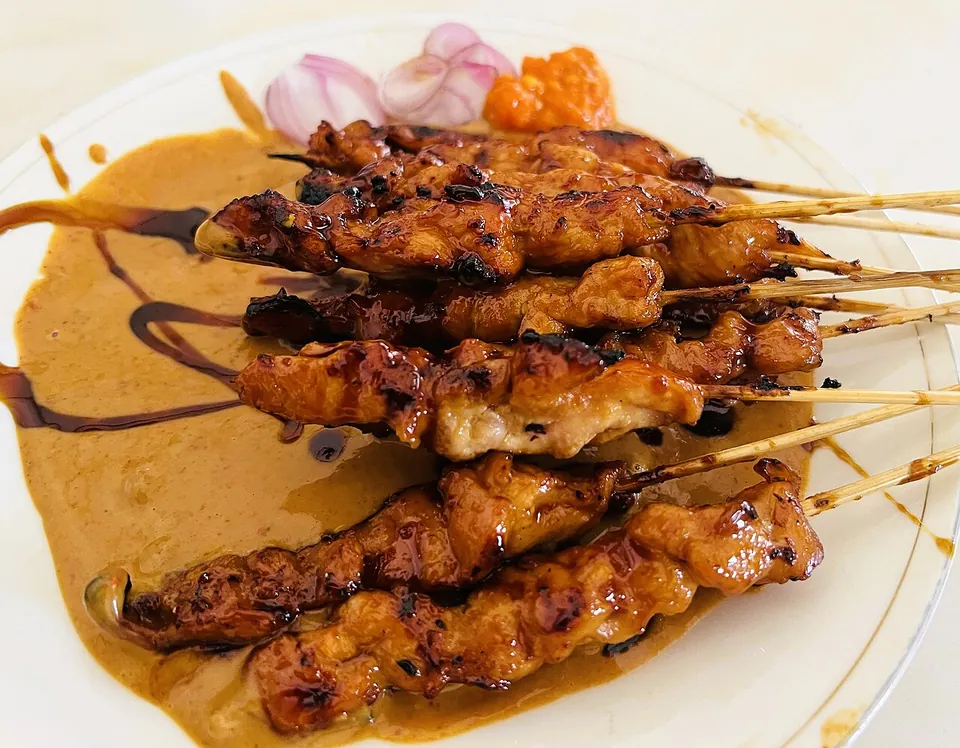
Satay is a Javanese dish of small pieces of meat threaded on skewers, grilled over an open charcoal fire, and served with a sauce of ground peanuts. Smoke rising from the coals, sold and bought at the market, it has long been rooted in the street as an everyday food of ordinary people.
The grilled meat itself is old in Java. Stone inscriptions from the Mataram period, in the ninth and tenth centuries, record a dish of minced water buffalo, evidence that a tradition of skewered and minced meat ran deep in this land. So the age of something that resembled satay and the moment the dish we now call satay took its present shape are two separate questions.
What completed that present shape was the peanut sauce. The groundnut is a New World crop, and it reached Southeast Asia only from the sixteenth century onward, carried across the Pacific on the Spanish Manila galleons. Until the peanut crossed the sea and arrived in these kitchens, a satay dressed in a sauce of ground legumes had no way of coming into being. Onto the old foundation of grilled meat the newcomer was laid, and by the nineteenth century the sauced dish had settled into the street. The Dutch word sate is recorded in Java, with a photograph, around 1870, and the English satay first appears in 1917 — dates that sit with a dish whose form was set between early modern and modern times.
Neither the open charcoal fire nor the handwork of grinding peanuts calls for special equipment. Satay was therefore never confined to one class; it spread from stall to home, and took hold as a cheap food of the market and of everyday people.
How we know
Satay's beginnings come in two accounts that give no ground to each other.
One is the foreign account, which casts satay as an Asian version of the kebab. It holds that grilled meat brought by the kebabs of the Middle East, and by Tamil and Gujarati Muslim traders from South Asia, reached the port towns of Java through the trade and migration of roughly the eighteenth century, and developed there. Chinese contributions — the bamboo skewer and the cutting of meat into small pieces — are said to have fused in as well. This view once leaned mainly on Wikipedia, but on re-examination the public reference of Singapore's National Library Board (Infopedia) was found to trace satay's source back to the Arab kebab independently, and the footing grew a step firmer.
The other is the native Javanese account. It once rested on weak footholds: a fifteenth-century newspaper item deriving the name from Javanese sak beteng (one skewer), and the reliefs of the Cabean Kunti site in central Java, dated eighth to tenth century. Re-examination replaced these with firmer sources. Mataram-period inscriptions (Taji, 901; Mantyasih I, 907, among others) record a dish of minced water buffalo, akin to the sate lilit of modern Bali, as held by the provincial museum Sonobudoyo in Yogyakarta. The native tradition of skewered and minced meat now reaches back to ninth- and tenth-century Java not as hearsay but as a record cut in stone.
A folk story clung to the name as well. The English satay has widely been derived from the Hokkien saⁿ tè bah, three slices of meat, but both the Oxford English Dictionary and Wiktionary mark this as a false or unlikely etymology. The scholarly derivation runs through Malay satai/sate back to Tamil catai, meat; the three-slices tale is simply one that has been set aside.
The foreign account has its footing in a public source, the native account in stone, and the two cross without converging into a single line. The lineage of the grilled meat remains unsettled between foreign and native. Only one point is firm. Scholarship (Amano et al., 2021) places the groundnut's arrival in Southeast Asia through the galleon trade in the sixteenth to eighteenth centuries, so the peanut sauce — the present face of satay — belongs to a new layer that could only follow the New World crop's arrival, a thing that can be said without waiting for the question of origins to be settled.
The full set of origin theories and the detailed verification log — traceable all the way to their sources — are available on the Japanese edition.
See the full origin theories and verification log (Japanese) →
Related dishes
Shares the key ingredient
- SuyaNigeria (Hausa)C
- Gado-gadoJava (Indonesia)C
- Muamba nsusuRepublic of the Congo (Central Africa)B
- MaafeSenegalC
- NdoléCameroon (Central Africa)C