All dishes / サブサハラ・アフリカ
Maafe Period BOrigin theory CVerified
Some fields (dish name, region and gates) are shown from the Japanese-edition data.
Maafe, the West African peanut stew, is often introduced with a flat statement: that it was born in Senegal and was unknown in Mali until it was carried there. That sentence travels without a source behind it, and the name of the dish itself comes from the Mandinka and Bambara speech of Mali.
Verification highlight popular claim → verdict → evidence
A line that circulates widely has maafe born in Senegal and unknown in Mali until it was carried there. In the Wikipedia article that prints it, that sentence carries no citation, and the same article elsewhere calls the stew Mandinka and Bambara and notes that its origin is often confused with that of tigadegena, the older stew made from the native Bambara groundnut. Britannica has maafe originating in Mali and spreading to Senegal and Gambia during the colonial drive for groundnuts, and the name points the same way: the linguist Valentin Vydrine reads maafe as a Manding word for sauce. The peanut itself is South American and came to West Africa on Portuguese trade between about 1570 and 1650 (PROTA), so a stew built on it cannot be older than that, while the boom in commercial groundnut growing, which by 1851 gave peanuts 72 per cent of Gambian exports (Brooks 1975, Journal of African History), is when the dish became everyday fare rather than when it began. The milder form of the Senegalese account, that the rice-plate version with its creamy peanut sauce settled in colonial Senegal, stands beside the Malian tradition rather than against it. The year the dish or its name first appears in writing has yet to be found.
The three gates
- Ingredient-supply gate
- The peanut (Arachis hypogaea) is a South American crop, and it reached West Africa on Portuguese Atlantic trade in the later sixteenth century, in a window running from about 1570 to 1650 (PROTA). The stew built on that nut can be no older than its arrival. Tomato is a New World crop as well, reaching West Africa between 1800 and 1849, but here it is a secondary ingredient. Beef, chicken and rice, African rice among them, were local crops or long-settled ones. The nineteenth-century expansion of commercial groundnut growing (Brooks 1975) marks the stage at which maafe became everyday food, not the point from which it could exist.
- Cooking-technique gate
- Peanuts pounded to a paste in a mortar, then simmered in one pot with meat and tomato. A mortar and a pot are enough; nothing beyond ordinary kitchen work.
- Venue gate
- Everyday home cooking across a wide swathe of West Africa, taking in Senegal, Mali and Gambia. It spread outward from the Mandinka and Bambara heartland, and today it is cooked in city eating houses and in the West African diaspora.
Overview
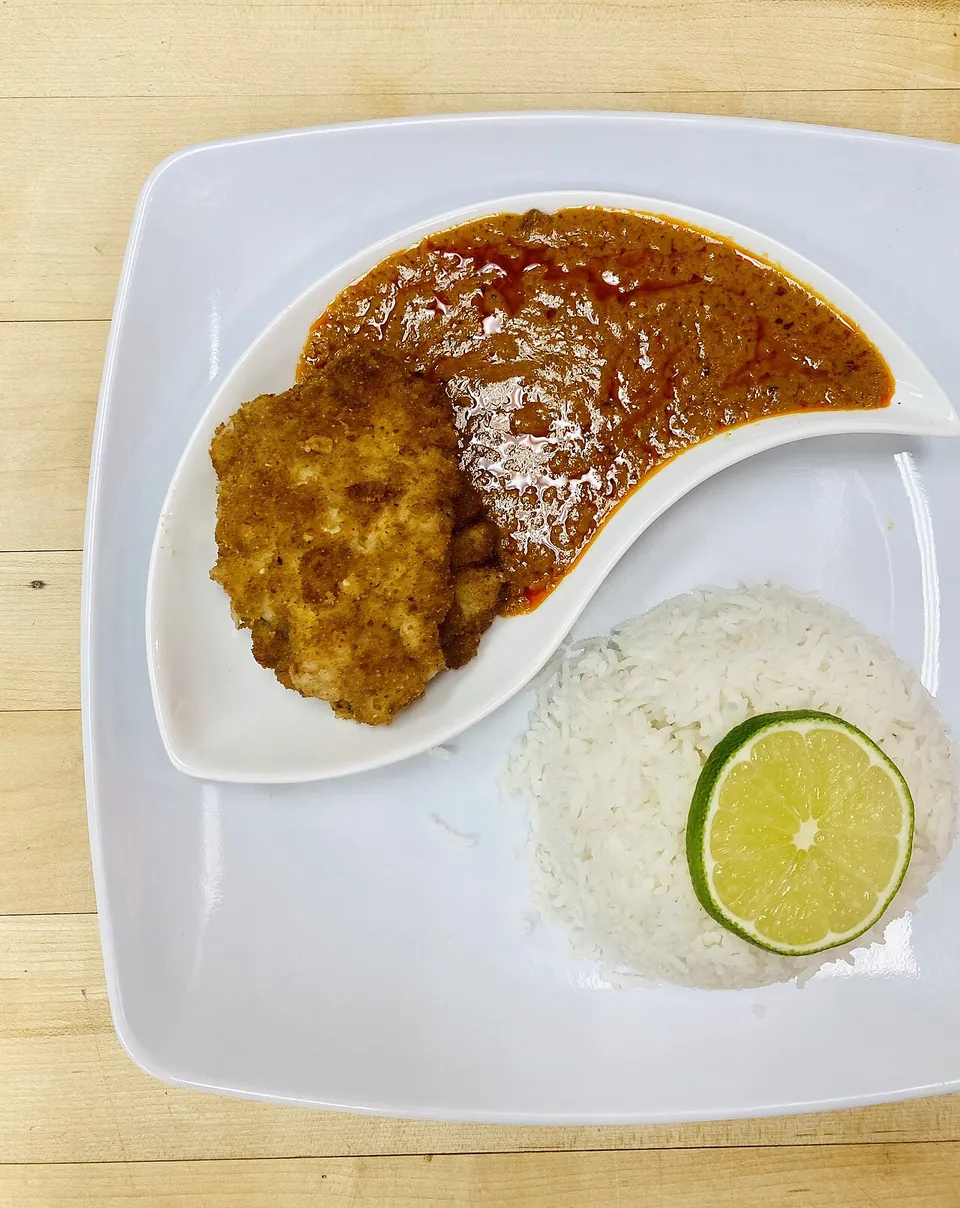
Maafe, also written mafé, is a West African stew of beef, lamb, or chicken simmered in one pot with peanuts. The peanuts are pounded to a paste in a mortar, then cooked down with tomato and the meat until the sauce turns thick and creamy. A mortar and a pot are all the equipment it asks for. It is spooned over rice or fonio, both of them long-established staples of the region.
The peanut at the center of the dish is a South American crop. In the later sixteenth century it reached the Senegambian coast aboard Portuguese Atlantic trade, and from there it moved inland from farm to farm. Until the peanut crossed the ocean and arrived, a stew built around it had no way of coming into being. The year the peanut landed, though, is not the year the stew took shape: the earliest appearance of the name or the recipe in writing has yet to surface. Maafe belongs somewhere in the span between the seventeenth century, when peanuts took root in West African fields, and the nineteenth, when the dish settled into the form it has now.
Peanuts came within everyone's reach later still. Under colonial rule, growing them for export expanded fast — commercial cultivation spread along the Gambia River in the early 1830s and in Senegal in the early 1840s, and by 1851 peanuts made up more than seventy percent of Gambia's exports. With peanuts filling the fields and the markets, and with a dish that begins and ends in a single pot, maafe put down roots as everyday food in households across Senegal, Mali, and Gambia. Today it is a fixture of city eating houses, and it has traveled with West Africans into kitchens overseas.
How we know
Two different stews tend to blur together whenever the beginnings of maafe come up: the peanut maafe eaten today, and an older bean stew the region had been cooking long before. The older line runs to Mali's tigadèguèna, made with the Bambara groundnut, a bean of the country itself. The origin of maafe has repeatedly been mistaken for the origin of tigadèguèna. They belong to different stages, and no single founding story can hold both.
Alongside that confusion runs a much harder claim: that maafe is a colonial-era dish, unknown in Mali before it was brought there from Senegal. The sentence sits in the English Wikipedia article on peanut stew, and nothing is cited for it. Elsewhere on the same page the dish is traced to the Bambara and Mandinka of Mali, and the page itself warns how easily it is confused with tigadèguèna. A blunt assertion with no source behind it, at odds with the rest of the page it appears on, is not much to build on.
The case for the dish taking its present shape among Mandinka and Bambara cooks comes into view from other directions. Encyclopaedia Britannica records that mafé originated in Mali and spread to Senegal and Gambia during the colonial drive for groundnut production. Language points the same way: according to the linguist Valentin Vydrine, maafe belongs with the general Mandinka and Maninka words for "sauce". The name tigadèguèna is built along the same lines, stacking the words for peanut, paste, and sauce. The name of the dish, in other words, was born in the speech of this region.
Does that make the Senegalese account wrong? Not quite. In its narrower form — that the version the world knows today, creamy peanut and tomato over rice, settled in Senegal during the colonial period — it sits comfortably beside a Malian beginning. Place the older tradition in the Mandinka country of Mali and the rice plate in Senegal, and the two sets of records line up without a fight. Nothing so far settles who first put the pot on the fire, and the first year the dish appears in writing has yet to surface. What holds is that a peanut maafe can only be later than the sixteenth century, and that standing beside it is an older stew cooked from a bean of the region.
The full set of origin theories and the detailed verification log — traceable all the way to their sources — are available on the Japanese edition.
See the full origin theories and verification log (Japanese) →
Related dishes
Lineage Family, predecessor, variants
Shares the key ingredient
- SuyaNigeria (Hausa)C
- SatayJava (Indonesia)C
- Gado-gadoJava (Indonesia)C
- Muamba nsusuRepublic of the Congo (Central Africa)B
- NdoléCameroon (Central Africa)C