All dishes / サブサハラ・アフリカ
Suya Period BOrigin theory CVerified
Some fields (dish name, region and gates) are shown from the Japanese-edition data.
Suya, the skewered grilled meat of Nigeria's Hausa country, is often said to have been "invented in 1852." No contemporary record supports that oddly precise date.
Verification highlight popular claim → verdict → evidence
Myth: suya was 'invented in 1852.' Verdict: refuted — no primary source supports a single inventor or date; the claim conflates the commercialization of peanuts in West Africa (1830s-70s) with the dish's invention. Suya instead traces to the Hausa/Fulani pastoralist tradition of grilling meat (tsire); the earliest English-language attestation of the word is only from 1967. Main sources: OED; Brooks (1975).
The three gates
- Ingredient-supply gate
- Beef was long at hand in West Africa, but yaji, the spice mix that defines the dish, is built on the peanut, a New World crop. Its arrival in the region sets the earliest possible date for suya in its present form.
- Cooking-technique gate
- Skewered thin slices of meat grilled over open flame, coated with yaji (ground peanut and spices).
- Venue gate
- Everyday food for ordinary people, sold from stalls on the street and in the open markets where anyone passing by could buy it, and carried across the region along the trading networks of Hausa merchants.
Overview
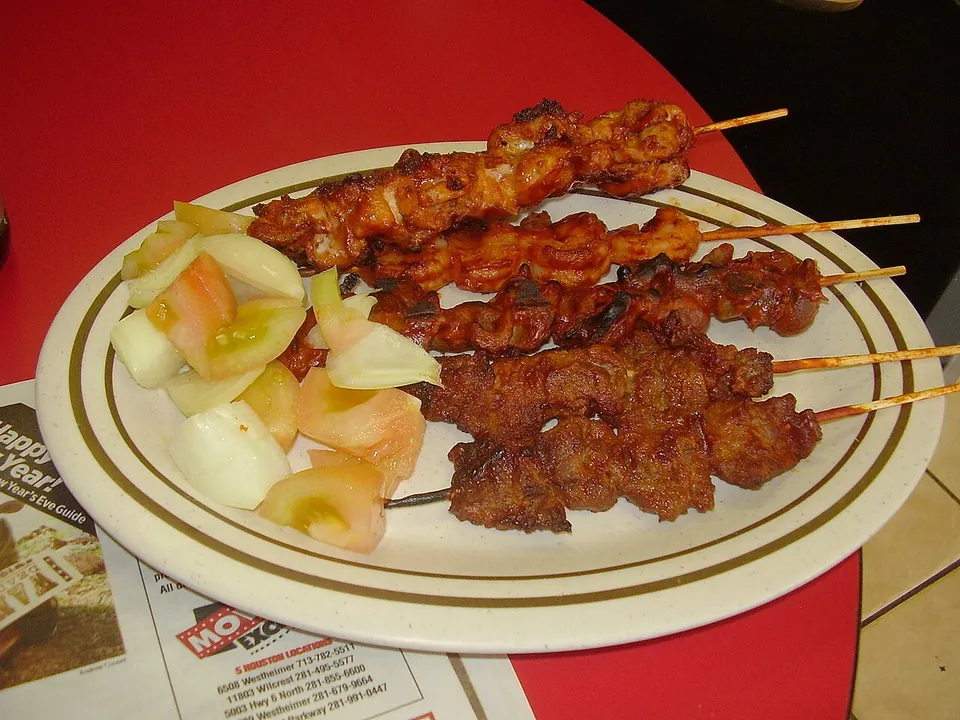
Thin slices of meat are threaded onto skewers, grilled over an open flame, and dusted with yaji, a spice mix built on ground peanut and chili. This is suya, the street snack cherished across West Africa. It took shape in the Hausa country of northern Nigeria, and it came into its present form in the early modern period, after peanuts had settled into the region.
Beef was long at hand in West Africa, and grilling meat over fire was woven deep into local life. Yaji is another matter: its foundation is the peanut, a New World crop. Until the peanut crossed the sea and reached West Africa, that spice mix had no way of coming together. Portuguese traders brought the crop over in the course of their traffic with the Americas in the latter half of the sixteenth century. Today's suya, its meat wrapped in peanut-based yaji, could only have emerged after that arrival.
The method itself is plain: slice the meat thin, skewer it, grill it over flame, and coat it with yaji. Sold from stalls and street corners, it spread across a wide stretch of West Africa along the trade routes travelled by Hausa merchants.
How we know
A curiously specific claim circulates in encyclopedias and the like: that suya was "invented in 1852." Yet no contemporary record ties its beginning to that year or to any particular person.
Food historians trace suya's origins to the Hausa and Fulani herding peoples of northern Nigeria, Niger, and Cameroon. In the long migratory life of the Sahel, it grew up as a way of preserving and cooking meat over a campfire, defined by the skewered meat (known locally as tsire) and by yaji, the spice built on ground peanut. From there it spread along the trade routes across the whole of West Africa. The dish's very name is said to come from the Hausa verb soya, "to fry" or "to roast" (OED), a mark of its roots in this soil.
So why did the year 1852 take on a life of its own? The clue lies in the history of the peanut. Large-scale peanut cultivation began in Senegambia in 1830, and the crop spread as a commodity across West Africa between 1830 and 1870 (Brooks 1975). The years when the peanut, the heart of yaji, became cheap and plentiful line up neatly with 1852. It seems the era when peanuts flooded the markets was mistaken for the year the dish itself was born. The genre of grilled meat is far older among the herding peoples, and the earliest written record of the word (OED) dates to 1967, unconnected to 1852.
What can be said with confidence is that the peanut was not in West Africa until the latter half of the sixteenth century. So today's suya, built around peanut-based yaji, can only be later than that. Not an invention story with a date attached, but this single point marks the earliest that suya could have come to be.
The full set of origin theories and the detailed verification log — traceable all the way to their sources — are available on the Japanese edition.
See the full origin theories and verification log (Japanese) →
Related dishes
Shares the key ingredient
- SatayJava (Indonesia)C
- Gado-gadoJava (Indonesia)C
- Muamba nsusuRepublic of the Congo (Central Africa)B
- MaafeSenegalC
- NdoléCameroon (Central Africa)C