All dishes / 北米
Breakfast taco Period BOrigin theory BVerified
Some fields (dish name, region and gates) are shown from the Japanese-edition data.
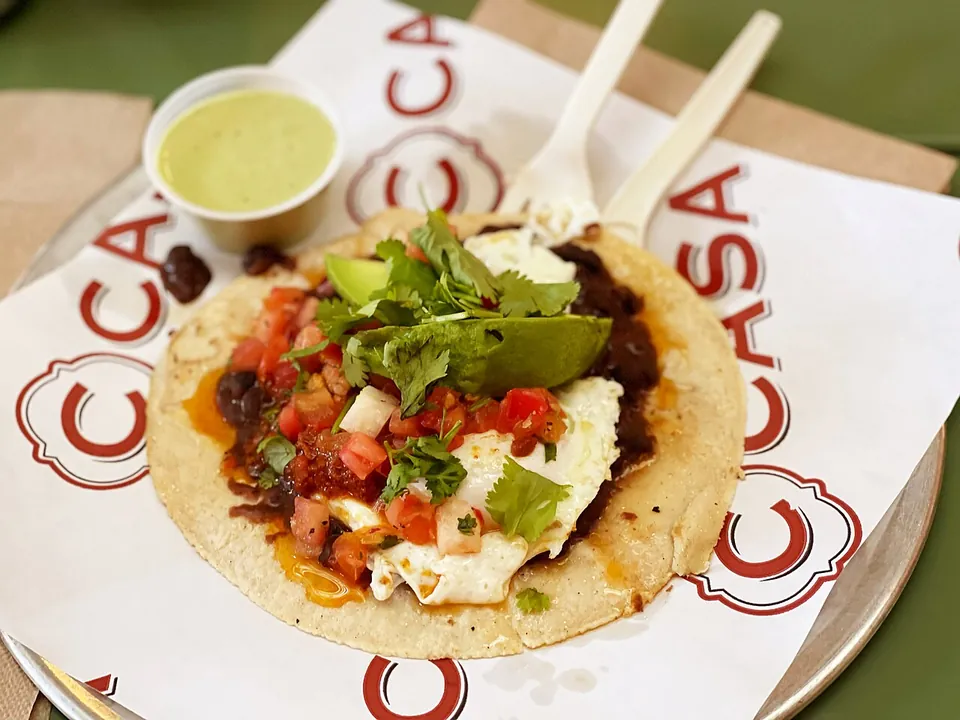
Scrambled eggs folded into a tortilla: a Texas breakfast staple. The claim that 'Austin invented it' set off a full-blown dispute, but food historians reject it as simply wrong.
Verification highlight popular claim → verdict → evidence
Myth: breakfast tacos originated in one specific city (San Antonio, or, per a 2016 claim, Austin). Verdict: no single city or inventor can claim credit -- the earliest print appearance of "breakfast taco" is a July 23, 1975 Arizona Republic article describing San Antonio, with a recipe following in the El Paso Herald-Post in 1976; food historians reject the Austin-origin claim. Key source: Jose R. Ralat, American Tacos: A History and Guide (University of Texas Press, 2020).
The three gates
- Ingredient-supply gate
- Eggs and corn/wheat were already available, so the ingredient bottleneck is loose; the real constraint is the formation of Tex-Mex culture as a "venue."
- Cooking-technique gate
- Filling a tortilla with scrambled eggs and other ingredients, cooked on a griddle/comal.
- Venue gate
- A breakfast among Mexican-American communities in Texas (San Antonio, etc.); it spread through 20th-century urban workers and taquerias.
Overview
The breakfast taco is a Texas breakfast: a warmed tortilla wrapped around scrambled eggs, cheese, and other fillings. Eggs, corn, and wheat were all long-established staples, always on hand in the kitchen.
In South Texas—San Antonio and the Rio Grande Valley—the habit of wrapping fillings in a tortilla was rooted in the mornings of Tejano (Mexican-American) households and workers from the early 20th century. Seared quickly on a griddle or comal, it filled you up fast before heading out to work. Out of that daily routine, this breakfast took its shape. The English name 'breakfast taco' first appears in print in 1975, well after the dish itself.
How we know
In recent years a quarrel dubbed the 'taco wars' broke out over where the breakfast taco began. The spark was a 2016 article suggesting that Austin was the city that gave rise to the 'breakfast taco.'
Food historians see this as mistaken. José Ralat, an editor steeped in Texas tacos, writes in his book American Tacos (University of Texas Press, 2020) that 'no Texas city can claim to have invented' it, and points out that the practice was rooted earlier in the cultures of San Antonio and the Rio Grande Valley. The English name first appears in print in July 1975, on a page describing San Antonio, and the following year a recipe ran in an El Paso newspaper. The name may be recent, but the dish itself belongs to no single city or inventor; it was raised over a long stretch of time by the morning culture of South Texas Tejanos. The Austin-origin claim is rejected as a telling that overlooked that slow making.
The full set of origin theories and the detailed verification log — traceable all the way to their sources — are available on the Japanese edition.
See the full origin theories and verification log (Japanese) →