All dishes / 東欧
Pljeskavica Period COrigin theory CVerified
Some fields (dish name, region and gates) are shown from the Japanese-edition data.
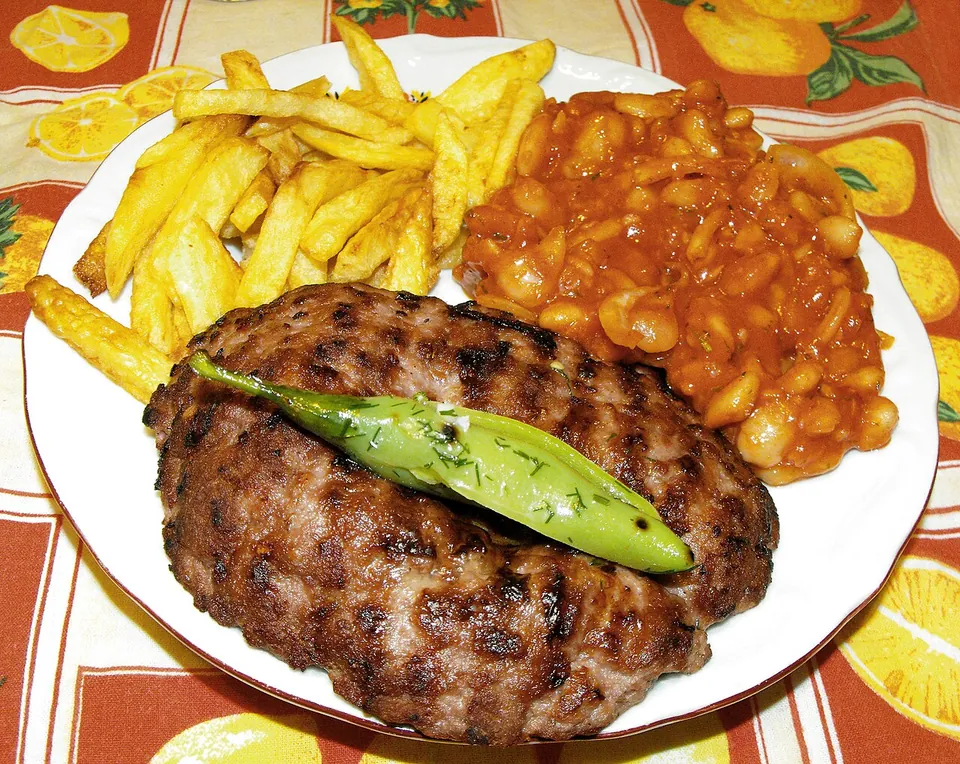
Pljeskavica, Serbia's signature flat grilled patty of minced meat, is often said to hail from Leskovac in the south, and is even billed as reaching back to ancient Assyria or Persia. Both credentials, though, belong not to the moment the dish was born but to tellings arranged in later ages.
Verification highlight popular claim → verdict → evidence
Pljeskavica adapted the ground-meat kofte/kebab cooking traditions that spread across the Balkans under centuries of Ottoman rule into a flat, paprika-seasoned patty by South Slavic cooks; what made it possible was not any local ingredient but the charcoal-grilling technique and modern food-service format. It first appears in print in the 1850s and spread from Leskovac in southern Serbia to Belgrade in the 1860s. The name comes from the Serbian word for 'to slap,' describing how the patty is shaped by hand. Scholars note that the story crediting Leskovac as the sole birthplace was largely built up as a 20th-century Yugoslav-era branding narrative, and the protected geographical-indication status granted since 2008 protects a specific regional label rather than establishing a single birthplace for the whole dish category. Claims tracing the dish to ancient Assyria or Persia are treated as unsupported popular lore lacking documentary evidence.
The three gates
- Ingredient-supply gate
- Ground meat was locally available; the bottleneck was not ingredients but the charcoal-grilling technique and modern food-service format.
- Cooking-technique gate
- Shaping ground meat into a large flat patty and grilling it over charcoal (in the roštilj grill-stand tradition).
- Venue gate
- Everyday street food sold at Balkan food stalls and roštilj grill stands.
Overview
A large disc of minced meat spread over charcoal—pljeskavica stands on the charcoal-grilling gestures rooted across the Balkans. The way it is shaped, patted flat by hand, survives in its name: pljeskati (Proto-Slavic *plěskati), "to slap, to clap," in the South Slavic tongue. The minced meat itself is an ingredient long present in the land, commonplace early on at village hearths and street grills.
Beneath this dish lies centuries of Ottoman-era food culture. Across the Balkans, köfte and kebab dishes of minced meat—rolled into balls or logs and grilled over charcoal—took deep root. It was above all in Ottoman frontier towns such as Edirne, Skopje, Niš, and Leskovac that such grilling grew into an early fast-food trade, and from it emerged the form of minced meat shaped into a large flat disc, seasoned with spice, and grilled. From the same grilling culture grew ćevapi, rolled into finger-sized logs, and pljeskavica is spoken of as a sisterly relation to it.
What colors today's pljeskavica red and rounds out its flavor is paprika. The peppers behind that paprika are a New World crop; they crossed to the Old World after Columbus and reached the Balkans in the sixteenth century. The red spice worked its way into the local seasoning, and the present shape—minced meat colored and grilled—took form well after the old techniques of skewer-grilling and grilling minced meat.
The dish begins to appear in the written record in the mid-nineteenth century, in the 1850s. By the 1860s, carried by migrants from Leskovac, it was brought to the Belgrade kafana (eating-house) Rajić and began to show up at the city's tables as well. The modern charcoal grill stand, and the street stalls and roštilj (grill houses) that served it, carried this disc-shaped patty into everyday life.
How we know
Two tellings that make pljeskavica look older than it is cling to the dish. One is the local story that "Leskovac, in southern Serbia, is the true birthplace." The other is the deep-origin story, repeated in recipe write-ups and in tourism and marketing, that "its origins reach back to the ancient Assyrians or Persians."
Take Leskovac first. The town is widely called "Serbia's grilling capital," is crowded each year with its roštilj (barbecue) festival, and since 2008 "Leskovac pljeskavica" has been a legally protected geographical-indication name. Set side by side, these make the town look like the sole point from which the dish sprang. Yet Leskovac itself was annexed to Serbia only in 1878; before that it was Ottoman territory, outside the Principality of Serbia that had gained autonomy in 1830. So the framing of a "local adaptation in post-autonomy southern Serbia" does not hold geographically. The dish's foundation lay in the wider Ottoman-frontier culture of grilled minced meat. The study by Beštić-Bronza and Bronza, Ćevapi: A Paradigm of Yugoslav Gastronomic Brandification, reads the very story of a single Leskovac origin as a "gastronomic brandification" arranged in the Yugoslav period—a story shaped after the fact, in effect. The 2008 geographical-indication protection, too, is a system that guards a branded product made in a particular region, not one that fixes a single birthplace for the dish as a genre.
The ancient Assyrian and Persian origin story reaches back even further than the Leskovac tale. But no independent source ties this particular dish to antiquity. What is old is the very idea of grilling minced meat and grilling on skewers—and that is a separate matter from the concrete dish of a flat, paprika-reddened patty. The deciding point is that paprika: the peppers behind it are a New World crop that reached the Balkans only in the sixteenth century. That a red, paprika-flavored pljeskavica was grilled over ancient Assyrian or Persian charcoal is, in time, impossible. Alan Davidson's The Oxford Companion to Food likewise places this family of dishes within the Ottoman-era current of grilled minced meat running from Persian kebāb to Turkish kebap, and does not support a line drawn straight to an ancient dish.
Follow the firm line, and the dish belongs to the lineage of grilled minced meat that spread into the Balkans in the Ottoman period, appearing as a flat, paprika-flavored patty in southern Serbia in the nineteenth century. From the same lineage came ćevapi (ćevapčići), rolled into small logs. Pljeskavica and ćevapi are equal sisters sharing a common prototype, and it cannot be decided which came first. Neither the date nor the birthplace can be shrunk by the sources to one town or to one antiquity. Pljeskavica shows itself in writing from the 1850s on, part of a current in which Ottoman grilled minced meat took root in the Balkans and was arranged into the red, paprika-flavored disc across broad reaches of modern Serbia.
The full set of origin theories and the detailed verification log — traceable all the way to their sources — are available on the Japanese edition.
See the full origin theories and verification log (Japanese) →