All dishes / 東欧
Chicken paprikash Period BOrigin theory CVerified
Some fields (dish name, region and gates) are shown from the Japanese-edition data.
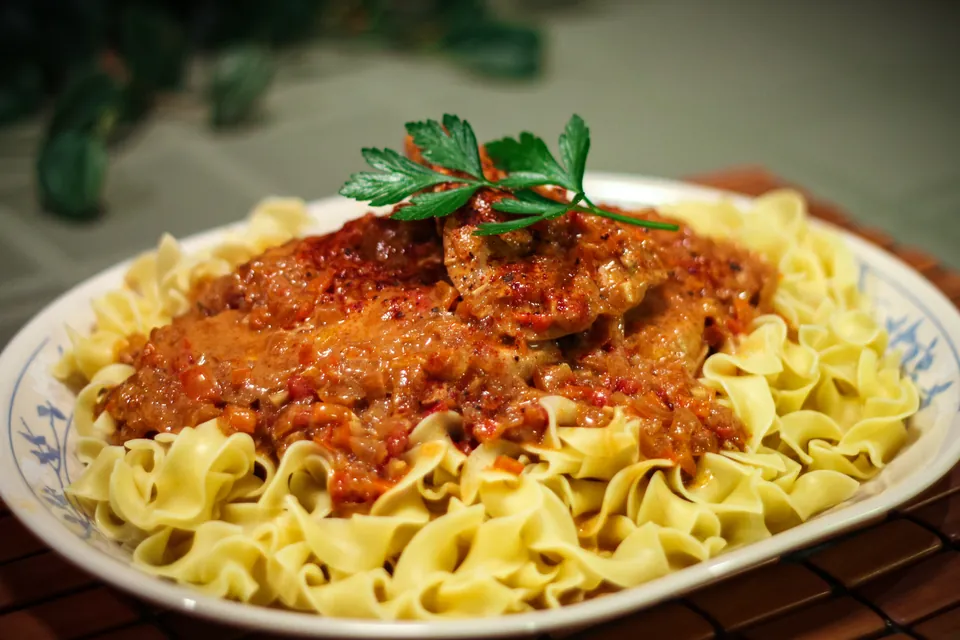
Chicken paprikash: chicken stewed red with paprika, finished by melting in sour cream. It is often said to have been invented at a famous Budapest restaurant in the early twentieth century, but the recipe is already in print by 1888.
Verification highlight popular claim → verdict → evidence
Myth: chicken paprikash was invented around 1920 at Budapest's Gundel restaurant by swapping cream for sour cream. Verdict: refuted -- a surviving copy of Czifray's Hungarian national cookbook, 8th edition (Budapest, 1888), already prints the modern sour-cream-finished recipe, 32 years before the claimed invention, and secondary Hungarian food history traces a recipe under this name back to an 1830 edition. Key sources: Czifray, Magyar nemzeti szakácskönyve (1888), Le Play (1855).
The three gates
- Ingredient-supply gate
- Chicken and dairy were locally available, but the dish could only take shape after paprika, a New World pepper, became common in Hungary
- Cooking-technique gate
- Chicken browned and simmered with paprika, finished with an emulsion of sour cream
- Venue gate
- Home cooking of Hungarian villagers and townspeople
Overview
Chicken paprikash is a chicken dish that took its shape in Hungary's rural and town kitchens over the nineteenth century. Chicken and dairy were long-established local foods here, on everyday tables from early on. The red color and aroma that define the dish came from paprika, the pepper that crossed the sea from the New World.
Paprika reached Hungary in the sixteenth century, in the period when the Ottoman Empire's reach extended into Central Europe. At first, though, the pepper was treated purely as an ornamental garden or medicinal plant and stayed out of the pot. Its turn into a kitchen spice came in the eighteenth and nineteenth centuries. Village people who could not afford costly black pepper began using the paprika they could grow themselves as a substitute, and mills to dry and grind it appeared in the later nineteenth century. Once paprika had settled into everyday seasoning, the red powder found its way into the plain one-pot dish of chicken fried and stewed.
The sour cream at the finish is what tied this dish to the town table. Chicken stewed with paprika, softened with the tang and richness of melted-in dairy: here is the path by which a humble rural stew was refined into something fuller. In 1855 the French sociologist Le Play, in his study of the lives of European workers, recorded a meat dish stewed with paprika as a Hungarian national food. By the middle of the nineteenth century, the dish had clearly taken firm root in the everyday life of the Hungarian people.
How we know
The beginning of chicken paprikash is often told through an appealing anecdote. Around 1920, at a famous Budapest restaurant, a cook is said to have swapped the sweet cream in a chicken stew for sour cream, and so the dish was born: a single shop, a single year, an origin story with a venerable ring to it.
But the story does not hold up by date. István Czifray's cookbook already gives a method for a chicken dish using paprika and sour cream. The earliest edition available to read in full today is the eighth, printed in 1888 — thirty-two years before the year the restaurant story claims. Hungarian food-history sources report that the recipe under this name first appeared in Czifray's fourth edition of 1830.
Either way, the restaurant tale points not to the origin itself but to one moment of refining a dish that already existed. The real beginning lies not in any one person's invention but in a gradual settling that took shape, little by little, in rural and town kitchens. Paprika spread as a substitute for pepper, the sour-cream finish was layered on top, and out of that accumulation the chicken paprikash of today emerged.
The full set of origin theories and the detailed verification log — traceable all the way to their sources — are available on the Japanese edition.
See the full origin theories and verification log (Japanese) →