All dishes / 東欧
Shkmeruli Period COrigin theory BVerified
Some fields (dish name, region and gates) are shown from the Japanese-edition data.
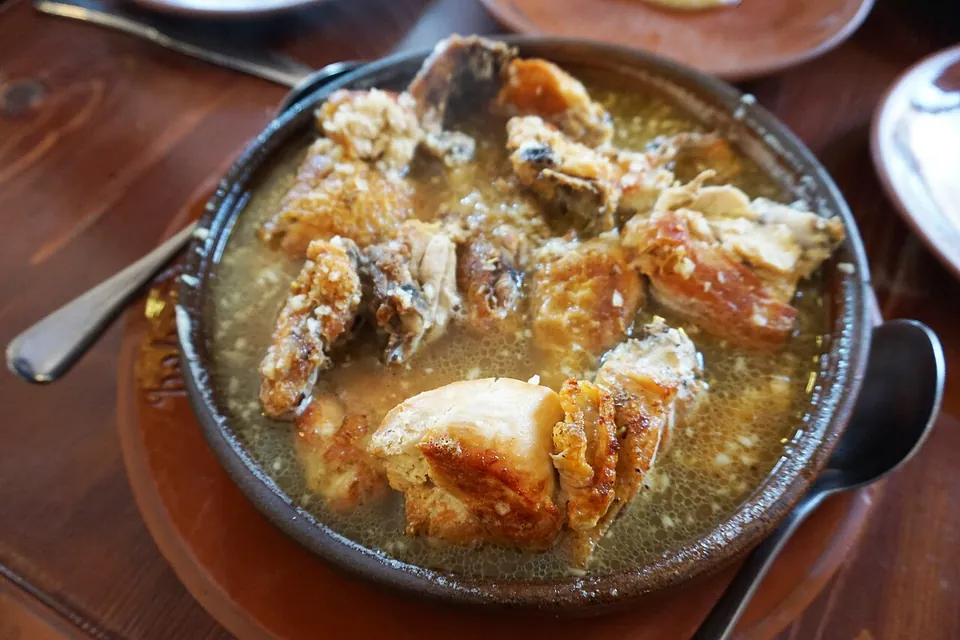
Shkmeruli, a Georgian dish of chicken simmered in a garlicky sauce of milk and butter, carries the name of a small village. A local legend credits a cook's improvisation, but the surest thread is what the name itself points to.
Verification highlight popular claim → verdict → evidence
Travel writing about Georgia likes to tell of a local landlord who asked his cook for something new, and of the cook improvising with the chicken, milk and garlic at hand. The sites that print the tale call it local legend themselves, and no contemporary record standing behind it has yet been found. The name points elsewhere: shkmeruli comes from Shkmeri, a village in the Oni district of Racha in western Georgia. Chicken with garlic is much older than the dish; what settled in the twentieth century was the version enriched with milk and butter, and no source fixes the year it did. Ken Albala's Food Cultures of the World Encyclopedia (2011) carries the dish as Georgian cooking and gives that village derivation, and Darra Goldstein's The Georgian Feast (1993) has it at p. 101 as garlic fried chicken, which puts the dish in print by that year at the latest. Neither book so much as mentions the landlord.
The three gates
- Ingredient-supply gate
- Chicken, garlic and milk were all steadily to hand in modern Georgia. The bird itself is not a native of the Caucasus: domestic fowl came from South and Southeast Asia and reached the region in the Iron Age, in the first half of the first millennium BCE (a window of roughly 965 to 530 BCE), which is far enough back to leave a twentieth-century dish untouched.
- Cooking-technique gate
- Chicken simmered in a sauce of milk and butter with garlic.
- Venue gate
- The home cooking of Shkmeri village in Racha, everyday fare of ordinary people in the local community.
Overview
Shkmeruli is a Georgian country dish: chicken cooked in a sauce of garlic, milk, and butter. Chicken, garlic, and milk are all long-familiar to Caucasian kitchens, staples the villages used day in and day out.
Cooking chicken with garlic is itself old across Georgia, traditionally braised and roasted in an earthenware pot (ketsi). The mellow version bound with milk and butter that we know today took shape in the twentieth century. It was carried by Shkmeri, a village in the Oni district of the Racha region in western Georgia, and the dish takes its name from that village.
No primary source records the exact year it came together. Even so, Darra Goldstein's book on Georgian cooking (1993) sets it down as a western Georgian country dish, which tells us the present form was established by that year at the latest. That the village's name became the dish's name lends further weight to Shkmeri as the point of origin.
How we know
Two accounts circulate about where Shkmeruli comes from. One is what the name itself points to; the other has been handed down as a local tale.
The naming thread is plain. Shkmeruli takes its name from the village of Shkmeri in the Racha region. Chicken-and-garlic dishes were old and widespread, but the present form, enriched with milk and butter, spread from this village and came to be called after it. Ken Albala's Food Cultures of the World Encyclopedia (2011) records the dish as Georgian and independently reports this village origin of the name. Darra Goldstein's The Georgian Feast (1993), for its part, does not mention the village, but it does record the dish as a western Georgian country dish — which tells us the present form was already set down in print by that year at the latest.
The other account has a local landlord ordering his cook to devise something new, who then improvised on the spot from the chicken, milk, garlic, and spices at hand. A founder-figure crediting a village grandee's whim is a familiar shape among regional origin tales. Yet none of the food-history works that treat this dish so much as mention the landlord. That story appears only in travel writing and tourism guides, which themselves flag it as local lore. Charming as a story, it does not square with the plainer thread in which the village name became the dish name, and it lacks the grounding to be taken as reliable history.
The full set of origin theories and the detailed verification log — traceable all the way to their sources — are available on the Japanese edition.
See the full origin theories and verification log (Japanese) →
Related dishes
Shares the key ingredient
- Chicken tikka masalaUnited KingdomC
- Wat (pre-chili Ethiopian stew, earlier layer)Ethiopian HighlandsC
- AjiacoBogotá, ColombiaB
- Jerk chickenJamaicaC
- Soto ayamJava (Indonesia)C
- Khao man gaiThailandB
- Hainanese chicken riceHainan (China) → SingaporeC
- MoambeCongo (Central Africa)C
- Nyembwe chicken (Poulet nyembwe)Gabon (Central Africa)C
- Chicken yassaSenegalC
- Chicken KievKyiv (Ukraine)C
- Circassian chicken (Çerkez tavuğu)Turkey (Ottoman court) / CaucasusB
- Sopa de limaYucatán (Mexico)C
- White cut chickenGuangdong (China)C
- Ohn no khao swèMyanmarC
- Kedjenou layer (canari steam-braise)Côte d'IvoireC
- WaterzooiFlanders (Belgium)C
- Soup currySapporo (Japan)B