All dishes / 東欧
Lobio Period BOrigin theory BVerified
Some fields (dish name, region and gates) are shown from the Japanese-edition data.
Lobio is the Georgian bean dish that dresses red kidney beans with walnuts and herbs. The notion that it must be a newcomer—because the kidney bean itself came from the New World—overlooks a much older lineage of Georgian bean cookery that the sources record.
Verification highlight popular claim → verdict → evidence
A myth holds that lobio cannot predate the New World bean at all, but the genre itself is older: lobio was originally made with native Old World legumes such as hyacinth beans, and the arrival of the American kidney bean in the 16th century only set the lower bound for today's red-bean version, not for the dish as a genre.
The three gates
- Ingredient-supply gate
- Kidney beans (Phaseolus) are a New World crop; their arrival and establishment in the Caucasus (17th-18th century) sets the physical lower bound for the current dish. Walnuts and herbs are native.
- Cooking-technique gate
- Stewing kidney beans and mixing them with walnuts and herbs.
- Venue gate
- A Georgian household and Lenten (fasting) dish.
Overview
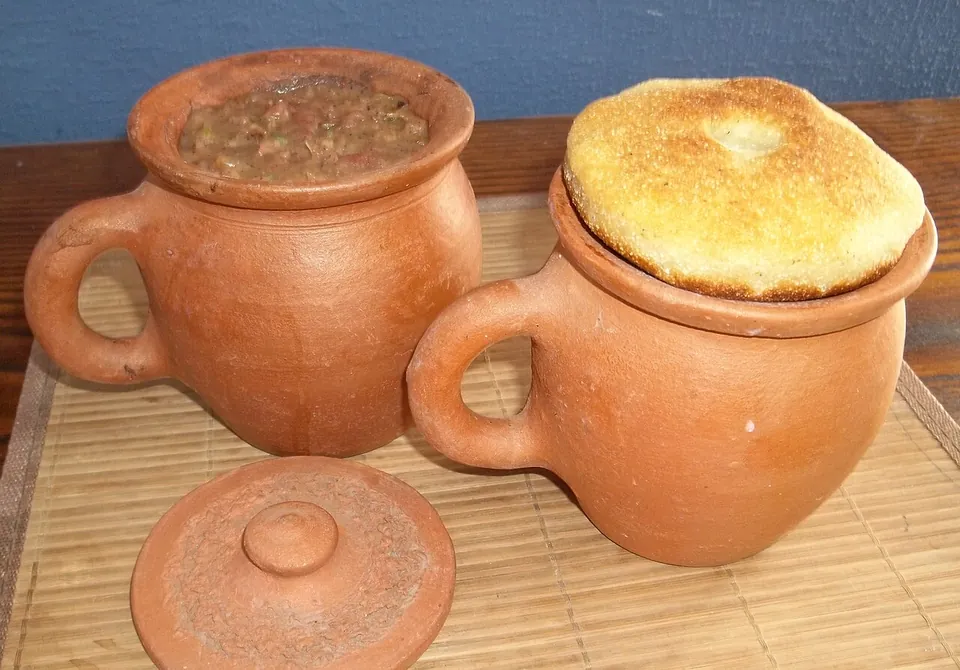
Lobio is Georgian simply for "beans," and the name fits a dish rooted deep in the Caucasian table. Red kidney beans are simmered soft and then dressed—or cooked down—with ground walnuts, coriander and other herbs, garlic and a touch of vinegar. Because it carries no meat, lobio holds an honored place in the fasting meals of the Georgian Orthodox calendar, and as a home dish it takes on countless local forms.
The red kidney bean (Phaseolus vulgaris) that gives today's lobio its face was not originally a Caucasian crop. Native to the Americas, it traveled across the Atlantic after the Columbian exchange, and only once it reached the fields of the Caucasus did the present kidney-bean version of the dish take shape. Walnuts and herbs, by contrast, are long-established here, and grinding, cooking and dressing them calls for no special equipment. The kidney-bean lobio as we know it therefore settled into place after the American bean had put down roots in local soil.
Yet the moment when the familiar kidney-bean version came together is one thing, and the age of lobio as a dish is another. Georgian bean cookery reaches back far earlier than the arrival of the New World bean—a distinction that is the heart of the story that follows.
How we know
Lobio is dogged by the idea that it is a newcomer that could not exist without the New World kidney bean. Because its most conspicuous ingredient is American in origin, the reasoning jumps to the conclusion that the dish itself must be young.
The record tells otherwise. Georgian lobio has an older layer built on Old World pulses. Before the kidney bean arrived, the dish was made with hyacinth beans (Dolichos / lablab), lentils and peas. The genre of the dish is old enough to predate Georgia's own statehood divisions. The American common bean reached the Caucasus in the sixteenth century, carried along Ottoman and Persian trade routes; cultivation began in the western regions of Guria and Samegrelo, and in time it displaced the earlier Old World pulses to establish today's characteristic red-bean lobio.
That sixteenth-century window comes into focus where three different kinds of evidence cross. A study tracing the bean's spread into Europe through its genome (Bitocchi et al. 2023), work following when beans appear in imagery after the Columbian exchange (Hammer & Khoshbakht 2018), and the textual record—the 1550s account of Hans Dernschwam and Ottoman tax registers noting Caucasian beans, gathered in Cornucopia magazine's "Bean vivant"—all point to arrival and spread across Ottoman lands in the sixteenth century. Where independent lines of evidence meet at a single point, the timing is that much surer.
The lesson is that the bean fixes only the lower bound of the present kidney-bean version, not the age of lobio itself. The newcomer myth mistook the moment the familiar version came together for the age of the dish. It reads far better as an old bean cookery onto which a new bean was grafted: the settled view accepts the antiquity of the genre and places only the lower bound of the current form at the bean's arrival.
The full set of origin theories and the detailed verification log — traceable all the way to their sources — are available on the Japanese edition.
See the full origin theories and verification log (Japanese) →