All dishes / 西欧
Cassoulet Period BOrigin theory CVerified
Some fields (dish name, region and gates) are shown from the Japanese-edition data.
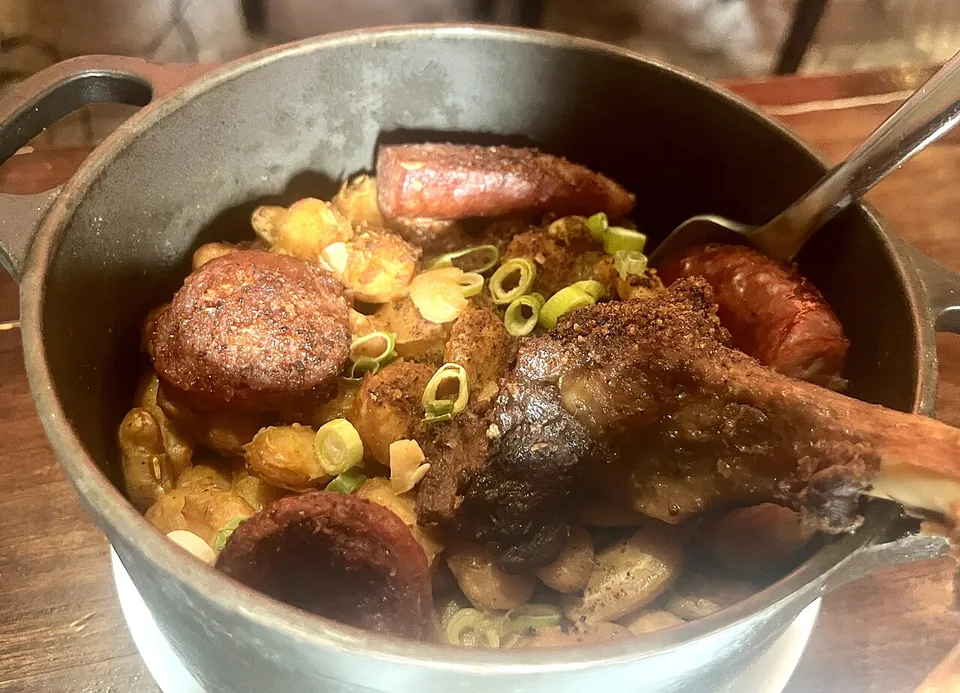
Cassoulet is a slow-cooked casserole of white beans, pork, and confit from Languedoc in southern France. A proud local legend holds that the people of Castelnaudary drove off an English army with this very stew during the Hundred Years' War, yet in that year the town was in fact sacked and burned by the English, and no such repulse ever took place.
Verification highlight popular claim → verdict → evidence
Myth: cassoulet was born when Castelnaudary's residents repelled an English siege in 1355 by cooking up their stores in one pot. Debunked — no such repulse took place (the Black Prince sacked and burned the town that year), and the word "cassoulet" itself is not attested before the 19th century. The real story is a gradual formation: in medieval Languedoc, haricot (de mouton) was the name of a dish and not of a bean — the 14th-century Le Viandier gives it as a ragout of mutton breast and onions with no beans in it. The New World white haricot bean reached Europe in the 16th century, went into that pot, and in time took over the name; the dish was christened cassoulet, after the earthenware cassole, only in the 1800s.
The three gates
- Ingredient-supply gate
- The star ingredient, the white haricot bean, is a New World crop; its arrival in Europe (16th c.) and subsequent spread set the earliest possible date.
- Cooking-technique gate
- Long, slow braising in a cassole (earthenware pot), breaking the surface crust back into the stew as it forms.
- Venue gate
- Home cooking of rural Languedoc.
Overview
The heart of cassoulet is a generous bed of white beans. These are haricot beans from the New World, and only once they had taken root in France did the dish as we know it come together. The beans are cooked with pork, duck or goose confit, and sausage in an earthenware pot called a cassole, simmered for hours on end. The care and the pleasure of the dish lie in breaking the thin skin that forms on the surface and folding it back in, over and over.
The path by which the haricot bean reached Europe has come into sharp focus through recent work on botanical imagery. The earliest documentary trace is 1532, when Pope Clement VII sent seed to Italy; by 1542 the bean is clearly drawn in the herbal of the German botanist Leonhart Fuchs. The New World bean was on European soil well within the sixteenth century.
Arriving in Europe, however, is not the same as becoming a staple in the pots of Languedoc. The Oxford Companion to Food places the bean's entry into France in the sixteenth century by way of Spain, while Larousse Gastronomique dates its actual use to the nineteenth. The reference works still differ; in either case the name settled and the modern form was completed only in the nineteenth century.
The farms of Languedoc already had a foundation for this: meat and fat left to simmer for hours on end. In medieval French such a pot went by the name haricot, or haricot de mouton, and that was the name of a dish rather than the name of a bean. The fourteenth-century cookbook Le Viandier, attributed to Taillevent, sets out what went into it: breast of mutton, browned and then stewed with onions, ginger, cinnamon, and verjuice, with no beans at all. It was only from the sixteenth century that the newly arrived white haricot bean went into that stew, and in time the bean took over the name haricot itself. One bean had not replaced another; what had changed was the thing the name pointed to. The dish was christened cassoulet in the nineteenth century after the cassole (a pot whose name descends from the pottery of Issel), and it settled into its present shape. The cook and writer Prosper Montagné set out the three town variants of Castelnaudary, Carcassonne, and Toulouse.
How we know
Cassoulet carries a founding legend that the town of Castelnaudary holds dear. In 1355, in the thick of the Hundred Years' War, the besieged townspeople are said to have fortified themselves on a stew of beans and meat and driven the English off. It is a piece of local heroism, and it appears in the town's own tourist literature.
The historical record runs otherwise. On 31 October of that same 1355, the Black Prince did in fact plunder Castelnaudary and put it to the torch. No repulse of the English by way of a stew occurred. The name cassoulet itself cannot be traced past the nineteenth century in the dictionary of the Académie française: one of its early appearances in print is around 1836, when the Maison Bouissou of Castelnaudary used it as a brand name for a canned product, nearly five hundred years after the year of the legend. The Wikipedia entry on cassoulet that draws on the Oxford Companion to Food, Larousse Gastronomique, and Montagné sets the siege story down as an invented tradition, a tale the historical record does not bear out.
The bean at the center of the dish has a history of its own, and it too can be followed in the sources. Read in full, the fourteenth-century Le Viandier shows what medieval cooks meant by haricot de mouton: the entry is a ragout of mutton breast and onions, and not a bean appears in it. What the Middle Ages had was the name of a dish, not the bean that now bears the name. The beans themselves turn up in Europe later, and along an entirely separate line of evidence: the 2018 study by Hammer and Khoshbakht follows them through the seed sent on in 1532 and the herbal of Fuchs in 1542, both squarely in the sixteenth century. When the New World bean was finally dropped into that mutton pot, it came away with the name of the dish as well. This is not the story of one bean giving way to another; it is the story of a name whose contents were exchanged.
With the legend set aside, the real history of cassoulet is if anything the richer for it. There was no single inventor and no dramatic battle: a mutton ragout called haricot simmered for generations in the farmhouses of Languedoc, a bean from across the Atlantic joined it and took over its name, and the name of an earthenware pot became the name of the dish. What shaped this plate was the long accumulation of kitchen work.
The full set of origin theories and the detailed verification log — traceable all the way to their sources — are available on the Japanese edition.
See the full origin theories and verification log (Japanese) →