All dishes / 中東・北アフリカ
Harissa Period BOrigin theory CVerified
Some fields (dish name, region and gates) are shown from the Japanese-edition data.
Harissa, the fiery chili paste that stains the Tunisian table red. Its name is an old word, found in Arabic cookbooks a thousand years back, yet the red heat we know today is a comparatively new taste that could only arise once chilies had crossed the Atlantic and reached this coast.
Verification highlight popular claim → verdict → evidence
Popular claim: none beyond a dispute over exactly how harissa reached its current form. Verdict: unsettled which route brought the chile pepper harissa depends on -- chiles are a New World crop that could not have reached Tunisia before the Columbian Exchange. One account traces the chile's arrival to Spain's occupation of Hafsid Tunisia (1535-1574); another credits Andalusi Muslim and Jewish refugees who settled the Cap Bon peninsula and established chile farming there through the 17th century. Both agree harissa is Tunisian. The name comes from Arabic harasa, "to pound" -- the same root behind an unrelated medieval wheat-and-meat porridge recorded centuries earlier, so that older word does not extend the chile paste's own history.
The three gates
- Ingredient-supply gate
- Provisional: chile pepper is a New World crop that reached the Maghreb via Spain after the Columbian Exchange, setting the earliest possible date; the dish could not have existed before that.
- Cooking-technique gate
- Provisional: grinding dried chiles into a paste using a mortar and pestle.
- Venue gate
- Provisional: a household and market staple condiment in Tunisia that spread across the wider Maghreb.
Overview
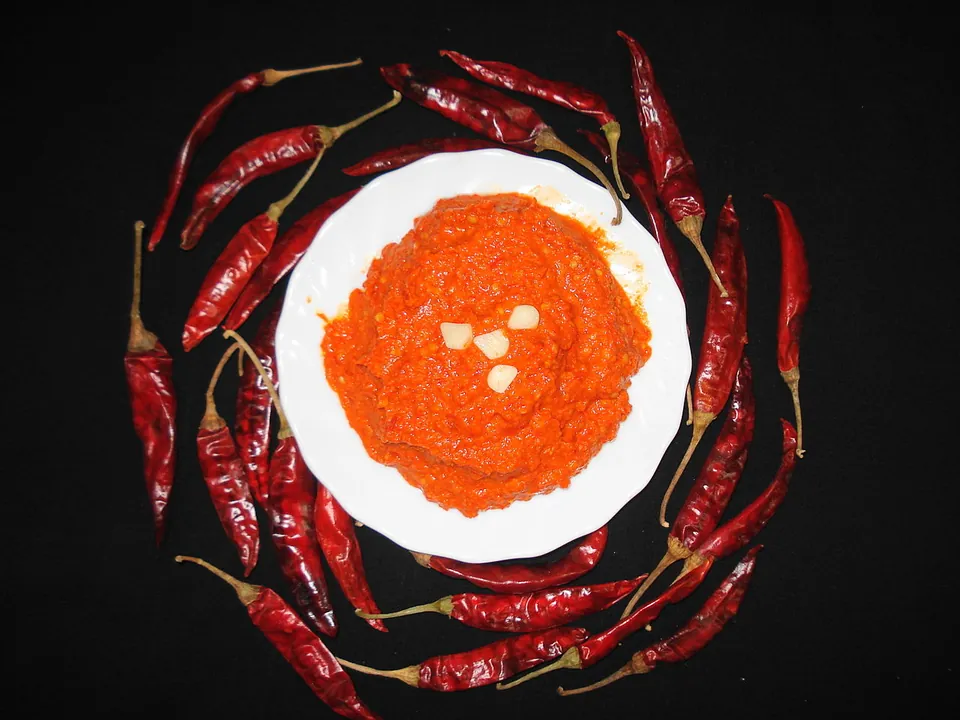
Harissa is Tunisia's signature hot condiment: sun-dried chilies pounded in a mortar and worked together with garlic, coriander, salt, and olive oil. It is stirred into soups, spread over meat and fish, and served alongside couscous. In Tunisian homes and markets it is an indispensable pantry staple, and from there it has spread across the whole of the Maghreb. In 2022 the craft and its attendant food culture were inscribed on UNESCO's list of Intangible Cultural Heritage, publicly confirming that harissa is Tunisian in origin and woven into Tunisian society.
The story of this taste is inseparable from the journey of a single ingredient: the chili. The chili is a South American plant, and until Europeans crossed to the New World it was unknown to the Mediterranean world. The seeds Columbus carried back to Spain reached North Africa within about half a century, following the trade routes of the Mediterranean. So it was that, from the sixteenth century onward, a heat the Maghreb had never known arrived on its shores.
The name itself speaks of the handwork behind the condiment. The word harissa belongs to the Arabic root harasa, 'to pound.' Dried chilies pounded in a mortar and worked into a thick paste: that motion of the hand is inscribed in the dish's name. The newly arrived chili was taken up by the region's old craft of pounding and turned into a Tunisian taste.
How we know
That harissa is a condiment born in Tunisia is scarcely disputed. The name, however, holds a trap. The word harissa already appears in the oldest surviving Arabic cookbook, the tenth-century Kitab al-Tabikh of Ibn Sayyar al-Warraq, compiled in Baghdad. But the harisa written of there was a porridge of pounded wheat and meat. It is a dish that shares the same root, 'to pound,' and the same name, yet it is a different food from the red chili paste. The name may be traced back far earlier, but that does not date the harissa we know today. The red paste is a taste that belongs to the time after the chili reached this land.
Just when, and by whose hand, that chili took root in Tunisia is a question on which the accounts divide in two. One looks to the Spanish occupation of the sixteenth century. During the years when Tunisia lay for a time under Spanish rule, the chili that had crossed from the New World may likewise have been carried here through Spanish hands. The other looks to the people driven out of Spain a little earlier. The Muslims and Jews who left Andalusia between the end of the fifteenth and the seventeenth century brought New World seeds with them, chilies, squash, and beans, and settled along the Tunisian coast. Around Nabeul on the Cap Bon peninsula, where the climate resembles southern Spain, chili cultivation took hold, and in the early seventeenth century the area became a center of harissa-making.
The two are not related as right and wrong. They differ only in where they place the emphasis, on who brought the chili and on when it took root. Was it carried by occupiers or by refugees? Had it arrived by the sixteenth century, or did it settle in the seventeenth? For now, there is not the material to decide firmly for one over the other. What does not change is that today's red harissa arose only in the era after the chili had crossed the Atlantic. That single point is the fixed ground the two accounts share.
The full set of origin theories and the detailed verification log — traceable all the way to their sources — are available on the Japanese edition.
See the full origin theories and verification log (Japanese) →
Related dishes
Shares the key ingredient
- KimchiSouth KoreaC
- Mapo tofuSichuan (China)C
- Doro watEthiopian HighlandsB
- Indigenous molli (chilmolli, pre-Old-World-spice chili sauce proto-layer)MexicoC
- RendangMinangkabau, West Sumatra (Indonesia)C
- Tom yum goongThailandC
- SambalMalay Archipelago (Indonesia)C
- TteokbokkiKorean PeninsulaC
- Tandoori chickenNorth India (Punjab / Delhi)C
- LaksaPenang (Straits Settlements)C
- MuhammaraAleppo, SyriaC
- VindalooGoa (India)C
- Piri piri chickenMozambique (Portuguese colonial sphere)C
- BibimbapSouth KoreaC
- Twice-cooked pork (huiguorou)Sichuan (China)C
- LarbLaos / Isan (Thailand)C
- Chili con carneTexas, USA (San Antonio)C
- Dan dan noodlesChengdu, Sichuan (China)C
- General Tso's chickenNew York (USA)C
- Pol sambolSri LankaB
- Chapli kebabPeshawar (Pakistan)C
- ShiroEthiopian HighlandsB
- Hiroshima soupless dandan noodlesHiroshima (Japan)B
- Kung pao chickenSichuan (China)C
- Fuqi feipianSichuan (China)D
- Nasi lemakMalaysiaC
- LampraisSri LankaC
- Nigerian pepper soupNigeria (West Africa)C
- MerguezMoroccoB